CO-NELEMixing & Granulation
Explore our core forced-action concrete mixing machinery, intensive granulators, and batching plant lines engineered in Qingdao, China.
Analyzing micro-homogeneity, 3D turbulence vectors, and mechanical wear resilience in modern twin-shaft compulsory concrete mixers.
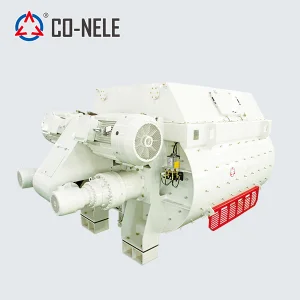
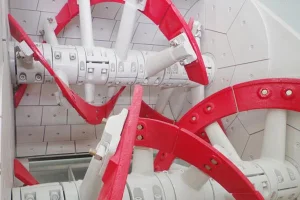
In modern industrial concrete production and heavy infrastructure construction, the mechanical efficiency of aggregate fluidization determines both cycle speed and strength consistency. A high-performance China Twin-Shaft Mixer operated within commercial batching plants functions on the principle of forced-action 3D counter-rotating turbulence. Unlike gravity-fed tilting drum mixers or simple single-shaft agitators, twin-shaft mixers utilize two synchronized horizontal shafts fitted with multi-angle mixing arms and spade-like blades.
When driven by synchronized planetary transmission units, these shafts spin in opposing directions at calculated linear velocities (typically between 1.4 m/s and 1.8 m/s). This kinematic pattern creates an overlapping central mixing zone where coarse aggregates (ranging from fine sand up to 150mm crushed gravel), cementitious binders, mineral admixtures, micro-silica, water, and liquid chemical agents are violently forced together. The resulting shear forces break down binder agglomerates in seconds, ensuring complete surface wetting and micro-dispersion of water droplets throughout the mix matrix.
Overlapping blade sweeps generate high-intensity turbulence vectors that accelerate paste coating around aggregates, cutting mixing cycles to 30–45 seconds.
Multi-layer labyrinth seals combined with automated hydraulic oil pressure barriers prevent slurry ingress, extending bearing operational lifespans past 100,000 batches.
Bolt-on lining plates with Brinell hardness exceeding HB600 withstand extreme abrasion from quartz-heavy gravels and abrasive refractory aggregates.
Fast-acting rotary discharge doors equipped with proportional hydraulic valves enable high-volume dumping and metered trickling into transit mixers.
Quantitative benchmarks and manufacturing capacity driving global ready-mix concrete and infrastructure growth.
The global construction sector is undergoing a massive shift toward modularity, carbon-lean concrete formulations (such as slag-blended cement, fly ash activation, and geopolymer mixes), and strict batch uniformity standards. Twin-shaft compulsory mixers manufactured by Qingdao CO-NELE Machinery Co., Ltd. stand at the center of this movement, offering high volumetric throughput per hour while minimizing electrical power consumption per cubic meter mixed.
To assist EPC contractors, batching plant engineers, and industrial procurement officers in choosing the exact machine specification, the table below details core operational metrics for our heavy-duty CHS Twin-Shaft Mixer series:
| Mixer Model | Charging Volume | Compacted Concrete Output | Mixer Motor Power | Max Aggregate Size | Discharge Door Control |
|---|---|---|---|---|---|
| CHS 1000 | 1500 Liters | 1.0 m³ / batch | 2 x 18.5 kW | 60 / 80 mm | Hydraulic Pump System |
| CHS 1500 | 2250 Liters | 1.5 m³ / batch | 2 x 30 kW | 80 / 100 mm | Hydraulic Proportional Valve |
| CHS 2000 | 3000 Liters | 2.0 m³ / batch | 2 x 37 kW | 80 / 120 mm | Dual-Cylinder Hydraulic |
| CHS 3000 | 4500 Liters | 3.0 m³ / batch | 2 x 55 kW | 100 / 150 mm | Dual Independent Gates |
| CHS 4500 | 6750 Liters | 4.5 m³ / batch | 2 x 90 kW | 120 / 180 mm | Multi-Stage Hydraulic Gate |
Deploying heavy twin-shaft mixing units across commercial ready-mix plants, precast concrete factories, dam projects, and high-speed railway infrastructure.
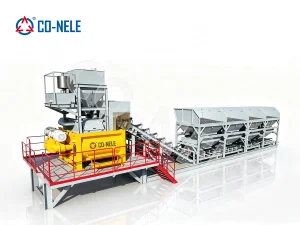
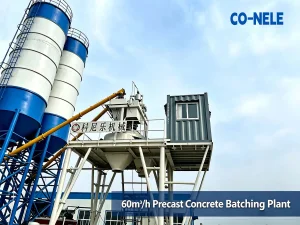
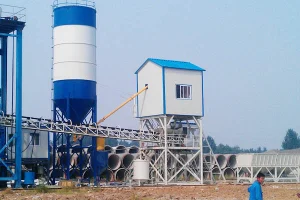
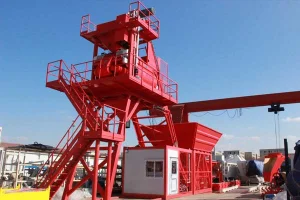
Integrated into stationary HZS plants (90 to 180 m³/h output), providing rapid discharge and zero phase-separation during transit mixer loading.
Configured with heavy-duty rock-deflection blades to handle Roller-Compacted Concrete (RCC) containing massive aggregate sizes up to 150mm without blade breakage.
Delivers homogeneous color distribution and consistent low-slump concrete essential for precast concrete pipes, architectural wall panels, and pre-stressed bridge girders.
Ensures ultra-precise water-cement ratio metering for ballastless track slab production, meeting stringent national rail authority standards.
Engineered to perform seamlessly under harsh environmental conditions across sub-zero regions, tropical humidity, and offshore marine operations.
Concrete batching plants operated in northern latitudes face freezing temperatures that can seize unheated pneumatic lines, freeze water dosing valves, and drastically alter mixing rheology. Conversely, high-ambient tropical desert environments cause rapid water evaporation, leading to slump loss and flash setting during mixing. CO-NELE twin-shaft mixers incorporate custom environmental adaptation packages:
Meeting international engineering certifications with robust spare parts SLAs and local commissioning assistance.
All CO-NELE twin shaft mixers comply with EU Machinery Directive standards, featuring dual-channel safety interlocks, emergency stop loops, and ISO certified weld testing.
Standardized wear liners, mixing arms, hydraulic seal kits, and solenoid valves stocked centrally in Qingdao for immediate air express dispatch worldwide.
Experienced commissioning engineers dispatched on site for foundation layout verification, electrical wiring setup, PLC calibration, and operator training.
Engineered to dismantle into standard 40ft High Cube (40HC) shipping containers, drastically lowering international ocean freight expenses.
Integrating artificial intelligence, real-time slump telemetry, and self-diagnostic predictive maintenance.
As concrete batching shifts toward Industry 4.0 automation, CO-NELE is pioneering smart mixer hardware upgrades designed to maximize operational uptime and optimize recipe accuracy:
In-pan optical and torque-resistance sensors calculate concrete moisture content and slump dynamically during shaft rotation, auto-adjusting water dosing prior to discharge.
Embedded ultrasonic transducers within lining plates transmit real-time thickness metrics to plant managers, warning of wear threshold limits before pan damage occurs.
Smart VFD frequency drives convert kinetic deceleration energy during rapid mixing arm speed changes back into plant grid power, reducing kWh per m³ mixed by up to 18%.
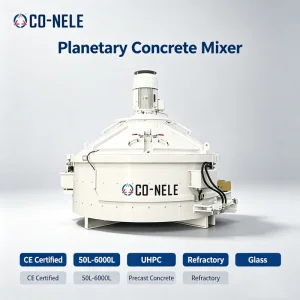
Explore additional planetary concrete mixers, laboratory units, mobile batching plants, and industrial processing systems.
Comprehensive answers regarding machine sizing, wear part longevity, maintenance intervals, and electrical integration.