
CO-NELEMixing & Granulation
Precision-engineered mixing equipment designed for micro-homogeneity, high thermal transfer, and consistent granulation across demanding industrial recipes.
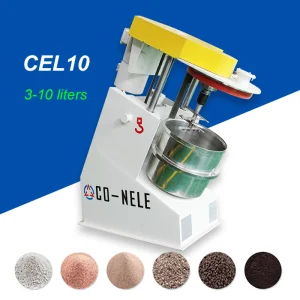
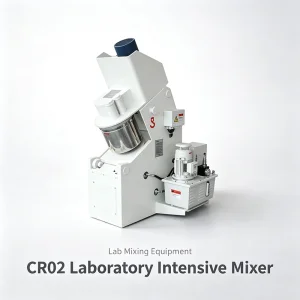
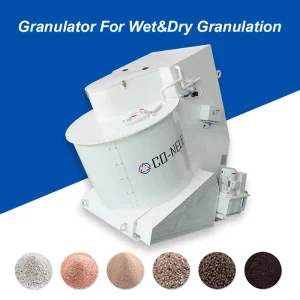
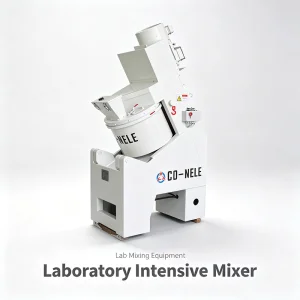
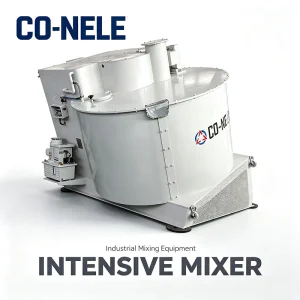
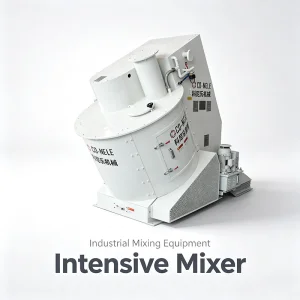
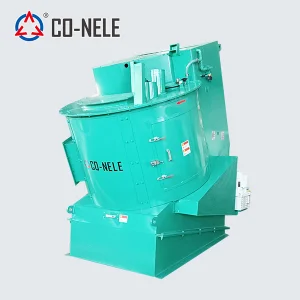
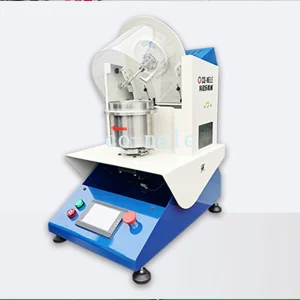
Modern industrial processing demands level of material uniformity that conventional mixing systems—such as horizontal ribbon blenders, twin-shaft concrete mixers, or simple planetary pan mixers—can no longer reliably deliver. As advanced manufacturing transitions toward high-performance materials (including lithium-ion battery dry electrodes, ultra-high performance concrete (UHPC), technical ceramics, and synthetic refractories), the physical parameters of batch mixing have shifted from coarse blending to precise **hydrodynamic shear, particle dispersion, micro-pelletization, and controlled energy input**.
An **Intensive Mixer Machine** operates on the fundamental principle of separated material transport and high-speed energy dispersion. Unlike conventional mixers where a single mixing mechanism attempts to both transport the bulk material and perform localized shear, an intensive mixer utilizes an inclined, rotating mixing pan coupled with an independently driven, high-speed eccentric rotor. This dual-kinematic motion ensures that 100% of the material is continuously directed into the high-shear zone without relying on gravity alone or suffering from dead spots.
Core Engineering Distinction: In an inclined intensive mixer, the rotating pan moves the bulk charge upward, while the high-speed rotor imparts concentrated shear forces up to 30 m/s. This allows complete micro-homogeneity within 60 to 90 seconds, reducing binder consumption by 15–30% and eliminating agglomerate defects in downstream sintering or pressing processes.
To understand the performance advantage of a CO-NELE intensive mixer, one must analyze the kinetic interaction between the raw ingredients, the rotating pan wall, and the eccentric rotor tool.
The inclined vessel rotates at moderate speeds, conveying material against gravity to the highest point of the pan, where it is fed continuously into the high-speed rotor zone.
The tool rotor runs at tip speeds from 5 m/s to 32 m/s depending on process intent. High speeds break up agglomerates; controlled lower speeds allow uniform moisture distribution and sphere-shaped pellet building.
A stationary, multi-angle deflector blade clears the bottom and walls of the pan on every single revolution, eliminating build-up and acting as a mechanical flow-reverser.
Intensive mixers double as high-yield **mixing granulators**. Rather than requiring separate dry mixing, liquid addition, and pan pelletizing steps, an intensive mixer carries out all three phases inside a single enclosed, dust-tight vessel:
Evaluating mechanical efficiency, energy consumption per ton, and batch repeatability across different mixing topologies.
| Performance Metrics | Inclined Intensive Mixer (CO-NELE) | Vertical Shaft Planetary Mixer | Twin-Shaft Compulsory Mixer | Horizontal Ribbon / Ploughshare |
|---|---|---|---|---|
| Mixing Kinematics | Inclined rotating pan + eccentric high-speed rotor | Fixed pan + planetary counter-current star arms | Twin horizontal shafts with overlapping paddles | Single horizontal shaft with ribbon/plough blades |
| Homogeneity (Coeff. of Var.) | CV < 1.5% (Micro-homogeneity) | CV < 3.0% to 5.0% | CV < 5.0% to 8.0% | CV < 7.0% to 10.0% |
| Shear Input Control | Fully variable VFD rotor (0.5 to 32 m/s) | Fixed or semi-variable (2.5 to 6 m/s) | Fixed speed (1.5 to 3.5 m/s) | Low shear (1.0 to 3.0 m/s) |
| In-Vessel Granulation | Yes (0.2–8mm controlled sphere size) | No (Causes clumping) | No | Limited (Requires lump breakers) |
| Wear & Maintenance | Low (Wall scraper + bolt-on chrome liners) | Medium (High contact area on floor) | High (Shaft seal exposure) | High (Stuffing box packing wear) |
| Discharge Efficiency | 99.9% complete self-discharge via pan incline | 98% via bottom door | 95% via bottom gate | 90-95% residual accumulation |
Tailored mixing and granulating plants designed to meet strict chemical, physical, and thermal specifications across major global industries.
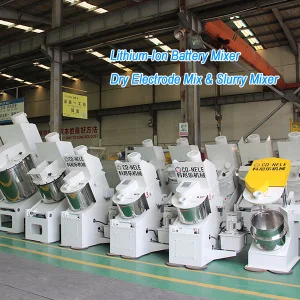
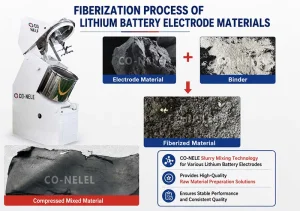
Processing active cathode/anode powders, graphite slurries, and dry electrode formulations. Achieves uniform PTFE fibrillation and zero metallic contamination via custom ceramic lining (Al2O3 / SiC).
Ideal for corundum, silicon carbide, bauxite, and carbon-bonded bricks or unshaped castables. Ensures perfect dispersion of liquid binders and micro-silica without crushing fragile porous aggregates.
Overcomes extreme viscosity in low water-cement ratio (<0.18) concrete mixes. Rapidly shears steel or synthetic micro-fibers, preventing fiber balling and yielding ultra-dense matrix packing.
Granulates alumina, zirconia, silicate, and glass batch powders into dust-free pressable granules with high bulk density, replacing energy-intensive spray drying towers.
Pelletizes hazardous baghouse dust, metallurgical slag, lithium leach residues, and municipal waste ash into stable, easy-to-handle industrial aggregates or landfill-safe briquettes.
Homogenizes fine iron powders, tungsten carbide, and diamond abrasive grains with liquid lubricants, delivering press-ready feeds with accurate grain envelope coatings.
Operating an industrial manufacturing plant requires full compliance with regional electrical codes, environmental laws, and safety standards. CO-NELE supplies customized intensive mixer configurations designed explicitly for overseas plant integration.
Every standard machine can be adapted to regional compliance requirements including CE (European Conformity), UL / CSA certification for North American electrical panels, and ATEX Zone 1 / Zone 21 explosion-proof execution for processing organic powders, battery solvents, or chemical dusts.
CO-NELE maintains a global spare parts tracking database for every serial number manufactured since 2004. High-wear components—including HARDOX pan liners, high-chrome rotor blades, tungsten-carbide coated scrapers, and mechanical shaft seals—are held in stock for immediate air dispatch.
Refractory Brick Production: Inclined 1500L intensive mixers operating in automated refractory plants in the Ruhr valley, running continuous 24/7 cycles for high-density alumina-magnesia-carbon bricks with zero batch-to-batch variance.
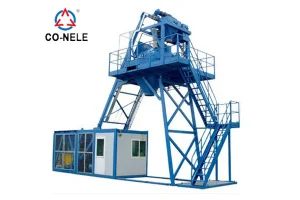
UHPC Bridge & Infrastructure Grouting: Mobile quick-moving batch stations fitted with CMP planetary and intensive mixers producing 150+ MPa strength concrete mix on-site for interstate bridge joint restoration.
Architectural UHPC Façade Panels: Inclined intensive mixing systems engineered to handle rapid cement hydration under high ambient temperatures (45°C+), incorporating jacketed cooling water loops.
Ceramic Powder Granulation (India & Vietnam): Replacing traditional wet spray dryers with CEL-series lab and production granulators, reducing electric thermal energy costs by up to 65%.
Mining Slag & Ore Agglomeration: Processing iron ore concentrates and copper leach tailing powders into uniform micro-pellets prior to furnace charging.
High-Density Concrete Block Batching: Automated intensive batch plants supplying color-consistent dry-cast paving stones and structural masonry units.
CO-NELE's R&D team in Qingdao is actively developing smarter, cleaner, and more energy-efficient mixing technology to support next-generation industrial demands.
Integration of real-time rotor shaft torque sensors linked to deep learning neural networks. The PLC automatically adjusts rotor RPM and liquid injection speed when targeted rheological viscosity is reached, eliminating human operator error.
Fully sealed, negative-pressure mixing vessels equipped with high-pressure fluid CIP (Clean-in-Place) nozzles for ultra-fast recipe changes in pharmaceutical, battery, and technical ceramic plants.
Application of cold-isostatically pressed zirconia ceramic linings and plasma-sprayed diamond-like carbon (DLC) blade coatings, extending component operational life by 300% in abrasive applications.
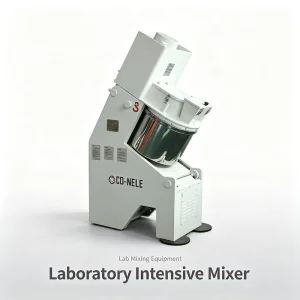
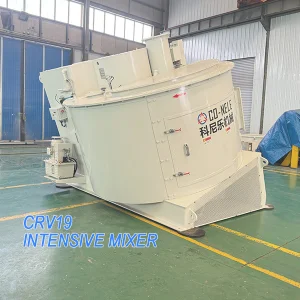
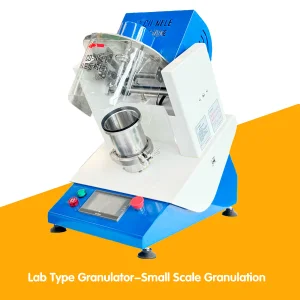
Explore our industrial range of inclined mixers, battery dry electrode mixers, laboratory units, and mobile concrete batching systems.
Technical guidance compiled by CO-NELE senior process engineers for equipment selection and operational optimization.
While vertical planetary mixers rely on rotating mixing arms moving through a static or rotating tub at fixed speeds, an inclined intensive mixer separates material transport from mixing shear. The vessel is tilted at an angle (typically 20° to 30°) and rotates to elevate the material. An independently driven high-speed rotor interacts with the material at speeds up to 32 m/s. This yields significantly higher energy input per unit time, enabling batch homogenization in under 60 seconds and allowing simultaneous wet/dry granulation.
Yes. CO-NELE operates an advanced R&D material testing lab in Qingdao equipped with 5L, 10L, 50L, and 75L lab-scale intensive mixers and granulators. Clients can ship 15–50 kg of raw material for trial runs. Our engineers evaluate energy consumption curves, particle size distribution (PSD), granule sphericity, bulk density, and mixing time, providing a comprehensive engineering test report and direct scale-up ratios for industrial production machines.
For abrasive applications (such as refractories, ceramics, and abrasives), CO-NELE fits machines with specialized protective wear packages. This includes replaceable HARDOX 500/600 pan liners, high-chrome alloy wear plates (65+ HRC), tungsten-carbide hard-faced rotor blades, and optional alumina ceramic (Al2O3) or silicon carbide (SiC) tiled interiors for zero metallic contamination.
Scale-up in CO-NELE intensive mixers is linear due to geometrically consistent kinematic ratios. Key parameters maintained during scale-up include the Froude number (Fr), rotor tip speed (m/s), power input per kilogram (kW/kg), and pan filling degree (typically 60-80% of net volume). This ensures that lab results (e.g., on a 10L CEL10) scale directly to 1,000L or 3,000L industrial production machines.
Dry electrode manufacturing requires shearing PTFE binder particles into microscopic nano-fibrils that interlock active cathode/anode powders without liquid solvents. The high-speed rotor of a CO-NELE intensive mixer generates high impact energy and shear stress at precise temperatures, converting PTFE powder into a fine 3D web matrix within minutes.
CO-NELE mixing plants feature fully automated Siemens S7-1500 or Allen-Bradley PLC control systems with high-resolution touch HMIs. Systems include recipe management for hundreds of batch formulations, precise loss-in-weight or gain-in-weight dosing controls, energy consumption logging, automatic moisture adjustment via microwave sensors, and OPC-UA / Industry 4.0 SCADA integration.
Contact CO-NELE process engineering specialists today. Provide your raw material details, target throughput (L/h or t/h), and quality requirements to receive a full engineering recommendation, 3D CAD layout, and formal equipment quotation.
Contact Engineering Team