CO-NELEMixing & Granulation
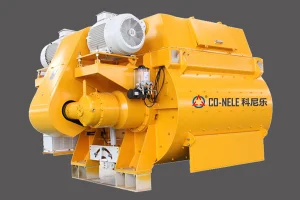
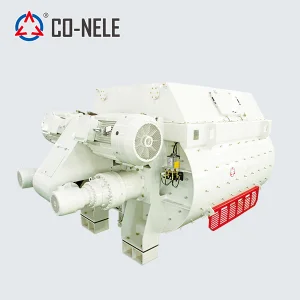
Explore CO-NELE’s core compulsory twin shaft mixing systems engineered for ready-mix plants, precast concrete, and heavy infrastructure projects.
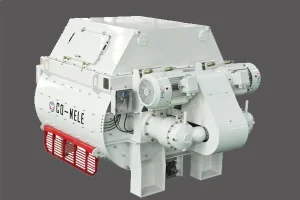
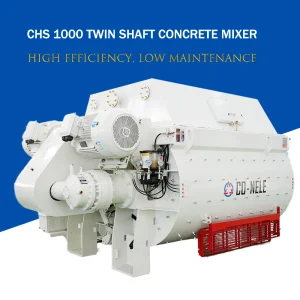
Analyzing global demand shifts, low water-cement ratio formulations, and automated batching plant optimization.
In modern civil infrastructure, high-speed rail network development, mega-scale marine dams, and commercial ready-mix concrete (RMC) production, the concrete mixing process has shifted decisively away from legacy gravity drum mixers and single-shaft units. Today's global procurement standards demand strict compliance with homogeneity targets (Coefficient of Variation < 5%) within extremely short cycle times (typically 30 to 45 seconds). The twin shaft concrete mixer factory and machine sector lies at the center of this industrial transformation.
As a premier manufacturer operating three state-of-the-art production bases in Qingdao, China, QINGDAO CO-NELE MACHINERY CO., LTD. (established in 2004) has spearheaded technical advancements in compulsory mixing technology. With over 80 granted patents and a operational presence spanning more than 80 countries, CO-NELE engineers twin shaft concrete mixers designed to handle complex concrete rheology—ranging from standard C30 wet mixes to stiff-dry concrete, RCC (Roller Compacted Concrete), and fiber-reinforced formulations.
Modern concrete recipes incorporate supplementary cementitious materials (fly ash, GGBS, silica fume) and liquid chemical admixtures. Double counter-rotating shafts equipped with synchronized mixing arms create intense 3D turbulence, ensuring uniform dispersion of aggregates and cement pastes down to micro-particle scales.
Unplanned plant downtime during major pours leads to severe financial penalties. Modern twin shaft mixers incorporate automated lubrication systems, floating shaft-end seals, and ultra-high chrome wear parts (Ni-Hard alloys > 60 HRC) that extend component lifespan beyond 100,000 continuous batch cycles.
Rising industrial electricity tariffs make mechanical efficiency crucial. By utilizing specialized dual planetary gear reducers sync-connected via heavy-duty couplings, twin shaft mixers deliver maximum torque to the mixing zone with minimal parasitic heat loss, lowering total energy consumption per cubic meter by up to 15%.
Proven track record of engineering excellence, intellectual property, and global field deployments.
A comprehensive look inside the mechanical heart of CO-NELE twin shaft compulsory batch mixers.
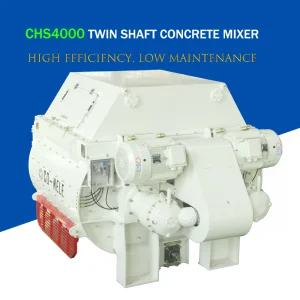
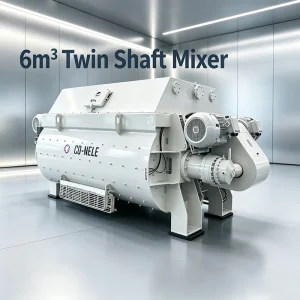
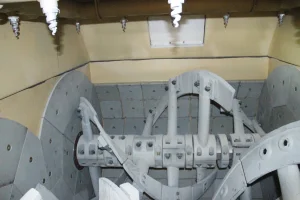
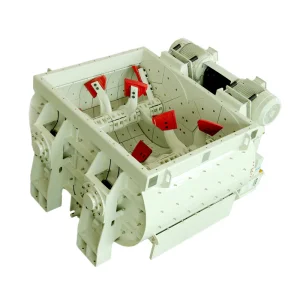
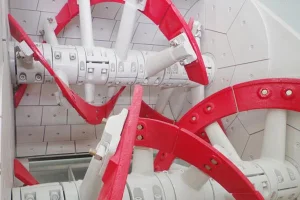
The fundamental advantage of a compulsory twin shaft concrete mixer lies in its fluid shear mechanism. Unlike planetary mixers which excel at micro-homogeneous dry-cast batches, twin shaft mixers generate a violent, overlapping counter-rotational mixing ring. The mixing blades are arranged at precise helical angles along twin parallel shafts. As the shafts rotate inward at synchronized speeds (typically 24 to 30 RPM), materials are propelled both radially around the drum circumference and axially along the shaft lengths.
This dual axial movement causes aggregate particles to collide within the center zone of the mixing trough rather than slamming aggressively against the wear liners. Consequently, energy is transferred directly into particle dispersion rather than friction, significantly extending the service life of internal armor tiles while keeping cycle times under 45 seconds for a complete 3m³ to 6m³ batch discharge.
Historically, the most vulnerable failure point in twin shaft concrete mixing machines has been slurry leakage into the drive bearings. CO-NELE resolves this with a patented multi-stage sealing architecture:
| Technical Parameter | Twin Shaft Concrete Mixer (CHS/CTS) | Planetary Mixer (CMP) | Single Shaft Mixer | ||||
|---|---|---|---|---|---|---|---|
| Primary Application | Ready-Mix Concrete (RMC), Mega Infrastructure, Mass Pours | Precast Elements, Block/Paver, UHPC, Refractory | Small-scale Civil Construction, Mortar | Output Capacity Range | 1.0 m³ to 6.0 m³ per batch (up to 180 m³/h) | 0.15 m³ to 4.0 m³ per batch | 0.5 m³ to 1.5 m³ per batch |
| Typical Mixing Cycle | 30 – 45 seconds | 60 – 90 seconds | 60 – 120 seconds | ||||
| Max Aggregate Size | Up to 120 mm (Crushed Stone / Gravel) | Up to 60 mm | Up to 80 mm | ||||
| Discharge System | Dual Hydraulic Gate / Multi-Stop Position | Pneumatic / Hydraulic Sector Door | Manual / Simple Drop Gate | ||||
| Homogeneity (CV%) | < 5% (EN 206 / ASTM Standards) | < 3% (Micro-mixing precision) | < 8-10% |
Selecting the optimal twin shaft mixer configuration based on plant footprint, motor kw ratings, and batch logistics.
When procurement managers, commercial batching plant owners, and EPC contractors evaluate purchasing options from a twin shaft concrete mixer factory, selecting the correct model involves balancing initial CAPEX against lifetime operational performance (OPEX). Key engineering sizing metrics include:
Target Applications: Medium to large commercial ready-mix plants, highway paving batch plants (HZS60, HZS90, HZS120).
Features: Compact footprint, single or dual electric motor drives with synchronized belts, heavy-duty planetary gearboxes, high-chrome wear tiles (20mm thickness).
Target Applications: High-throughput infrastructure projects (dam wall pours, airport runways, nuclear power foundation slabs).
Features: Dual 2x90kW or 2x110kW heavy motors, reinforced mixing arms, dual hydraulic discharge gates allowing multi-stage truck loading, automated high-pressure wash-down manifolds.
Target Applications: Highly sticky mixes, mortar additives, and low-slump concrete recipes requiring constant ribbon shearing.
Features: Continuous double spiral ribbon flighting replacing discrete paddles, minimizing dead zones and reducing torque spikes during restart under full load.
Ensuring seamless compliance with international safety codes, electrical grids, and global spare parts supply networks.
Deploying concrete mixing machinery across different global markets presents severe engineering challenges regarding local electrical frequencies (50Hz vs 60Hz), ambient thermal extremes (-30°C in Nordic winters to +55°C in Middle Eastern deserts), and strict safety directives (CE Mark, UL/CSA electrics, ISO9001:2015 Quality Management).
Every twin shaft concrete mixer produced in CO-NELE’s Qingdao factories is customized to the client's local power supply standard (220V/380V/415V/440V/480V at 50Hz or 60Hz). Electrical control cabinets feature Siemens or Schneider PLC platforms, complete with multi-language HMI touchscreens, integrated load-cell batching interfaces, and remote telemetry modules that allow CO-NELE engineers to perform diagnostics over secure cloud channels.
To protect clients against prolonged operational downtime, CO-NELE enforces strict standardisation across all wear components. Mixing blades, scrapers, and trough liner tiles are cast from standardized Ni-Hard high-chrome alloy recipes. All spares produced today maintain 100% backward compatibility with CO-NELE mixers manufactured since 2004. Spares ship within 24 to 48 hours from regional warehouse hubs in Qingdao.
Next-generation innovations shaping the future of intelligent concrete batching and sustainable mixing technology.
As the global construction sector transitions toward low-carbon footprint cements, recycled aggregate utilization, and AI-driven smart job sites, industrial mixing equipment must evolve. CO-NELE's R&D team is actively commercializing innovations that will define the next decade of twin shaft mixing:
Integrating microwave moisture probes and real-time motor torque spectrum analysis into the mixing tub to automatically calculate mix slump and workability during the batching cycle, instantly adjusting water dosing without stopping the shafts.
Smart vibration and thermal sensors embedded directly into the main drive gearboxes and shaft bearings transmit real-time health data to the cloud, warning plant operators of seal wear or gear backlash weeks before a failure occurs.
Variable Frequency Drive (VFD) optimized mixing profiles dynamically adjust shaft rotation speed during initial loading, high-shear mixing, and discharge phases, reducing peak power demand and carbon emissions per batch.
Expert answers directly from CO-NELE senior process engineers regarding mixer selection, wear life, and trial testing.
Explore high-capacity 4m³/6m³ twin shaft mixers, planetary units, asphalt line mixers, and intensive granulators.