CO-NELEMixing & Granulation
Precision-engineered single shaft mixers, planetary concrete mixers, intensive granulators, and pipe mixing stations from China's leading engineering factory.
Analyzing global shifts in dry powder mortar manufacturing, environmental mandates, and industrial automation.
The global building materials sector is undergoing an unprecedented paradigm shift from job-site wet mixing to factory-manufactured, precisely batched dry powder mortar solutions. Driven by stringent carbon neutrality goals, strict quality standards for high-tier architectural coatings, and modern construction timelines, the demand for high-efficiency, multi-functional dry powder mortar mixers has surged across infrastructure, industrial, and residential sectors.
Over the next decade, equipment specifiers and industrial plant managers must navigate four major technical vectors:
Rising adoption of low-clinker cements, calcined clays, fly ash, and ground granulated blast-furnace slag (GGBFS). These materials possess vastly different bulk densities, surface energies, and particle size distributions, demanding shear-adjustable mixing dynamics.
High-value technical mortars rely heavily on ultra-fine synthetic fibers and dry polymers. Standard ribbon blenders fail to disaggregate fiber clumps, whereas specialized forced-action planetary and high-speed fly-cutter mixers ensure 100% monofilament dispersion.
Modern manufacturing plants demand continuous telemetry monitoring: motor torque curves, batch temperature variations, real-time moisture compensation, and automated wear-part diagnostics linked directly to SCADA systems.
Comparing single-shaft, twin-shaft, planetary counter-current, and intensive inclined mixer architectures for optimal formulation homogeneity.
The primary performance indicator of any industrial dry powder mortar machine is its ability to achieve uniform particle spatial distribution without damaging brittle lightweight aggregates (e.g., expanded perlite, glass microspheres) or causing segregation during high-speed discharge.
| Mixer Kinematic Type | Froude Number (Fr) | Batch Mixing Cycle | Homogeneity (CV) | Best Suited Dry Powder Formulations |
|---|---|---|---|---|
| Single Shaft Ploughshare Mixer | 1.5 – 3.5 (Fluidized Zone) | 60 – 120 Seconds | < 4.0% | Standard masonry mortar, plaster, thick-bed tile adhesives, block laying dry-mix. |
| Twin Shaft Non-Gravity Mixer | 1.0 – 2.0 (Weightless State) | 30 – 60 Seconds | < 3.5% | High-throughput wall putty, exterior render, insulation mortar with heavy aggregates. |
| Planetary Counter-Current Mixer | 0.8 – 1.8 (Forced Kinematics) | 45 – 90 Seconds | < 2.0% | Technical repair mortars, self-leveling compounds, pigmented architectural grouts. |
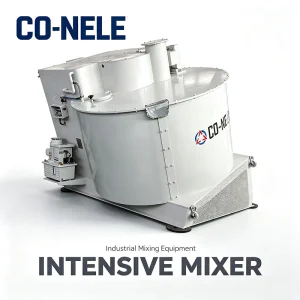
| Inclined Intensive Mixer Granulator | 2.5 – 6.0 (High Shear Rotor) | 40 – 90 Seconds | < 1.5% | Ultra-fine specialty powder, ceramic raw materials, refractory castables, battery materials. |
To eliminate dead zones, high-efficiency single-shaft and twin-shaft dry mortar mixers operate within a critical mechanical state defined by the dimensionless Froude Number ($Fr$):
Where w is the angular velocity of the mixing shaft, r is the rotor radius, and g is gravitational acceleration. When $Fr > 1.0$, the centrifugal force generated by the mixing elements exceeds gravitational acceleration, lifting the dry powder particles into a three-dimensional fluidized weightless zone. Within this state, particles move freely, allowing inter-particle diffusion and dispersion at minimal frictional energy input.
Why Tier-1 international contractors choose QINGDAO CO-NELE MACHINERY CO., LTD. for custom mixing engineering.
China has established itself as the world epicenter for heavy machinery innovation, combining vast metallurgical supply chains with advanced CNC machining capabilities. Located in Qingdao, Shandong Province, QINGDAO CO-NELE MACHINERY CO., LTD. (est. 2004) represents over 20 years of relentless R&D and precision manufacturing in industrial mixing and granulation technology.
Specific mixing requirements across residential, commercial, infrastructure, and extreme environmental projects.
Formulation Challenge: High content of cellulose ether (HPMC) and organic redispersible powders (RPP). Cellulose tends to agglomerate into gelatinous lumps when exposed to ambient moisture or improper shear.
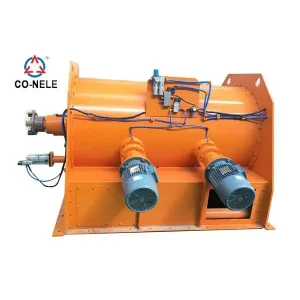
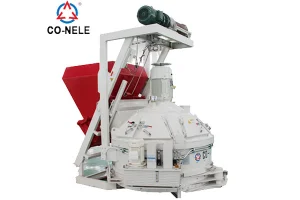
Mixer Solution: CO-NELE single-shaft dry powder mortar mixers equipped with high-speed side-mounted chopper units (1,400–2,800 RPM). Choppers break down polymer agglomerates within seconds, guaranteeing uniform water-retention across the applied tile bed.
Formulation Challenge: Requires extremely high fluid flowability combined with zero segregation of fine aggregate (graded quartz sand < 0.5 mm) and defoaming agents.
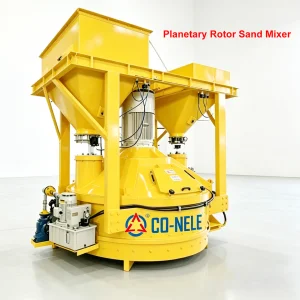
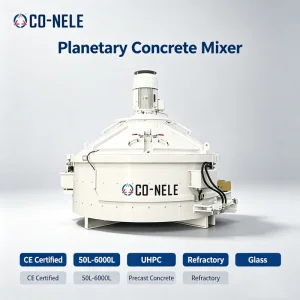
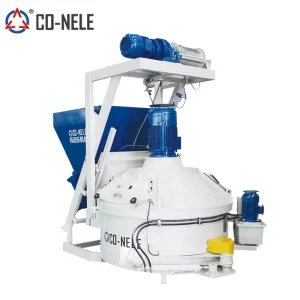
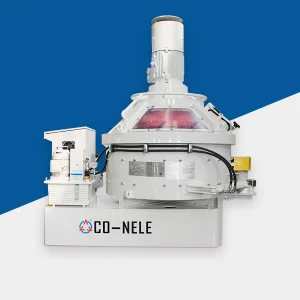
Mixer Solution: Vertical-shaft planetary counter-current mixers (CMPS series). Kinematic rotation ensures micro-homogeneity without entraining excess air bubbles, preventing pinholes and micro-cracks on cured concrete surfaces.
Formulation Challenge: Incorporates delicate lightweight aggregates such as expanded polystyrene (EPS) beads or expanded glass. High shear forces crush these fragile aggregates, drastically reducing thermal insulation R-values.
Mixer Solution: Gentle non-gravity twin-shaft paddle mixers operating at calibrated low rotational velocities ($Fr \approx 1.1$). Aggregates are blended via spatial rotation without mechanical crushing.
Formulation Challenge: Heavy bulk density materials containing corundum, silicon carbide, steel fibers, and ultra-fine silica fume, deployed in heavy bridge joints, wind turbines, and blast furnace linings.
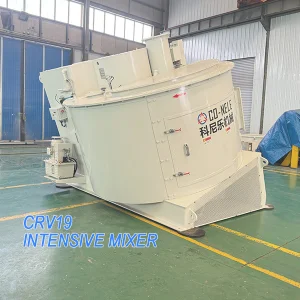
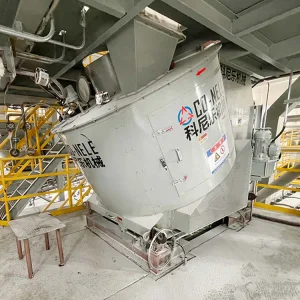
Mixer Solution: Heavy-duty inclined intensive mixers (CR series) with reinforced high-torque gearboxes and wear liners capable of withstanding abrasive sliding forces up to 2.5 t/m³ bulk density.
Engineering complete turn-key dry powder mortar production plants from raw material storage to high-speed automatic bagging.
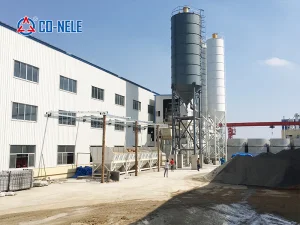
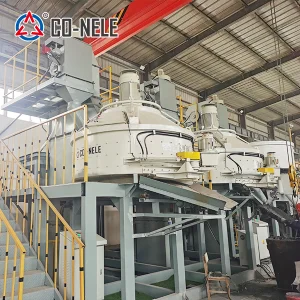
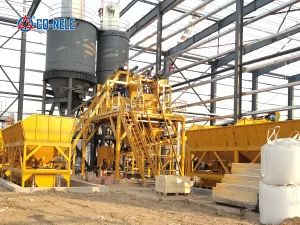
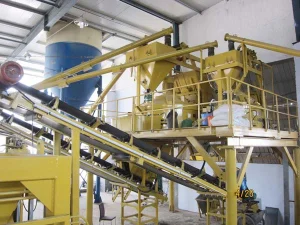
Selecting the correct core mixer is only one component of a successful production installation. CO-NELE designs and manufactures integrated dry mortar batching plants tailored to plant floor dimensions, height restrictions, and local environmental standards.
Raw materials are lifted via bucket elevators to top-mounted storage silos. Gravity drives material down through weighing hoppers, the central dry mortar mixer, finished product hoppers, and automatic packing machines.
Advantage: Lowest energy consumption per ton, highest output (30–100 t/h), zero pneumatic material degradation.
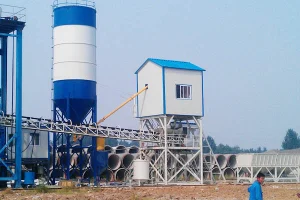
Raw material silos are positioned on ground level adjacent to the mixing structure. Pneumatic conveyors or short incline bucket elevators transport weighed batches to the elevated mixer level.
Advantage: Moderate capital cost, lower structure height requirements, simplified maintenance access.
All dosing, weighing, mixing, and bagging equipment are integrated on a single skid-mounted or foundationless chassis. Ideal for remote infrastructure contracts and leased manufacturing land.
Advantage: Rapid installation within 7 days, fully relocatable, zero permanent concrete foundation required.
Key technical parameters global procurement teams must verify before placing an equipment order.
When evaluating a commercial proposal for a dry powder mortar machine from China, procurement engineers should assess Total Cost of Ownership (TCO) rather than focusing solely on initial purchase price (CAPEX). High quality wear parts and electrical safety compliance reduce operational downtime (OPEX) dramatically.
| Evaluation Parameter | Standard Machine Spec | CO-NELE Premium Engineering Standard | Impact on Operational TCO |
|---|---|---|---|
| Main Reducer / Gearbox | Outsourced commercial gearbox | Proprietary heavy-duty planetary gear drive | Prevents gearbox tooth breakage; extends drive lifespan to 10+ years. |
| Shaft Seal System | Basic packing gland seal | Multi-layer pneumatic air-purge + mechanical seal | Zero fine dry powder leakage into bearings; prevents bearing failure. |
| Discharge Gate Mechanism | Single pneumatic cylinder | Full-length hydraulic or dual-cylinder bomb-bay gate | Discharges 2 m³ batch in < 8 seconds without material segregation. |
| Liner & Blade Wear Alloy | Standard Q235 or manganese steel | High-chrome alloy cast iron (HRC 60–65) | Replaces wear components every 120,000 batches instead of 30,000. |
| Electrical Compliance | Standard domestic wiring | CE / UL certified, Siemens PLC, ATEX explosion-proof option | Passes European & North American site safety compliance audits effortlessly. |
Advanced mixing machines, refractory granulators, castable mixers, and specialized batching solutions for worldwide delivery.
Addressing core technical questions submitted by project engineers, factory operators, and equipment importers worldwide.
A: Single-shaft ploughshare mixers use high-velocity plough elements to push materials in a radial and axial directions, creating high shear ideal for dispersing liquid additives and micro-fibers (with side choppers). Twin-shaft non-gravity mixers rely on counter-rotating paddles that create a fluidized, weightless zone, allowing extremely fast mixing times (30–45s) with low power consumption, making them ideal for high-volume standard mortar plants.
A: Organic additives like starch ethers and cellulose powders can form explosive dust clouds when suspended in air. CO-NELE equipment is engineered with pressure-equalization vents connected to pulse-jet dust collectors, grounding terminals for static dissipation, and optional ATEX-certified explosion-proof motors and spark-resistant seals.
A: Standard ribbon or dry ploughshare mixers are designed specifically for dry solids and will suffer seal failure or motor overload if exposed to wet concrete paste. However, CO-NELE Planetary Concrete Mixers (CMP series) and Intensive Mixers are multi-functional forced-action machines capable of handling both dry powder batches and wet concrete mixes (including UHPC and GFRC).
A: High-chrome alloy liners (Cr26) produced by CO-NELE achieve a service life of 100,000 to 150,000 standard batches under normal quartz sand abrasion (< 3.0 mm particle size). All wear plates are bolt-on segment tiles, allowing fast replacement in the field without cutting or welding the outer shell.
A: Every machine ships with standard English operation manuals, complete foundation load drawings, wiring schematics, and 3D installation models. CO-NELE offers remote AR-guided video commissioning as well as on-site dispatch of resident service engineers to setup, calibrate PLC batching controls, and train local staff.
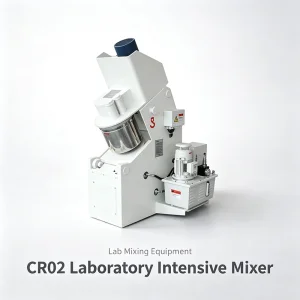
A: CO-NELE operates an industrial mixing R&D laboratory in Qingdao equipped with 5L, 15L, 50L, and 75L test units. Clients can send raw material samples to evaluate mixing homogeneity, particle dispersion, optimal Froude numbers, and batch power curves prior to contract signature.
Retained directory of CO-NELE mixing equipment product pages and technical indexes.