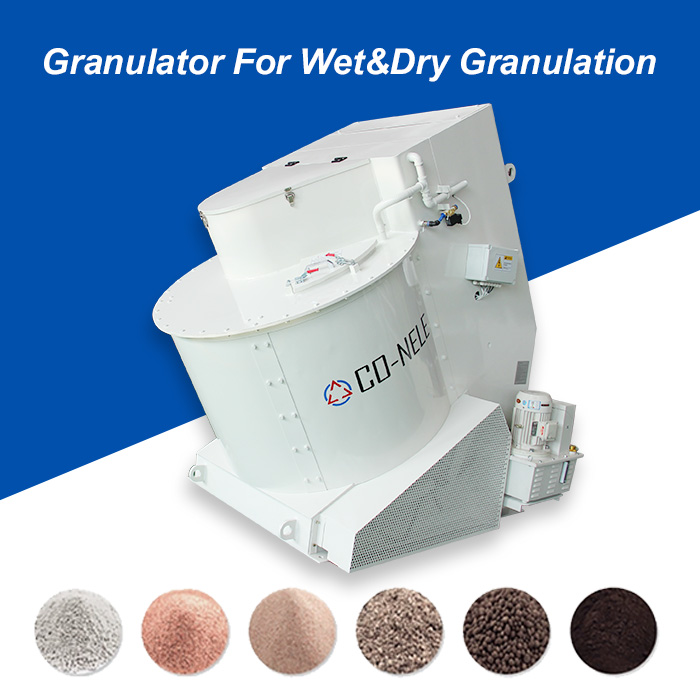
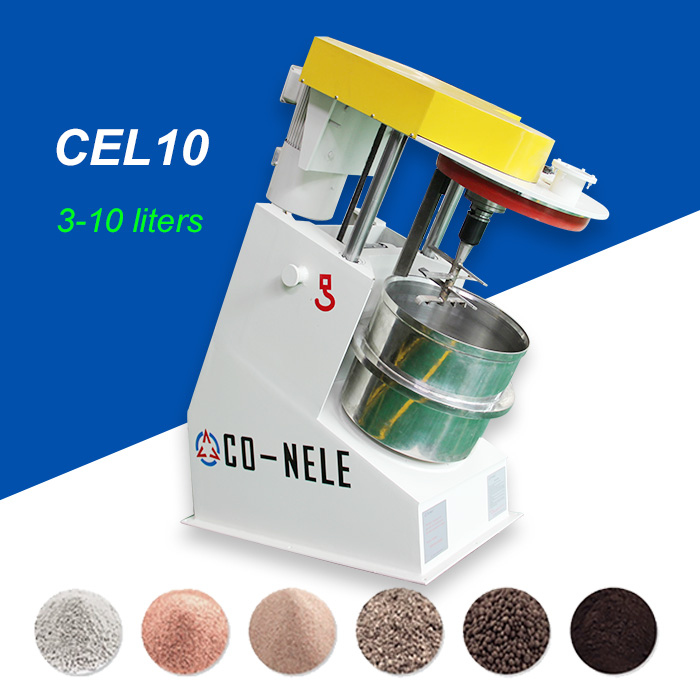
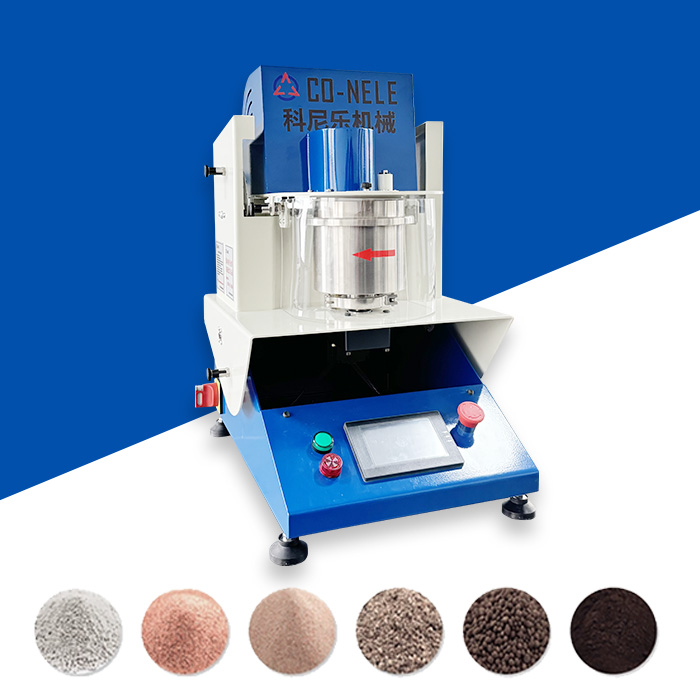
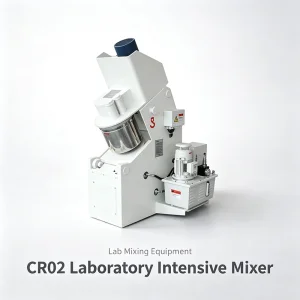
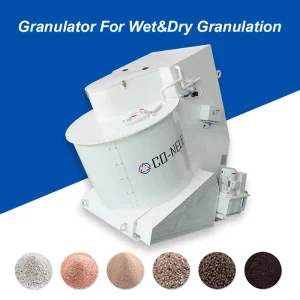
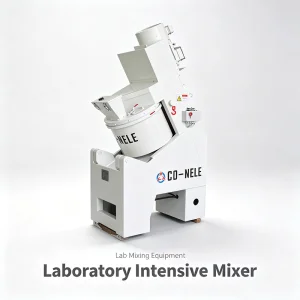
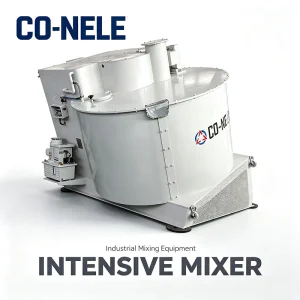
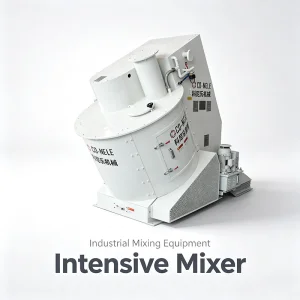
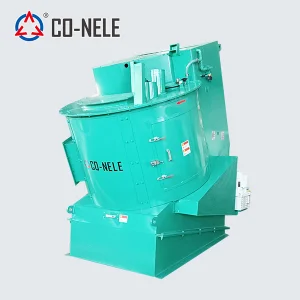
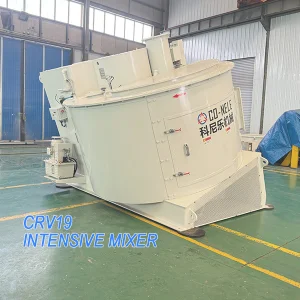
Intensive ceramic mixer solves the problem of uniformity of ceramic raw materials. The two processes of mixing and granulation are completed efficiently in one device.
Ceramics Mixers play a vital role in the production of ceramic materials. Their core task is to ensure that various raw materials (including powders, liquids and additives) are mixed in a highly uniform state. This has a decisive impact on the performance, quality and consistency of the final ceramic product.
Intensive Mixer for Ceramic Materials
Uniformity
Fully mix different ingredients (such as clay, feldspar, quartz, flux, additives, colorants, water, organic binders, etc.) to ensure uniform distribution of ingredients at the microscopic scale.
Deagglomeration
Break up agglomerates in raw material powders to improve dispersibility.
Wetting
In wet mixing (such as preparing mud or plastic mud), make the liquid (usually water) uniformly wet the powder particles.
Kneading / Plasticization
For plastic mud (such as mud for plastic molding), the mixer needs to provide sufficient shear force to fully hydrate and align the clay particles to form a mud mass with good plasticity and bonding strength.
Gas Introduction / Degassing
Some processes require the mixing of specific gases, while others require vacuum degassing at the end of mixing to remove bubbles (especially for demanding products such as slip casting and electrical porcelain).
Ceramic raw materials uniform mixing determines the performance, color consistency and sintering success rate of ceramic products.
The traditional manual Ceramic mixer or simple mechanical Ceramic mixer mixing methods of ceramic raw materials often face pain points such as low efficiency, poor uniformity and dust pollution. The intensive ceramic mixer came into being. With its high efficiency, uniformity, intelligence and reliability, it has become the core equipment for modern ceramic companies to improve quality and competitiveness.
Advantages of the Intensive Ceramic Mixer
Extremely Uniform Mixing
The uniquely designed stirring structure is used to achieve three-dimensional forced mixing, ensuring that various ceramic raw materials such as powders, particles, slurries (including clay, feldspar, quartz, pigments, additives, etc.) are evenly dispersed at the molecular level in a short time, completely eliminating defects such as color difference, uneven composition, shrinkage and deformation.
Efficient and Energy-Saving Production
The processing volume per unit time is significantly increased, and the energy consumption is significantly lower than the traditional method, which greatly reduces the production cost.
Sturdy, Durable and Reliable
The core contact parts (mixing paddles, inner wall) are made of high-wear-resistant alloys with strong resistance to ceramic raw material wear and long service life.
Intelligent and Convenient Control
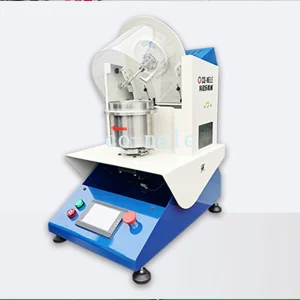
Standard PLC intelligent control system, accurate setting and storage of mixing time, speed, and process; optional touch screen human-machine interface, intuitive and easy operation; support automatic connection, easy connection to feeding, conveying, and discharging systems.
Closed, Environmentally Friendly and Safe
The fully enclosed structure design effectively suppresses dust from escaping, and is equipped with safety protection devices (emergency stop button, protective door lock, etc.) and configurations that meet explosion-proof requirements (optional) to ensure production safety.
Widely Applicable and Flexible
Modular design, can be flexibly customized according to different ceramic process requirements (dry mixing, wet mixing, granulation).
Intensive Ceramic Mixer Parameters
Intensive Mixer
Hourly Production Capacity (T/H)
Mixing Quantity (Kg/batch)
Production Capacity (m³/h)
Batch / Liter
Discharging
CR05
0.6
30-40
0.5
25
Hydraulic center discharge
CR08
1.2
60-80
1
50
Hydraulic center discharge
CR09
2.4
120-140
2
100
Hydraulic center discharge
CRV09
3.6
180-200
3
150
Hydraulic center discharge
CR11
6
300-350
5
250
Hydraulic center discharge
CR15M
8.4
420-450
7
350
Hydraulic center discharge
CR15
12
600-650
10
500
Hydraulic center discharge
CRV15
14.4
720-750
12
600
Hydraulic center discharge
CRV19
24
330-1000
20
1000
Hydraulic center discharge
Intensive Ceramic Mixer is Widely Used In:
Architectural ceramics (ceramic tiles, bathroom)
Daily ceramics (tableware, handicrafts)
Special ceramics (electronic ceramics, structural ceramics, refractory materials)
Color glaze preparation
Ceramic raw material pretreatment
Ceramic mixer is your reliable partner to improve ceramic quality, optimize production process, and achieve cost reduction and efficiency improvement!
Frequently Asked Questions (FAQ)
What is the primary role of an intensive ceramic mixer?
An intensive ceramic mixer ensures raw materials (powders, liquids, and additives) are thoroughly mixed to achieve microscopic-level uniformity, which directly enhances the strength, color consistency, and sintering reliability of the final ceramic products.
How does an intensive mixer compare to traditional mixing methods?
Traditional mixing often leads to low efficiency, uneven composition, and dust pollution. Intensive mixers use three-dimensional forced mixing to deliver higher efficiency, better energy savings, precise PLC control, and complete dust suppression.
Can the mixer handle both dry and wet mixing processes?
Yes, intensive mixers feature a flexible modular design that easily adapts to dry mixing, wet mixing, plastic mud kneading, and granulation based on specific ceramic processing needs.
How does the equipment withstand wear from abrasive ceramic materials?
The core contact components, such as inner walls and mixing paddles, are engineered from high-wear-resistant alloys designed to withstand abrasive raw materials, extending service life significantly.
What production capacities are available?
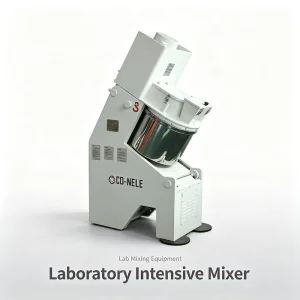
Mixer models range from small lab/pilot scales (e.g., CR05 with 0.6 T/H capacity) to large industrial production units (e.g., CRV19 capable of up to 24 T/H output).