CO-NELEMixing & Granulation
Explore our engineered concrete mixing and block batching systems designed for zero-defect precast production, dry-cast block manufacturing, and high-duty infrastructure projects.
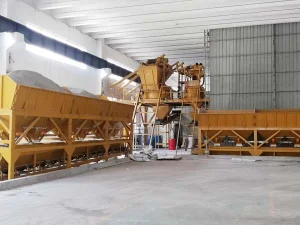
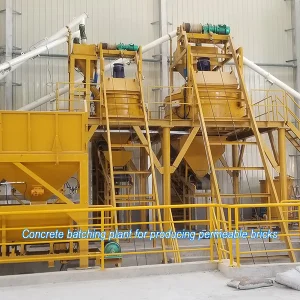
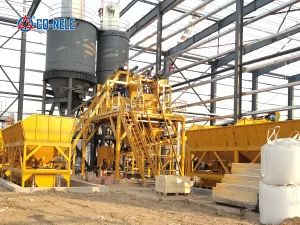
In the contemporary global infrastructure landscape, the procurement of a Concrete Block Batching Plant has evolved from a simple capital equipment acquisition into a strategic decision driving supply chain efficiency, material compliance, and operational sustainability. Modern precast concrete manufacturing facilities face rigorous international performance mandates—such as ASTM C90 in North America, EN 771-3 across the European Union, and regional sustainability directives demanding substantial reductions in embodied carbon.
Industrial buyers across North America, Western Europe, the Middle East, Southeast Asia, and Latin America exhibit nuanced procurement priorities based on local raw material variance, ambient operating conditions, and target product application lines (e.g., architectural masonry, permeable paving blocks, retaining wall blocks, and eco-friendly lightweight aggregate blocks).
| Economic Zone | Dominant Block Applications | Primary Technical Constraints | Mandated Plant Features |
|---|---|---|---|
| North America | Architectural Masonry, CMU, Heavy Retaining Walls | Strict ASTM C90 shear specs, rapid color change requirements | High-speed counter-current mixing, automated pigment dosing, telemetry tracking |
| European Union | High-density Permeable Pavers, Insulated AAC Blocks | EN 771-3 compliance, low carbon footprint, silica dust containment | Enclosed zero-emission batching, microwave moisture probes, planetary drive power |
| Middle East (GCC) | Solid Structural Blocks, Heavy Interlocking Pavers | Extreme thermal conditions (>45°C), abrasive silica sand wear | Chilled water dosing systems, high-chrome wear plates (65 HRC), insulated aggregate bins |
| Southeast Asia | Permeable Eco-Bricks, Roadway Drainage Tiles | Variable aggregate moisture, monsoon humidity variations | Dynamic real-time moisture compensation, fast-discharge hydraulic gate kinematics |
The heart of any modern Concrete Block Batching Plant is its compulsory mixing engine. Concrete block formulations overwhelmingly utilize zero-slump, ultra-dry cast concrete mixtures. These formulations require intense mechanical action to fully coat fine sand particles and coarse aggregates with cementitious paste while uniformly dispersing trace additives, fly ash, micro-silica, and synthetic iron-oxide pigments.
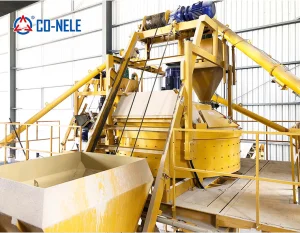
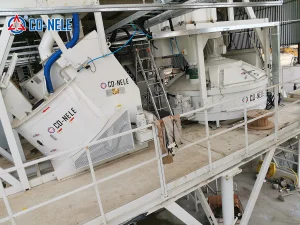
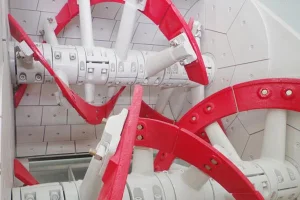
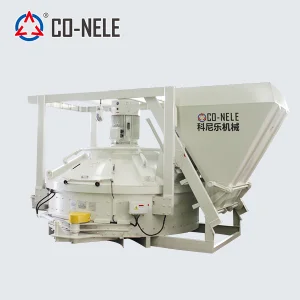
Engineered with counter-current star arms rotating on dual orbital paths. This eliminates material segregation and guarantees zero dead zones. Essential for high-grade block production, facing layers, and pigmented pavers.
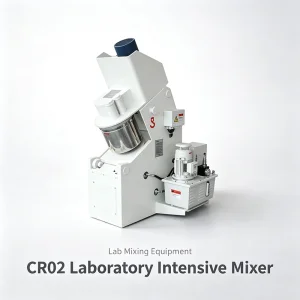
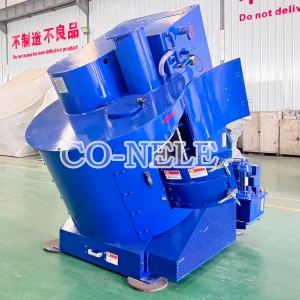
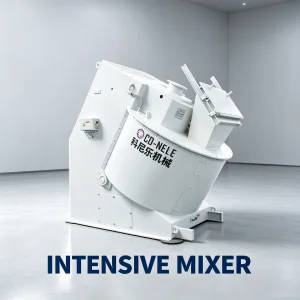
Utilize inclined rotating pans combined with high-speed rotor tools. Ideal for specialized micro-granulation, lightweight aggregate blocks, and technical refractory masonry units requiring micro-porosity control.
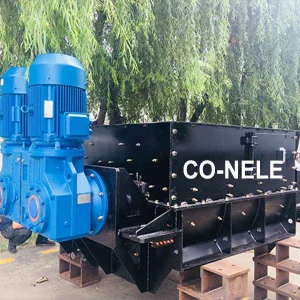
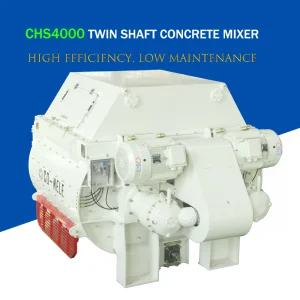
Optimized for high-throughput structural core concrete. Dual horizontal shafts create counter-rotating turbulent zones, maximizing volume production for mass foundation blocks and heavy industrial masonry.
Achieving a Coefficient of Variation ($CV$) below 5% in dry-cast block batches is chemically impossible with simple gravitational or single-axis ribbon mixers. The table below illustrates the mechanical efficiency profile across industrial mixing methodologies:
| Performance Metric | Vertical Planetary (Counter-Current) | Intensive Mixer-Granulator | Twin-Shaft Horizontal |
|---|---|---|---|
| Mixer Kinematics | Complex planetary path, 100% floor coverage | Counter-directional inclined pan + high-speed rotor | Dual horizontal counter-rotating helical shafts |
| Dry-Cast Compatibility | Optimal (Industry Standard) | Superior for Ultra-Fine Powders | Moderate (Risk of aggregate balling) |
| Homogeneity Time (CV < 5%) | 45 – 60 seconds | 30 – 45 seconds | 75 – 90 seconds |
| Pigment Dispersion Rate | 99.4% uniform distribution | 99.9% uniform distribution | 92.1% uniform distribution |
| Energy Consumption / m³ | Low (Optimized Torque Transfer) | Medium-High (High Rotor Power) | Medium |
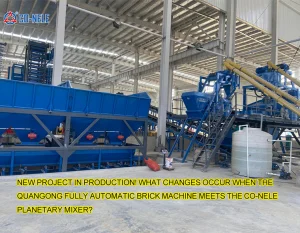
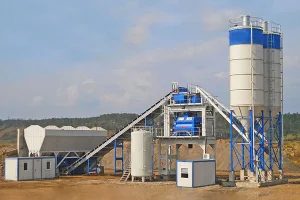
A complete commercial Concrete Block Batching Machine installation requires flawless synchronization between aggregate feeding, precision batching, water-binder ratio compensation, mixing, transfer, and block molding machine feeding. Our turnkey plant architectures are custom-engineered to eliminate bottlenecks, minimize cement wastage, and maintain uninterrupted continuous manufacturing.
Integrated batching solution configured for no-fines porous concrete. Utilizes double-bin weighing with high-frequency vibratory feeding to maintain continuous void ratio consistency for urban flood management bricks.
Dual-mixer architecture consisting of a high-capacity main core mixer (twin shaft or planetary) paired with a specialized secondary planetary mixer dedicated to thin face-mix colored architectural finishes.
Automated high-incline skip hoists and overhead flying bucket shuttles deliver freshly mixed zero-slump concrete directly into block machine hoppers within 15 seconds of discharge, preventing premature hydration setup.
The next decade of concrete block manufacturing belongs to intelligent, fully automated, and ecologically resilient batching infrastructures. As global aggregate supplies fluctuate in particle grading and moisture content, manual control leads to unacceptable product variance. CO-NELE's technical engineering roadmap integrates cutting-edge AI and sensor technologies directly into the batching ecosystem.
Optical and high-frequency microwave moisture sensors placed in aggregate hoppers and inside the mixing pan continuously sample moisture 60 times per second. Algorithms automatically adjust water dosing in real-time, locking target slump within $\pm 0.1\%$.
Next-generation batching plants feature direct gaseous $\text{CO}_2$ injection systems during the mixing cycle. The introduced carbon dioxide chemically reacts with calcium hydroxide in early hydration, permanently sequestering $\text{CO}_2$ into nanoscale calcium carbonate minerals ($CaCO_3$), raising block compressive strength by up to 15% while reducing cement consumption.
Vibration analysis sensors and thermal imaging probes on planetary gearboxes stream diagnostic telemetry to cloud enterprise dashboards. Maintenance engineering teams receive automated alerts before wear liner failure or mechanical fatigue can cause unplanned plant downtime.
Deploying heavy industrial concrete machinery across international jurisdictions demands total alignment with localized electrical codes, structural wind/seismic regulations, and international export quality certifications. Equipment failure in remote markets results in costly operational downtime—which is why CO-NELE engineers compliance directly into machine blueprints.
Every batching plant control cabinet is assembled with premium global components (Siemens PLC, Schneider Electric relays, ABB variable frequency drives) engineered to match regional mains voltage: 220V/380V/415V/440V/480V at 50Hz or 60Hz. Full CE and UL compliance documentation is standard.
All batching plant structures—including aggregate silos, skip runways, and mixer platforms—are designed around standard 40ft HQ shipping container dimensions. This eliminates open-top freight premiums and accelerates port-to-site transit times.
With interchangeable spare parts retained for every model manufactured since 2004, high-chrome wear blades, pan liners, seal kits, and pneumatic valves ship within 24 hours from regional distribution warehouses or directly from our Qingdao manufacturing hub.
In-depth technical answers prepared by senior equipment design engineers to address common procurement and operating challenges in concrete block manufacturing.
Explore the remaining specialized mixing platforms, laboratory batching units, stationary batch plants, and heavy compulsory twin-shaft systems in our product lineup.