
CO-NELEMixing & Granulation
Explore our core laboratory mixing equipment engineered for perfect material homogeneity, exact formulation testing, and seamless scale-up to full production capacities.
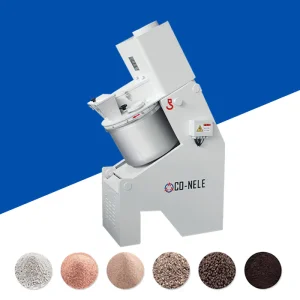
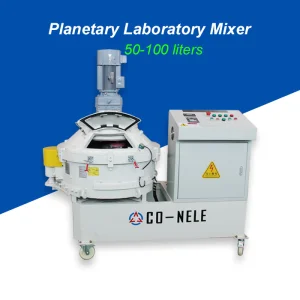
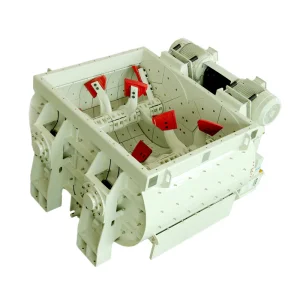
Analyzing micro-homogeneity, shear energy distribution, and rheological predictability in modern R&D scale processing.
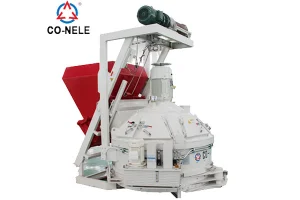
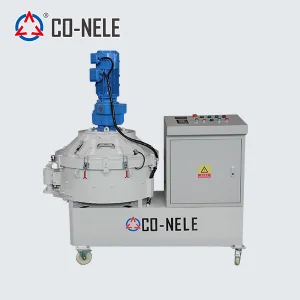
In modern industrial material science, the gap between laboratory research and commercial-scale manufacturing remains one of the most critical challenges for process engineers. Whether formulating Ultra-High-Performance Concrete (UHPC), advanced alumina ceramics, lithium-battery dry electrodes, or complex refractory castables, achieving 100% micro-homogeneity at small batch volumes is paramount. A standard laboratory mixer must not merely stir raw ingredients; it must reproduce the exact kinematic energy, shear profile, and material flow dynamics required to transition formulas seamlessly from a 5-liter R&D benchtop trial to a 3,000-liter industrial batching plant.
Information Gain Insight: Traditional planetary mixers often suffer from rotational dead zones where micro-additives, silica fume, or chemical binders agglomerate along vessel walls. Modern counter-current intensive mixers eliminate dead space completely by decoupling the rotating mixing pan from high-speed rotor tools, reducing cycle times by up to 60% while cutting standard deviations in batch dispersion below 2%.
When selecting a laboratory mixer factory and machine manufacturer, international procurement teams and senior chemical engineers must look beyond basic mechanical assembly. The true value lies in precision gearbox torque transmission, variable-frequency energy input control, wear-resistant alloy metallurgy, and digital telemetry integration. This technical guide examines the architectural principles, global compliance benchmarks, supply chain dynamics, and intent-driven selection criteria for state-of-the-art laboratory mixing machinery.
Understanding the mechanical innovations that enable zero-segregation dry, wet, and high-viscosity mixing.
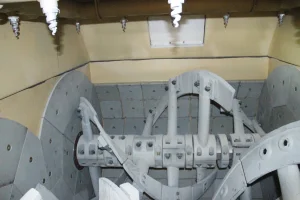
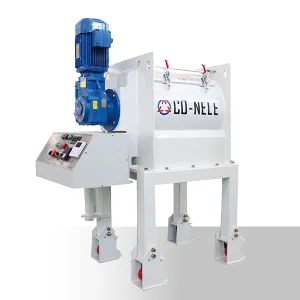
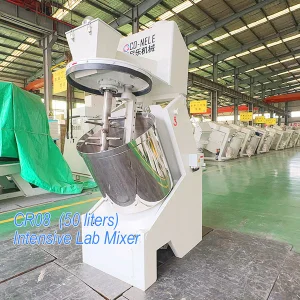
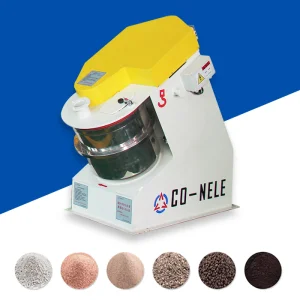
By rotating the mixing pan and mixing rotor tools in opposite directions (or at offset eccentric vectors), materials are subjected to multidirectional velocity fields.
Integrated high-speed rotor tools running from 100 RPM to 3,000 RPM break down micro-agglomerates without destroying delicate aggregate structures.
Industrial laboratory mixers utilize custom-cast, integral planetary reducers with high-torque gear trains designed for continuous heavy-load operations.
Evaluating how laboratory mixer models benchmark against scale-up parameters for industrial batching lines.
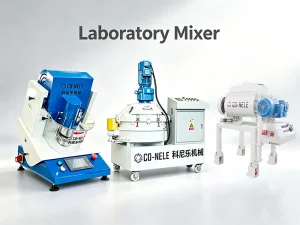
| Performance Parameter | Laboratory Intensive Mixer (CR08/CQM10) | Laboratory Planetary Mixer (CMP50) | Industrial Scale-Up Plant (CMP750/MP500) |
|---|---|---|---|
| Batch Capacity Range | 5 Liters – 50 Liters | 50 Liters – 100 Liters | 500 Liters – 4,000 Liters |
| Rotor Tool Speed (VFD) | 0 – 3,000 RPM (Stepless) | 0 – 1,200 RPM (Adjustable) | Synchronized Planetary Speed |
| Mixing Coefficient of Variation (CV) | < 1.2% (Micro-Homogeneous) | < 2.5% (High Uniformity) | < 3.0% (Standard Industrial) |
| Primary Application Scope | Battery dry electrodes, fine ceramics, pelletizing | UHPC trial mixes, precast concrete, refractories | Commercial ready-mix, UHPC plants, block production |
| Discharge Mechanism | Manual tilt or bottom hydraulic gate | Bottom central hydraulic discharge | Multi-gate dual pneumatic/hydraulic pneumatic |
| Data Telemetry Integration | PLC Torque, Temp, Energy & Viscosity logging | Moisture probe & load-cell connectivity | SCADA / Enterprise ERP fully integrated |
Why Qingdao machinery clusters represent the world's most resilient industrial mixing equipment manufacturing base.
Over the past two decades, China—specifically the Qingdao industrial manufacturing hub—has transformed into the epicenter of high-end compulsory mixing machinery design. As a specialized laboratory mixer factory, local manufacturing capabilities combine complete raw material vertical integration with advanced CNC machining centers and dedicated metallurgical testing labs.
From raw chromium steel casting to precision gear grinding, Chinese factories control 100% of the production chain. High-chrome wear liners (HRC 62-65) are cast on-site, drastically reducing component lead times and cost.
Unlike third-party equipment assemblers, dedicated factories manufacture planetary reducers using 5-axis CNC machining, ensuring micron-level tooth alignment and zero gear backlash under shock loads.
By leveraging China's dense industrial component ecosystem, buyers gain access to world-class heavy machinery built with Siemens PLCs, Schneider electrics, and Hardox wear plates at a total cost of ownership 40–50% lower than European alternatives.
Aligning laboratory mixing hardware with rigorous international engineering, safety, and operational standards.
When international enterprises—ranging from Fortune 500 building materials manufacturers to national defense research laboratories—procure industrial machinery, compliance and risk mitigation dominate the buying criteria. A reliable laboratory mixer machine must seamlessly adapt to regional electrical grids, safety directives, and cleanroom environments.
E-E-A-T Guarantee: Every machine delivered is accompanied by certified raw material test reports (MTR), dynamic balancing certificates for all rotating rotors, complete circuit schematics, and an exhaustive English language Operation & Maintenance (O&M) manual.
From advanced battery labs in Europe to high-temperature refractory development in North America.
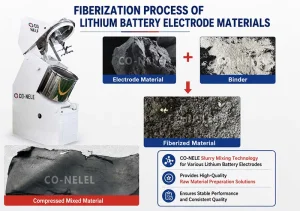
In energy storage hubs, intensive laboratory mixers perform PTFE fibrosis and dry powder coating. High shear fields homogenize active materials, conductive carbon, and binders without liquid solvents.
High-temperature steel mill suppliers utilize specialized lab pan mixers to disperse micro-silica and corundum aggregates rapidly, ensuring maximum density and thermal shock resistance.
Concrete technology labs use planetary counter-current laboratory mixers to distribute steel and synthetic micro-fibers perfectly without balling or clumping, reaching strengths exceeding 150 MPa.
The convergence of smart IoT sensor arrays, digital twin modeling, and sustainable zero-dust processing.
As industry 4.0 transforms process engineering, modern laboratory mixers are evolving from purely mechanical units into intelligent, data-driven research tools. Key industry shifts shaping the next decade include:
By measuring real-time motor torque fluctuations, power draw curves, and material temperature spikes inside the mixing pan, artificial intelligence algorithms predict the precise transformation point of dry powder into a plastic mass, eliminating human error in liquid dosing.
Laboratory test data logged during small-scale trials is directly uploaded to cloud platforms. Digital twin software models the precise tool speed, energy consumption, and cycle timing needed for industrial 3,000L production mixers, drastically accelerating commercialization timelines.
With tightening environmental regulations regarding fine particulate matter (PM2.5 / PM10) in silica and lithium processing, next-generation laboratory mixers integrate negative-pressure pulse dust extraction and fully sealed automated dosing ports.
Detailed technical answers addressing procurement, operational kinematics, material trials, and wear guarantees.
Our laboratory intensive mixers (such as the CR and CQM series) utilize identical kinematic velocity ratios, blade geometry angles, and specific energy inputs per unit mass (kW/kg) as our commercial production mixers. By maintaining geometrical similarity and Froude number scaling, batch results achieved in a 5L or 50L lab test can be translated directly to a 1,500L or 3,000L plant mixer with a margin of error under 3%.
We supply specialized wear packages tailored to your raw material abrasiveness. Options include replaceable high-chrome alloy steel liners (HRC ≥ 62), tungsten carbide coating on mixing blades, polyurethane/rubber linings for iron-contamination-sensitive applications, and solid ceramic (silicon carbide or alumina) tiles for extreme abrasion environments.
Yes. We operate a fully equipped material test laboratory in Qingdao. International clients can send 10–50 kg of raw material samples. Our process engineers perform mixing, wetting, and granulation trials, providing a comprehensive report detailing density, grain size distribution, particle sphericity, cycle time, and recommended machine configurations.
Standard laboratory units ship within 20 to 30 calendar days. All machines carry a comprehensive 12-month global warranty covering drive units and electrical controls. Critical replacement parts (mixing blades, scrapers, seals) are maintained in stock for immediate international express dispatch (DHL/FedEx within 48–72 hours).
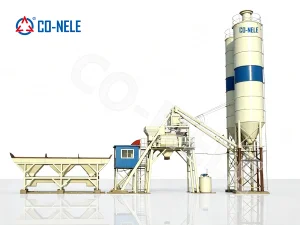
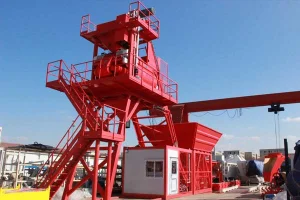
Explore our complete range of specialized mixers, concrete batching plants, and granulating machinery built to industrial quality standards.