
CO-NELEMixing & Granulation
Engineered by Qingdao CO-NELE Machinery Co., Ltd. for extreme wear resistance, micro-homogeneity, and rapid cycle efficiency.
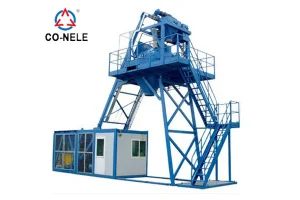
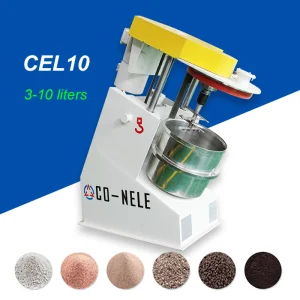
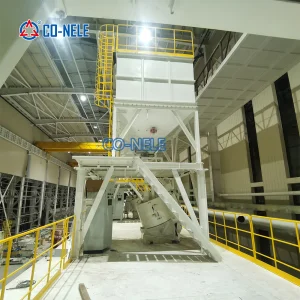
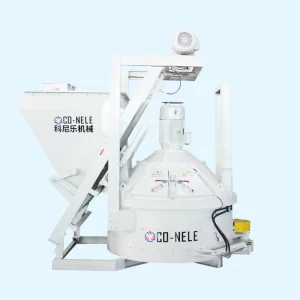
Moving Beyond Conventional Ribbon and Planetary Drums to High-Velocity Inclined Rotor Mechanics
Traditional horizontal twin-shaft or gravity drum mixers rely on macro-movement of aggregates, leaving micro-agglomerates intact. Intensive mixers use counter-rotating high-shear tools that break particle agglomerates down to the sub-micron scale in seconds.
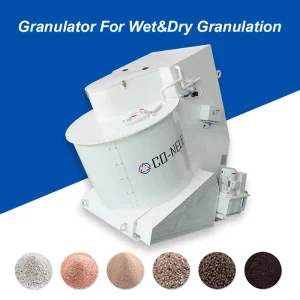
Unlike standard blenders, intensive mixers function as hybrid Mixer-Granulators. By adjusting rotor tip speed (15 m/s to 35 m/s) and binder addition, operators control granule size, density, and roundness (sphericity > 90%) within a single vessel.
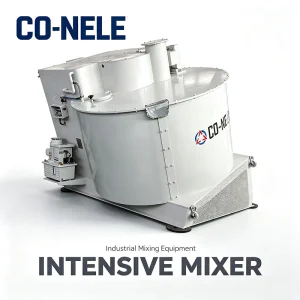
By tilting the mixing pan at an inclined angle (typically 20° to 30°) and spinning the pan counter to the rotor tool, gravity feeds material continuously into the high-shear agitator zone, eliminating dead zones completely.
Understanding the Macro Drivers Reshaping High-Shear Mixing Technology Procurement Across Europe, North America, and Asia-Pacific
The global EV energy storage sector is rapidly abandoning solvent-heavy slurry mixing in favor of dry electrode coating processes. This transition requires intensive mixers capable of ultra-high dispersion shear without overheating heat-sensitive fluoropolymer binders (e.g., PTFE). China manufacturers offering jacketed temperature-controlled intensive mixers are seeing explosive global demand.
As the construction industry shifts to Calcined Clay, Alkali-Activated Slag, and Ultra-High-Performance Concrete (UHPC with strength > 150 MPa), water-binder ratios are dropping below 0.18. Conventional mixers stall or fail to coat silica fume particles. Intensive counter-current pan mixers are now mandatory equipment for modern precast plants.
Thermal spray drying consumes massive natural gas reserves to granulate ceramic powders (Alumina, Zirconia, Silicon Carbide). Intensive mixing granulators convert wet ceramic powders directly into spherical granules within 3 to 5 minutes, saving over 70% in thermal energy costs while delivering uniform press-feed bulk density.
Global procurement teams no longer look solely at FOB machinery price; they audit operational downtime. Key buyer intent focuses on liner life (High-Chrome Alloys vs. Tungsten Carbide matrices) and modular bolt-on blade replacement. Chinese engineering leadership now delivers European-grade metallurgical longevity at competitive capital cost.
| Mixing Technology | Kinematic Energy Transfer | Cycle Time | Homogeneity (CV%) | Granulation Capability | Target Materials |
|---|---|---|---|---|---|
| Inclined Intensive Mixer (CO-NELE CQM) | High Impact Shear + Rotational Transport | 45 – 120 sec | < 1.5% | Direct Spherical Pellets (0.2–8mm) | Battery Electrodes, Ceramics, Refractories, UHPC |
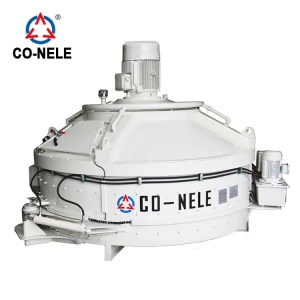
| Planetary Mixer (CO-NELE CMP) | Counter-Current Planetary Stars | 90 – 180 sec | < 3.0% | Micro-Pelletizing Only | Precast Concrete, Glass, Block Bricks |
| Twin-Shaft Compulsory Mixer | Horizontal Overlapping Paddles | 30 – 60 sec | < 5.0% | None (Mixing Only) | Commercial Ready-Mix Concrete, Base Aggregates |
| Horizontal Ribbon / Ploughshare | Low-Speed Diffusion Friction | 300 – 600 sec | < 8.0% | Requires Liquid Spray Bar | Dry Mortar, Food Powders, Chemical Blends |
Custom-Engineered Mixing and Granulating Plants Tailored to Specific Material Rheology
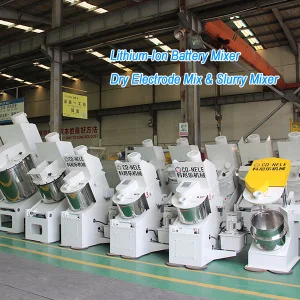
Intensive mixing plays a pivotal role in cathode (NMC, LFP) precursor homogenization and dry electrode processing. CO-NELE battery mixers feature stainless steel clad bodies, ceramic linings (Zirconia/Alumina) to eliminate iron contamination, vacuum-sealed mixing chambers, and explosion-proof (ATEX/IECEx) drive assemblies for NMP solvent environments.
In structural ceramic manufacturing (Alumina oxide, Zirconia, Proppants, Silicon Nitride), raw sub-micron powders must be converted into pourable granules with maximum bulk density for ISO-static pressing. CO-NELE granulators utilize computerized liquid binder dosing and variable rotor acceleration to achieve target yield in minutes.
Foundry molding sand requires fast, uniform encapsulation of bentonite clay and moisture around silica sand grains without destroying grain structure. CO-NELE Foundry Sand Intensive Mixers process up to 120 tons per hour with dynamic moisture sensors adjusting water dosing in real time within 10 milliseconds.
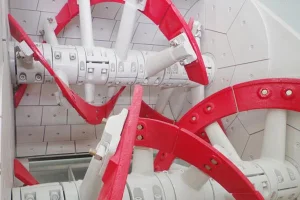
From carbon-bonded Magnesia-Carbon (MgO-C) bricks to high-alumina monolithic castables, handling coarse aggregates (up to 15mm) alongside micro-silica powder without segregation is critical. Our heavy-duty inclined mixers utilize armored rotor arms and bolt-on tungsten carbide tiles to withstand extreme physical abrasion.
Ultra-High-Performance Concrete (UHPC) and Glass Fiber Reinforced Concrete (GFRC) require high shear energy to disperse steel/synthetic fibers evenly without clumping. CO-NELE Planetary and Intensive Mixers disperse high percentages of steel fibers cleanly while achieving complete cement hydration with minimal water content.
Inside CO-NELE’s Own Gearbox Test Benches, AI Dosing Algorithms, and Green Manufacturing Infrastructure
Unlike competitors who assemble standard commercial gearboxes onto mixing pans, CO-NELE designs and manufactures its proprietary heavy-duty planetary gearboxes in Qingdao. Each transmission undergoes strict thermal imaging and vibration diagnostics under 150% rated load to guarantee zero mechanical failure under extreme torque spikes.
Modern industrial plants require strict batch traceability. CO-NELE mixing systems feature Siemens S7-1500 PLC platforms integrated with cloud SCADA dashboards. Real-time power curve monitoring determines the exact "mixing endpoint" based on rheological torque changes rather than fixed timer intervals, saving valuable power per cycle.
Commercial launch of heated intensive mixers capable of handling continuous powder batches up to 400°C for pitch carbon and hot-melt ceramic formulas.
Fully integrated zero-carbon batching plants driven by direct electric-hydrogen hybrid power units for remote mining and green construction projects.
Deployment of smart acoustic wear sensors embedded inside tungsten-carbide mixing blades, predicting wear life and auto-adjusting tool clearances.
Providing Overseas Buyers with De-Risked Procurement, Certified Quality Standards, and Free R&D Testing
Every machine manufactured at CO-NELE’s 30,000 m² Qingdao bases complies with European CE safety regulations, ISO9001 quality management, ISO14001 environmental standards, and optional ATEX explosion-proof directives.
Avoid capital risk by testing before buying. Global clients send 10kg to 100kg of raw material to our Qingdao laboratory. Our process engineers execute mixing/granulation trials, returning granular density and sphericity reports.
We maintain an active digital spare parts inventory for every mixer built since 2004. Key components (Siemens motors, SKF bearings, Schneider electrics, hydraulic seals) use standardized international brands for local procurement.
Answers to Sourcing, Scale-Up, and Kinematic Maintenance Questions Prepared by CO-NELE Senior Engineers
While planetary mixers use counter-current star arms rotating around a vertical axis (ideal for precast, block bricks, and standard UHPC), an inclined intensive mixer tilts the entire pan at a 20° to 30° angle and features a separate high-speed rotor running in the opposite direction. The inclined design introduces three-dimensional mechanical friction driven by gravity, allowing rapid micro-homogenization and direct spherical wet granulation within 1 to 3 minutes.
Yes. For abrasive applications such as ceramics, refractories, and foundry sands, CO-NELE fits mixing pans with replaceable high-chrome alloy wear plates (hardness > HRC 62), ceramic tile liners, or polyurethane linings. The mixing rotor tools are surfaced with tungsten carbide matrices or replaceable bolt-on carbide tips, extending operational wear life by 300% to 500% compared to standard steel alloys.
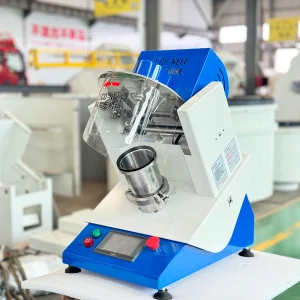
CO-NELE laboratory mixers (5L to 75L capacity) maintain geometric and kinematic similarity with industrial production models (up to 3,000L). By maintaining identical Froude numbers ($Fr$), tip speeds ($m/s$), and filling ratios ($%$), recipes perfected on lab units transfer to production plants with over 98% yield accuracy.
All export units are custom-wired to the buyer’s regional power supply (e.g., 220V, 380V, 415V, 440V, 480V at 50Hz or 60Hz). Electrical cabinets can be specified with UL/CSA compliance for North America, CE compliance for Europe, or ATEX explosion-proof certification for hazardous powder environments.
Liquid binders are introduced through multi-point ultrasonic or pneumatic atomizing spray nozzles positioned directly above the high-shear rotor zone. This ensures liquid droplets interact immediately with dispersed micro-powders, forming uniform liquid bridges without localized over-wetting or wall caking.
Explore CO-NELE’s Twin-Shaft, Double-Screw, Mobile Plants, and Dedicated Ceramic Powder Machinery
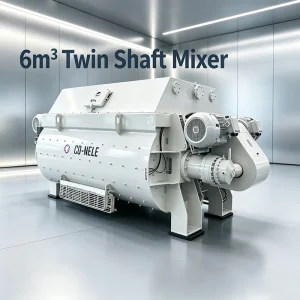
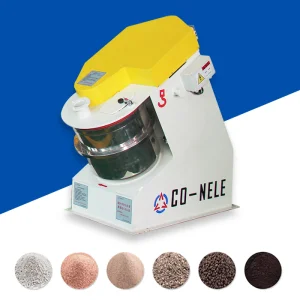
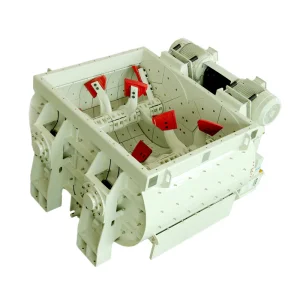
Connect directly with Qingdao CO-NELE process engineers. Request technical blueprints, CAD drawings, power consumption calculations, or schedule a material trial at our Qingdao laboratory.