CO-NELEMixing & Granulation
Explore high-performance concrete batching plants, planetary mixers, and intensive mixing granulators engineered to meet rigorous international standards.
A rigorous examination of technological convergence in modern concrete batching plants, vertical shaft planetary mixers, and high-intensity mixing granulators.
In the global industrial mixing and concrete production landscape, EPC contractors, precast concrete plant operators, and civil engineering infrastructure developers face a dual challenge: demanding German-grade mechanical precision and structural longevity while maintaining capital expenditure efficiency (CAPEX) and operating overhead (OPEX). The query keyword structure "China Concrete Batching Plant Germany Manufacturer & Machine" reflects a profound procurement shift. Modern industrial buyers no longer evaluate equipment purely on geographical origin; instead, they seek a hybrid manufacturing paradigm where German mechanical kinematics, drive transmission concepts, and quality assurance principles (DIN standards) are seamlessly integrated with China’s high-throughput Industry 4.0 manufacturing eco-systems.
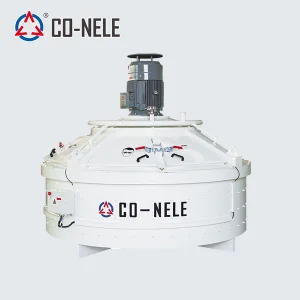
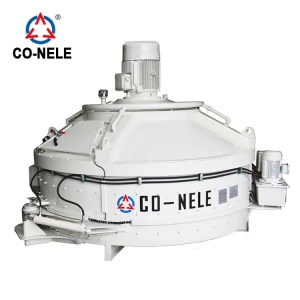
Traditional twin-shaft concrete mixers often struggle with micro-homogeneity when processing advanced concrete formulations such as Ultra-High-Performance Concrete (UHPC), Glass Fiber Reinforced Concrete (GFRC), or self-compacting high-density dry-cast mixes. By deploying counter-current vertical shaft planetary kinetics engineered under German metallurgical standards and produced within automated Chinese assembly hubs, modern batching plants achieve a mixing Coefficient of Variation (CV) below 3% in cycle times under 60 seconds.
Multi-star planetary motion path ensures 100% pan surface coverage per revolution without dead zones, enabling micro-dispersion of micro-silica, pigments, and steel fibers.
Incorporating high-chrome alloy liners (HB600+) and hardfaced mixing blades designed to withstand highly abrasive quartz aggregates and refractory formulations.
Optimized hydrodynamic drive efficiency reduces power consumption per cubic meter by up to 18% compared to legacy single-shaft or non-planetary vertical pan mixers.
How technical collaboration and localized supply chain integration deliver superior concrete equipment performance at optimal cost points.
| Engineering Domain | German Engineering Standard (DIN/VDI Target) | Chinese Industry 4.0 Integration (CO-NELE Model) | Combined Customer Benefit |
|---|---|---|---|
| Planetary Gearbox Reducer | DIN 3990 calculations; hardened gear teeth; extreme shock load protection. | In-house CNC machining, custom heat treatment, 100% bench testing under load. | Zero leakage, quiet operation (<75 dB), gear lifecycle exceeding 10 years. |
| Mixing Pan Wear Protection | VDI 2815 guidelines; high-hardness replaceable liner segments. | Cast high-chrome alloy plates (>60 HRC) and rubber-bonded ceramic options. | Up to 150,000 batches under normal aggregate wear; rapid bolt-on replacement. |
| PLC Control System | Siemens S7-1500 PLC, fully integrated SCADA, Industry 4.0 telemetry. | Pre-configured multi-language software, remote diagnostic connectivity, dual backup. | Real-time moisture compensation, ±1% weighing precision, automated batch logging. |
| Structural Integrity | EN 1090 structural steel execution classes; finite element analysis (FEA). | Robotic laser cutting, automated submerged arc welding, shot-blasting surface prep. | High structural fatigue resistance under continuous 24/7 heavy infrastructure loading. |
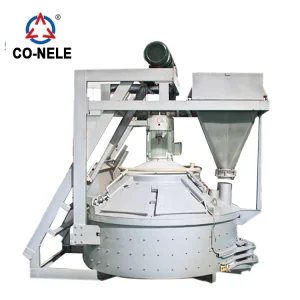
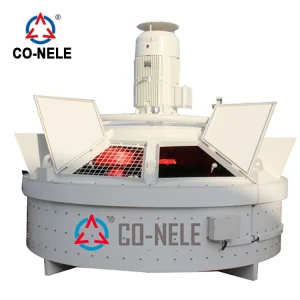
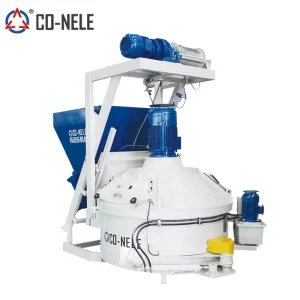
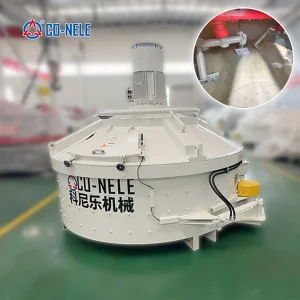
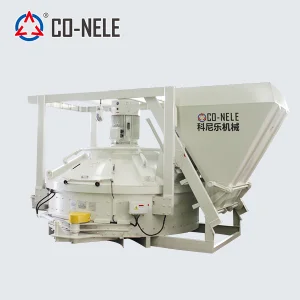
The fundamental difference between standard mixing equipment and a high-performance planetary mixer lies in the trajectory of the mixing arms. In a CO-NELE planetary mixer, the mixing stars rotate on a central vertical axis while simultaneously orbiting around the pan center. This counter-current forced mixing mechanism accelerates material velocity gradients, breaks down binder agglomerates, and ensures that additives, micro-silica, and color pigments are completely dispersed in under 45 seconds of dry mixing.
Engineered applications across precast concrete, ultra-high-performance concrete (UHPC), refractory manufacturing, and specialized industrial granulation lines.
For high-end architectural panels, precast structural beams, hollow-core slabs, and pipe production, consistency of color and slump control are paramount. Planetary batching plants deliver batch-to-batch repeatability that eliminates color variation and surface void defects (bug holes).
Ultra-High-Performance Concrete requires high shear energy to shear water-reducing superplasticizers and disperse micro-steelfibers cleanly. Specialized CMP series mixers handle ultra-low water-cement ratios (w/c < 0.18) without thermal buildup or fiber balling.
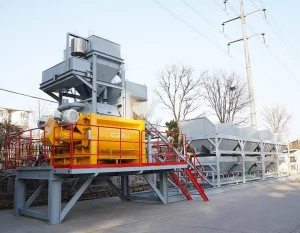
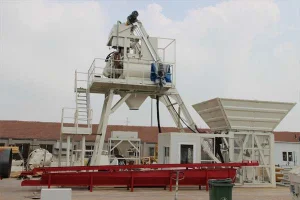
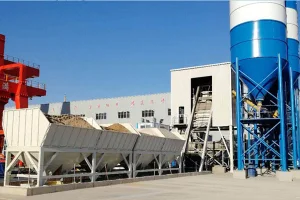
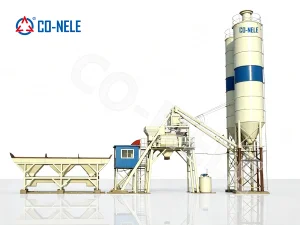
Designed for fast-track infrastructure, remote bridge repairs, and highway expansions. Compact, relocatable batching units (25 m³/h to 90 m³/h) require no deep concrete pits or permanent foundations, enabling operational readiness within days of arrival.
Refractory linings for steel ladles, cement kilns, and glass furnaces demand extreme density and zero moisture segregation. Intensive mixers and planetary units equipped with extra-thick armor lining handle high-density tabular alumina and silicon carbide mixes effortlessy.
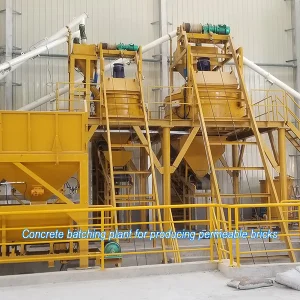
Urban sponge city initiatives require precise semi-dry concrete formulations to form water-permeable interlocking bricks. High-efficiency planetary concrete mixers ensure perfect coating of aggregate particles with cement paste at low moisture levels.
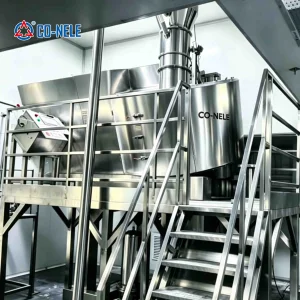
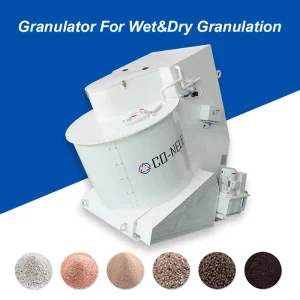
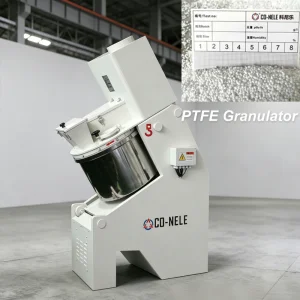
Beyond traditional concrete, intensive mixer granulators apply inclined rotating pan technology to convert fine powders (ceramics, battery materials, fertilizers, PTFE) into highly spherical granules with uniform bulk density (sphericity > 90%).
Emerging developments in smart batching automation, carbon-neutral concrete formulations, and real-time rheological sensor analytics.
Future batching plants are evolving from static batch recipes to closed-loop dynamic adjustments. By utilizing high-frequency microwave moisture probes (such as Hydronix integration) in combination with drive motor torque telemetry, the PLC algorithms predict slurry slump and rheology in real time, automatically auto-correcting water and additive dosing within milliseconds.
As the construction industry transitions toward low-clinker binders, alkali-activated slag concrete, and direct CO2 mineral sequestration during batching, mixing mechanics must adapt. Carbon-injected concrete requires intense initial shear to lock dissolved CO2 gas into calcium carbonate micro-crystals. Planetary counter-current mixers provide the necessary kinetic energy density to maximize carbon capture efficiency without delaying setting times.
By embedding vibration sensors into the planetary reducer housing and ultrasonic thickness gauges beneath high-chrome wear liners, plant operators receive early warnings regarding bearing wear or liner erosion before structural failure occurs. This predictive strategy aligns fully with European Industry 4.0 factory management standards.
Understanding the structural advantages of Qingdao's industrial machinery cluster: raw material integration, robotics, and port logistics.
China’s transformation into an advanced industrial machinery hub is anchored in vertical supply chain integration. Located in Qingdao, Shandong Province—one of Asia's primary engineering and port logistics hubs—CO-NELE operates three specialized production facilities spanning 30,000 square meters. Unlike assemblers who source key components from third-party vendors, total in-house manufacturing ensures end-to-end quality control:
Every planetary gear housing, sun gear, and internal ring gear is machined, heat-treated, and ground in-house, eliminating component lead-time bottlenecks and guaranteeing part tolerance precision within micrometers.
Automated robotic welding cells construct mixer frames and batching plant bins with flawless seam integrity, preventing stress concentrations and guaranteeing compliance with EN 1090 structural steel codes.
Direct proximity to Qingdao Deepwater Port simplifies containerization and heavy-lift flat-rack loading, allowing fast ocean transit times to major ports in Europe, the Middle East, North America, and Southeast Asia.
Ensuring compliance with DIN EN 206, CE regulations, electrical standards, and optimizing 10-year equipment lifecycle economics.
To operate seamlessly across European, Middle Eastern, and American regulatory environments, CO-NELE equipment is designed from the ground up to meet stringent global certification mandates:
| Cost Component | Legacy/Conventional Batching Line | CO-NELE German-Hybrid Planetary Line | 10-Year Value Impact |
|---|---|---|---|
| Initial Capital Expenditure (CAPEX) | High European premium or low-grade budget machine. | Optimized CAPEX via Chinese lean manufacturing. | 30% - 45% CAPEX Savings at equivalent engineering spec. |
| Energy Consumption per m³ | Higher due to longer cycle times & inefficiency. | Reduced mix cycles (45s) via planetary shear. | 15% - 18% Electricity Cost Reduction over lifecycle. |
| Cement Binder Optimization | Inconsistent mix requires +5% cement buffer. | Homogeneous dispersion reduces cement consumption. | Direct Cement Savings: $2.50 - $4.00 per m³ produced. |
| Maintenance & Wear Parts OPEX | Frequent liner replacement & gearbox oil leaks. | Bolt-on high-chrome plates (100k+ batch life). | 50% Reduced Maintenance Downtime & lower spare costs. |
In-depth responses to critical engineering questions asked by project buyers, plant managers, and structural engineers.
Explore compact batching plants, intensive granulators, and planetary mixers for ready-mix and permeable brick production lines.