CO-NELEMixing & Granulation
Explore China's industry-leading vertical-shaft planetary mixers, intensive granulators, and batching equipment engineered for optimal homogeneity.
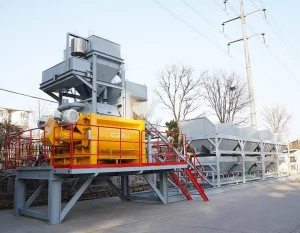
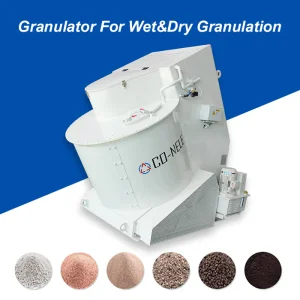
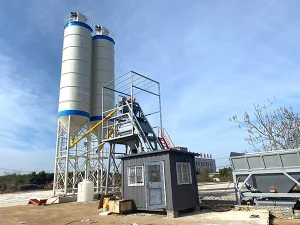
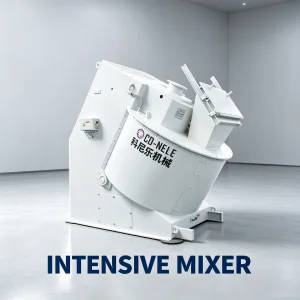
Understanding the transition from horizontal twin-shaft mixers to advanced vertical counter-current planetary technologies in global infrastructure and material processing.
Analyzing China's vertical concrete mixer price structure reveals an average initial CAPEX reduction of 35% to 50% compared to European equivalents, without compromising gear-transmission precision or metallurgical durability. Modern manufacturing hubs in Qingdao leverage integrated supply chains to optimize steel fabrication, CNC precision machining, and component sourcing.
Vertical planetary mixers utilize counter-current mixing mechanics that channel 92% of input mechanical energy directly into shear forces and material turnover. By minimizing dead zones, batch mixing cycles are reduced by 15-25 seconds per cycle, yielding substantial electrical energy savings across large-scale precast concrete batching plants.
Equipped with high-chrome alloy liners (HB600+) and hard-faced mixing paddles, modern vertical mixers resist abrasive wear from aggregate matrices, quartz sands, and refractory aggregates. Extended liner longevity directly reduces maintenance downtime and spare parts replacement overhead over a 10-year machine operational lifecycle.
Technical Insight: Selecting a vertical concrete mixer based solely on initial quote price often overlooks Total Cost of Ownership (TCO). High-efficiency planetary gearing reduces motor kilowatt consumption per cubic meter by up to 18% compared to traditional non-planetary pan mixers.
Mathematical and fluid-dynamic comparison of mixing trajectories, shear rate distribution, and micro-homogeneity coefficient of variation (CV).
| Mechanical Parameter | Vertical Shaft Planetary Mixer (CMP Series) | Horizontal Twin-Shaft Mixer (CHS Series) | Standard Non-Planetary Pan Mixer |
|---|---|---|---|
| Mixing Trajectory | Complex counter-current planetary (Self-orbiting + Revolution) | Dual counter-rotating intersecting ellipses | Fixed single-axis concentric circular paths |
| Micro-Homogeneity (CV) | < 3.0% (Ultra-high uniformity within 45s) | < 5.0% (Standard commercial grade) | < 8.5% (High risk of segregation) |
| Silica Fume & Fiber Dispersion | Optimal (High shear blades break micro-agglomerates) | Moderate (Prone to fiber clumping without prep) | Poor (Requires extended mixing times) |
| Discharge Efficiency | 99.4% clean discharge via bottom rotating door sweep | 96.5% (Residual buildup along shaft ends) | 94.0% (Substantial manual cleaning needed) |
| Target Applications | UHPC, GFRC, Precast Elements, Refractories, Glass, Granulation | Commercial Ready-Mix, Mass Civil Dam Concrete | Basic Masonry Mortars, Low-Grade Paving Blocks |
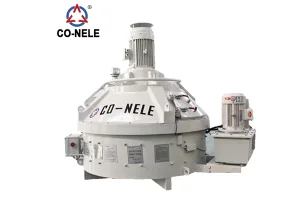
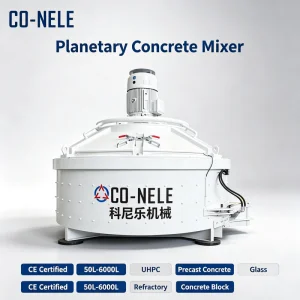
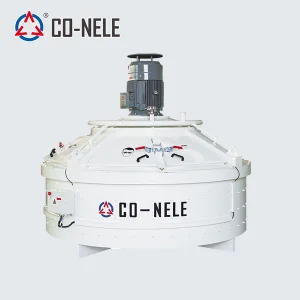
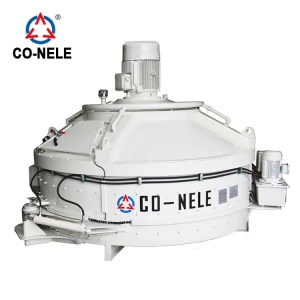
In a vertical planetary concrete mixer, mixing arms rotate on their own axis while simultaneously revolving around the central axis of the mixing pan. This dual-kinematic motion ensures that no point inside the mixing pan remains untouched for more than 0.5 seconds. The mixing blades intersect paths deterministically, imparting both compressive forces and high shear vectors into the concrete slurry.
This motion prevents heavy aggregate sinking and light additive floating, solving the classic buoyancy segregation challenge seen in low-viscosity or self-compacting mixes.
UHPC recipes contain fine powders such as silica fume, quartz flour, and micro-steels with particle sizes below 10 microns. Standard mixing blades create low velocity gradients, allowing fine powders to agglomerate into unhydrated clusters.
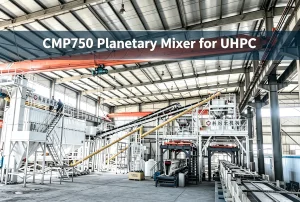
The intense shear zones generated by planetary vertical mixer arms overcome inter-particle van der Waals forces, completely coating micro-silica particles with water and superplasticizers to achieve compressive strengths exceeding 150 MPa.
Comprehensive cost breakdown transparently detailing how engineering specifications, material grades, and customization options influence machine pricing.
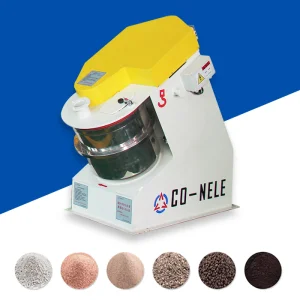
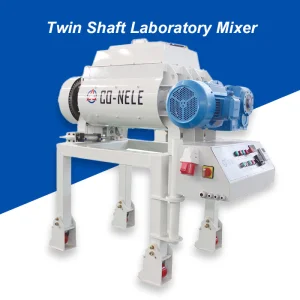
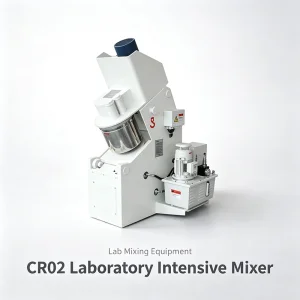
Capacities from 50L to 250L. Ideal for R&D laboratories, test batching, and specialized chemical or diamond powder mixing applications.
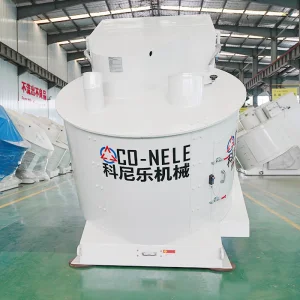
Capacities from 500L to 1000L output. Standard industrial workhorse for block machines, kerb manufacturing, and medium precast yards.
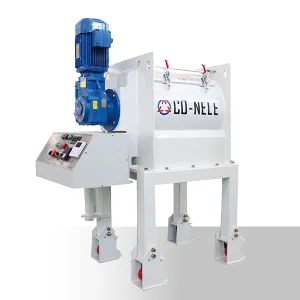
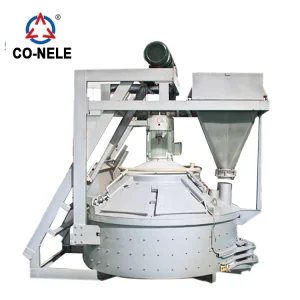
Capacities from 1500L to 3000L. Built for large-scale UHPC bridge girder production, pipe factories, and steel mill refractory lines.
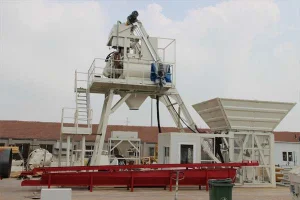
Fully integrated mixing and batching systems featuring moisture sensors, flying bucket delivery, pneumatic dosing, and SCADA PLC controls.
Engineered flexibility serving diverse industrial sectors from structural concrete to high-tech ceramic granulations.
Produces uniform color distribution and flawless surface textures for pavers, wall panels, hollow-core slabs, and architectural facing concrete. Eliminates color streaking and cement balling across batch cycles.
Handles zero-slump, dry-cast, and high-density refractory castables containing corundum, silicon carbide, and dense aggregates. Resists high abrasiveness while ensuring thorough binder activation.
Equipped with dust-tight seal housings and chemical-resistant stainless linings. Prepares homogeneous raw batch formulations for container glass, fiber glass, ceramic tiles, and advanced battery powders.
Built strictly according to global industrial standards with localized operational support across 80+ countries.
All vertical mixers manufactured in China undergo rigorous load testing, noise level audits (< 80 dB), and gearbox temperature monitoring prior to container packing. Dedicated export compliance includes CE electrical conformity (380V-480V, 50/60Hz adaptabilities), OSHA-compliant safety interlocks, and ISO 9001 quality management assurance.
The evolution of smart mixing systems integrated with IoT diagnostics, green manufacturing, and adaptive batching algorithms.
Integrated accelerometer sensors and thermal probes within the planetary gearbox stream real-time operational metrics to cloud platforms. Operators receive automated alerts before gear pitting or liner breakdown occurs.
Real-time electric motor torque profiling continuously measures batch viscosity changes during water and admixture dosing. The PLC automatically adjusts mixing speed via variable frequency drives (VFD) to minimize power draw.
Optimized blade kinematics allow mixing of low-carbon geopolymers, calcined clays, and high-volume fly ash/slag cement replacements that typically resist hydration wetting in standard mixers.
Authoritative technical answers to common buyer and engineering procurement inquiries.
Discover our full catalog of lab mixers, granulators, twin-shaft units, and portable concrete plants engineered for performance.