CO-NELEMixing & Granulation
Explore our top-tier planetary mixers, laboratory test rigs, and specialty refractory units engineered for zero-defect industrial manufacturing.
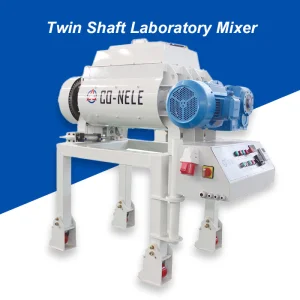
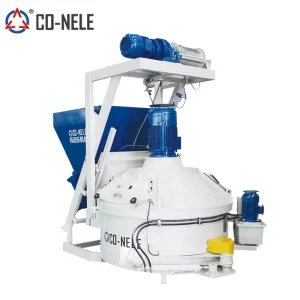
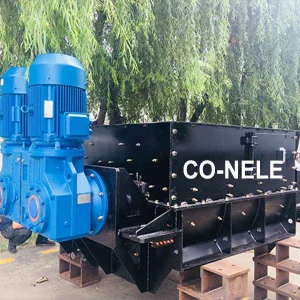
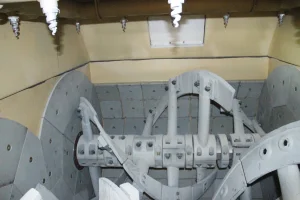
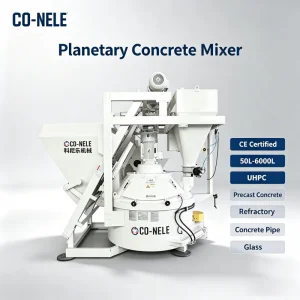
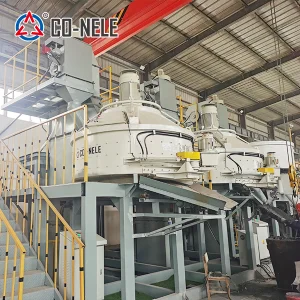
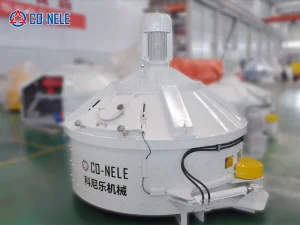
In modern industrial concrete manufacturing, civil engineering, and specialized refractory processing, achieving complete macro and micro-homogeneity within minimal cycle times is a key factor governing structural integrity and product profitability. The MP750 Planetary Concrete Mixer (with a nominal dry filling capacity of 750 liters and a compacted concrete output of 500 liters per batch) represents the pinnacle of vertical-shaft forced mixing technology engineered in China.
Unlike conventional twin-shaft or gravity drum mixers that depend primarily on linear shear vectors, the MP750 utilizes a counter-current planetary drive system. As the central drive motor powers the vertical shaft gearbox, the mixing arms rotate around a fixed center point while simultaneously revolving rapidly around their own axes. This complex planetary trajectory forces the aggregate, binder, silica fume, chemical admixtures, and water into multi-directional high-energy collision zones, eliminating dead angles along the pan wall and floor.
The operational reliability of an MP750 planetary concrete mixer relies on its mechanical power transmission and structural components designed to withstand severe torsional strain, abrasive aggregate impact, and continuous multi-shift usage:
| Technical Parameter | MP750 Planetary Mixer Spec | Standard Twin-Shaft 750 Spec | Industrial Advantage |
|---|---|---|---|
| Dry Input Capacity | 750 Liters | 750 Liters | Equivalent volumetric batch sizing |
| Compacted Concrete Output | 500 Liters (0.5 m³) | 500 Liters (0.5 m³) | Optimized for high-value precast & UHPC |
| Mixing Star / Arm Rotation Speed | 28 / 52 RPM (Counter-Current) | 22 RPM (Parallel Shaft) | 3x higher internal energy dispersion |
| Homogeneity Coefficient (CV) | < 3% to 5% | 7% to 12% | Eliminates micro-cracks and pigment streaks |
| Discharge Time (Zero Slump) | 12 - 18 Seconds | 25 - 35 Seconds | Rapid cycle completion without segregation |
| Wear Part Service Life | 80,000 - 150,000 Batches | 40,000 - 80,000 Batches | Substantially lower maintenance cost/m³ |
The international building materials industry is undergoing a structural shift toward decarbonization, material efficiency, and high-performance cementitious composites. These global macro-trends make vertical planetary mixing equipment an operational necessity rather than a luxury.
Global civil projects, bridge deck overlays, offshore wind turbine foundations, and architectural rainscreen panels increasingly specify Ultra-High Performance Concrete (UHPC). Producing mixes with compressive strengths over 150 MPa requires intense shear forces to de-agglomerate micro-silica and evenly distribute steel/synthetic fibres without clustering—a task impossible for traditional twin-shaft mixers.
Industrialized building systems (IBS) and prefabricated modular construction demand zero-defect dimensional stability and consistent surface aesthetics. Color-pigmented concrete, hollow-core slabs, concrete paving stones, and utility manholes demand precise batch-to-batch color and strength uniformity, driving precast plants toward MP750 planetary equipment.
As carbon taxation and net-zero commitments force cement producers to reduce clinker factors, concrete batching facilities are introducing high percentages of fly ash, ground granulated blast-furnace slag (GGBS), calcined clay, and carbon-capture minerals. Planetary mixers handle these variable particle size distributions without clumping.
Purchasing directors, plant operations executives, and EPC contractors evaluating MP750 planetary concrete mixers look beyond upfront equipment costs. Evaluating long-term Total Cost of Ownership (TCO), supply chain reliability, and engineering customization forms the foundation of modern enterprise procurement decisions.
Operational costs over an 8-to-10-year machine lifespan far outweigh initial capital expenditures. Modern Chinese OEM manufacturers design MP750 units with energy-optimized motor-gearbox pairings that yield a 15% to 22% reduction in kilowatt-hours per cubic meter of mixed material. Combined with bolt-on wear liners that extend replacement intervals from 6 months to over 18 months under heavy abrasive conditions, total operational overhead is reduced substantially.
No two mixing operations are identical. Leading OEM factories in Qingdao provide flexible engineering modifications, including:
Qingdao, China, has established itself as the world's leading industrial manufacturing hub for high-end planetary mixing equipment and concrete machinery. Here is how Chinese OEM engineering delivers competitive advantages to global buyers.
Rather than relying on outsourced components, tier-one factories utilize multi-axis gantry CNC milling centers, gear hobbing machines, and robotic welding lines under one roof. Shaft alignment tolerances are maintained within 0.01mm, ensuring gear mesh precision and long bearing life.
Every MP750 mixer undergoes 24-hour no-load thermal testing, hydraulic pressure surge checks, dynamic balance validation, and full torque simulation before export packaging, guaranteeing plug-and-play installation overseas.
By controlling the complete supply chain from raw foundry casting to PLC programming, Chinese manufacturers maintain rapid lead times (2-4 weeks) and guarantee 100% interchangeable wear parts for decades, eliminating operational risk for international customers.
The versatility of the MP750 planetary counter-current mixer allows it to serve as the core mixing engine in diverse industrial production environments worldwide:
Scenario: Production of precast kerbstones, interlocking paving blocks, drainage channels, cable troughs, and architectural façade panels in Europe, North America, and the Middle East.
Performance Impact: Counter-current mixing prevents color separation and guarantees streak-free distribution of oxide pigments. The zero-slump discharge speed improves batching productivity by up to 25% per shift.
Scenario: Steel mills, foundry furnace linings, cement kiln refractories, and glass plant castables requiring alumina, silicon carbide, and graphite powder mixtures.
Performance Impact: Handles ultra-heavy dry density mixes without stalling. High-chrome alloy liners resist aggressive abrasive wear from corundum and refractory aggregates.
Scenario: Container glass, float glass, and technical fiber-glass batch mixing facilities.
Performance Impact: Sealed dust-proof cover designs with negative pressure connection ports prevent silica dust leakage, ensuring worker safety and maintaining strict ingredient purity ratios.
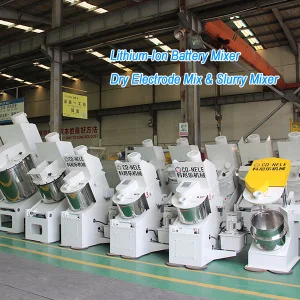
Scenario: Lithium-ion battery dry electrode mixing, cathode active material blending, and specialized metal alloy powder processing.
Performance Impact: Specialized stainless steel (316L/Duplex) pan linings and gas-purged shaft seals deliver zero-contamination mixing required for energy storage media.
Clear, authoritative engineering answers to common technical queries raised by global machinery buyers, plant managers, and structural engineers.
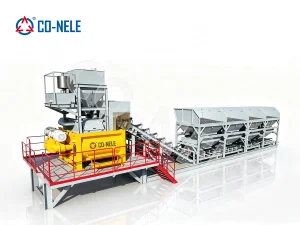
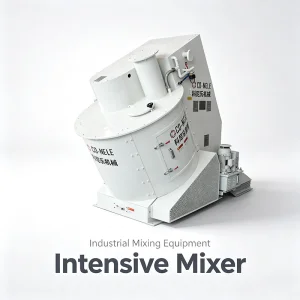
Discover our comprehensive lineup of foundationless batch plants, UHPC mixers, intense granulators, and high-capacity twin-shaft concrete machinery.