
CO-NELEMixing & Granulation
Direct factory engineering solutions optimized for Ultra-High Performance Concrete, ceramics, refractories, and advanced industrial batching.
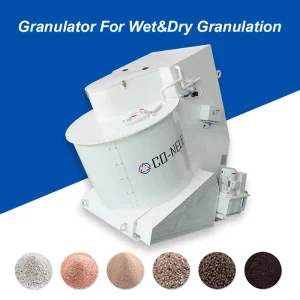
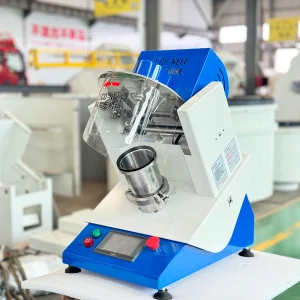
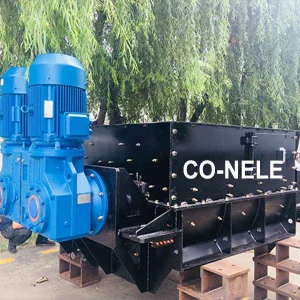
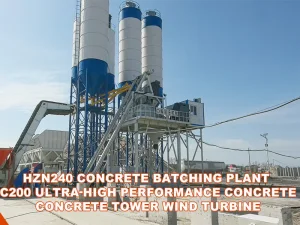
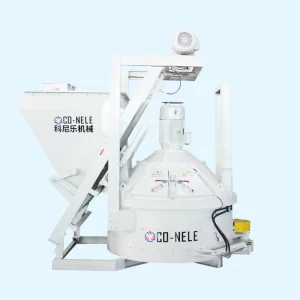
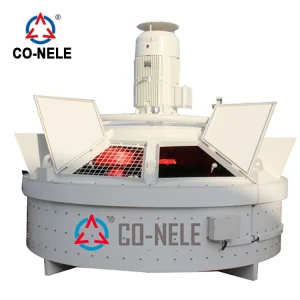
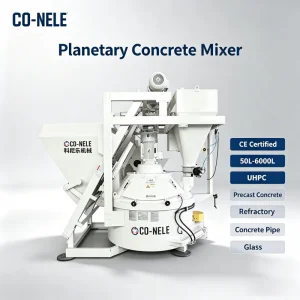
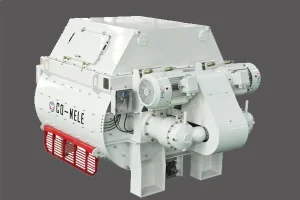
In the contemporary landscape of global civil engineering, precast concrete manufacturing, and advanced material synthesis, the operational efficiency of concrete production lines hinges upon forced-action mixing technology. Modern structural requirements—ranging from high-rise core walls and mega-span bridges to offshore wind turbine tower bases—demand concrete formulations with exceptionally low water-to-cement (W/C) ratios, dense particle packing, and seamless steel fiber dispersion. Consequently, traditional gravity-drop mixers and standard twin-shaft horizontal configurations are increasingly proving inadequate for specialized applications where micro-homogeneity is imperative.
Global procurement teams navigating the OEM market in China face a strategic imperative: evaluating suppliers not merely on initial Capital Expenditure (CAPEX), but on life-cycle Operational Expenditure (OPEX), kinematic performance metrics, and technological longevity. Selecting a premier China vertical concrete mixer manufacturer requires a systematic understanding of forced-action mixing dynamics, power transfer efficiencies, wear-part metallurgy, and automated batching integration.
Key Procurement Insight: The true cost of a vertical mixer system over a 10-year operational life cycle is dominated by energy consumption (35%) and maintenance downtime (28%), far outweighing initial purchase costs (22%). Sourcing from a tier-1 Chinese manufacturer with integrated gearbox production yields an estimated 38% TCO reduction compared to traditional European OEMs without compromising mix quality.
| Evaluation Parameter | Standard Horizontal Twin-Shaft | China Vertical Countercurrent Planetary | High-Intensive Inclined Rotor Mixer |
|---|---|---|---|
| Primary Mixing Kinematics | Overlapping fluid shear across dual horizontal axes | Counter-current planetary star rotation + pan rotation | High-speed rotor combined with rotating eccentric bowl |
| Homogeneity CV (Coefficient of Variation) | 5.0% – 8.0% (Standard Ready-Mix) | < 3.0% (Micro-Homogeneous) | < 1.5% (Ultra-Dense Powders / Granulation) |
| Suitable Recipe Applications | Wet ready-mix, mass dam concrete, aggregate >40mm | UHPC, Precast Blocks, GFRC, Refractories, Color Concrete | Ceramic powders, battery materials, diamond tools, iron powder |
| Discharge Velocity & Cleanout Rate | Moderate; potential bottom door residue | Rapid; complete floor sweep via scraping blades | Ultra-fast bottom discharge with automatic wash down |
| 10-Year Wear Parts Replacement Cost | Baseline (100%) | 72% (Segmented bolt-on high-chrome plates) | 85% (Specialized hard-faced rotor tools) |
Understanding why vertical shaft planetary mixers outperform traditional mixing equipment in complex concrete recipes.
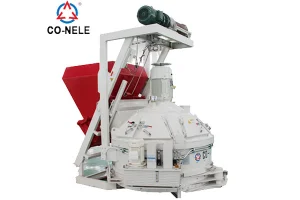
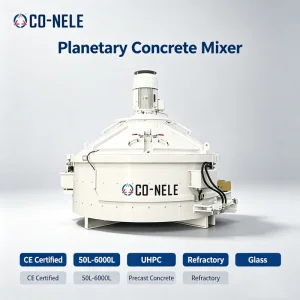
The mixing blades rotate on vertical axes while simultaneously orbiting around the central shaft of the mixing pan. This dual-motion trajectory creates a complex counter-current path, covering 100% of the pan floor every 4 revolutions, eliminating dead zones entirely.
Unlike factories that source generic commercial gearboxes, leading Chinese manufacturers engineer proprietary heavy-duty planetary reducers. Designed to absorb severe torsional shock loads, these gearboxes split mechanical power smoothly across multiple planet gears.
The internal mixing pan floor and sidewalls are protected by high-chromium alloy liners (hardness ≥60 HRC) and Ni-Hard cast steel mixing arms. Bolt-on modular designs allow targeted replacement of high-wear zones without stripping the main rotor framework.
The mixing efficiency of a vertical planetary mixer is governed by its velocity gradient and shear field profile. During batch operation, the mixing arms impart both radial and axial forces upon the aggregate-binder matrix. The mathematical interaction can be expressed through the kinematic relationship of the mixing star offset ratio and rotational speed differential:
V_relative = ω_main × R_orbit + ω_star × r_blade ± v_fluid
Where high differential velocity (V_relative) ensures complete breakdown of micro-silica agglomerates and instantaneous dispersion of fine pigments and synthetic/steel reinforcement fibers.
From infrastructure precast components to high-temperature refractory linings, vertical concrete mixers fulfill rigorous process criteria.
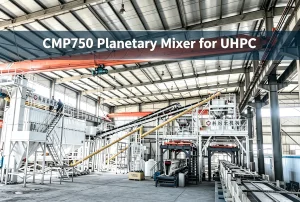
UHPC requires compressive strengths exceeding 150 MPa and zero micro-cracking permeability. Standard mixers suffer from heat buildup and incomplete fiber distribution. China vertical mixers feature water-cooled jackets, high-torque variable frequency drives (VFD), and custom fiber-feeder integrations, enabling rapid hydration without thermal degradation.
For dry-cast concrete blocks, kerbstones, prestressed railway sleepers, and core vibration concrete pipes (such as 60m³/h plants utilized across Southeast Asia), consistent color hue and surface density are paramount. Planetary countercurrent kinematics prevent pigment streaking and deliver batch-to-batch consistency within a 1.5% variance envelope.
Refractory mortars and castables contain dense corundum, silicon carbide, and ultra-fine binder powders with low moisture levels. Vertical intensive mixers utilize high-shear fly-cutters (CMPS series) to fluidize dense ceramic mixtures rapidly, reducing total batch cycle times from 8 minutes down to 90 seconds.
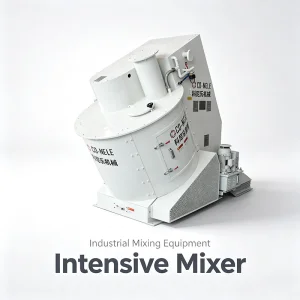
Transitioning from wet mixing to granulation, specialized intensive mixers operate with an inclined pan and high-speed rotor. This configuration converts fine alumina powder, zirconia, and iron oxide into spherical granules (0.5mm – 6mm) with 90%+ sphericity, eliminating expensive spray-drying processes.
Pioneering intelligent mixing control systems, decarbonized material handling, and next-generation wear-resistant alloys.
Integration of real-time microwave probes embedded directly within the rotating pan floor. AI algorithms continuously measure moisture, dynamic viscosity, and concrete slump during the mixing cycle, automatically adjusting micro-water dosing within ±0.1 liter accuracy.
As global concrete manufacturing transitions to supplementary cementitious materials (LC3 limestone calcined clays, alkali-activated slag, geopolymers), vertical mixers are engineered with optimized shear blade attack angles to fluidize high-viscosity binder pastes efficiently under low carbon regimes.
Deployment of IoT vibration sensors and oil-quality spectro-analyzers on planetary reducers. Cloud-based predictive maintenance alerts plant managers to gear fatigue or bearing micro-pitting long before operational failure occurs, achieving zero unplanned plant stoppage.
Ensuring seamless international deployment through rigid engineering compliance, certifications, and global spare part dispatch hubs.
Control cabinets are customized to client electrical grids (220V/380V/415V/440V/480V at 50Hz or 60Hz). Integrated with Siemens S7-1500 PLC systems, Schneider electrics, and optional UL/CSA certifications for North American and European regulatory markets.
Every vertical mixer and complete batching plant undergoes strict non-destructive weld inspection (UT/MT testing), carrying full CE directives compliance (Machinery Directive 2006/42/EC) and ISO 9001:2015 quality control validation.
Standardized, inter-changeable wear liner plates, mixing shovels, seal rings, and discharge gate hydraulics are maintained in regional stocking warehouses, guaranteeing fast global dispatch via air or sea logistics within 48 hours.
Addressing the technical, operational, and commercial inquiries of industrial buyers and plant engineers.
A standard pan mixer utilizes fixed blades rotating on a single central vertical axis, which creates distinct velocity zones where materials near the outer rim move faster than those near the center. In contrast, a Vertical Planetary Countercurrent Mixer employs mixing arms that rotate around their own individual axes while orbiting the main center shaft. This dynamic motion ensures complete cross-shear fluidization, eliminates dead zones, and achieves homogenization up to 4x faster than basic pan mixers.
Leading Chinese OEMs utilize custom-designed cast steel housing with internal planetary gear sets subjected to deep carburizing and precision gear grinding (ISO Grade 5 accuracy). The gearboxes incorporate forced-oil circulation filtration systems and thermal monitoring sensors, rated for a minimum service life factor of L10h > 100,000 continuous operating hours under rated peak load.
For standard ready-mix, a planetary mixer completes a cycle in 45–60 seconds. For UHPC formulations containing silica fume, quartz flour, superplasticizers, and steel fibers, the cycle typical runs between 2.5 to 4 minutes. The intense forced kinetic energy rapidly breaks down powder agglomeration and disperses steel fibers without balling or segregation.
Yes. Vertical concrete mixers feature compact footprints and symmetrical mounting geometry, making them ideal retrofitting candidates for replacing outdated pan mixers or underperforming twin-shaft units inside existing batching towers. Engineers provide custom mounting adapters, chute extensions, and interface protocols for existing PLC control systems.
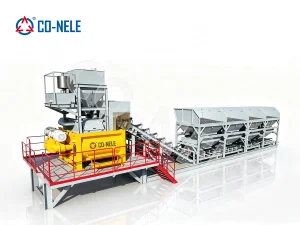
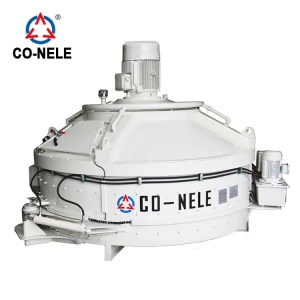
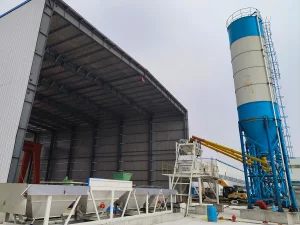
Explore our complete machinery portfolio engineered for precast plants, foundationless batching, and high-intensity industrial granulating.
Submit your raw material particle curves, target m³/h output, and application specifications. Our senior process engineers will prepare a technical proposal, CAD floor layout, and factory-direct quotation within 24 hours.