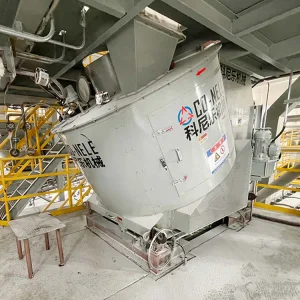
CO-NELEMixing & Granulation
Engineered for extreme durability, operational consistency, and low total cost of ownership across diverse global applications.
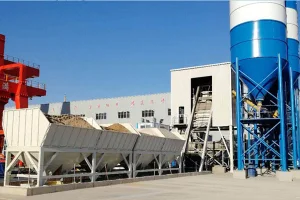
Analyzing the global paradigm shift toward ultra-precise, continuous, and heavy-duty stationary concrete batching plants in mega-scale construction projects.
In the contemporary global construction landscape, the demand for high-grade structural concrete has undergone a fundamental transformation. Driven by large-scale civil infrastructure initiatives—such as high-speed rail networks, deep-sea port terminals, nuclear power containment structures, and ultra-tall commercial towers—the focus of batching plant engineering has shifted from basic volumetric output to micro-homogeneity, chemical consistency, and strict environmental compliance.
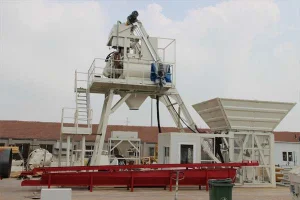
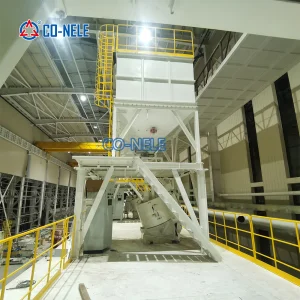
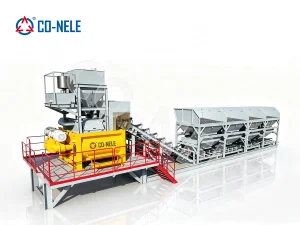
Stationary concrete batching plants serve as the operational backbone for central ready-mixed concrete (RMC) enterprises and large-scale precast concrete factories. Unlike temporary mobile plants designed for quick deployment on short-term road repair projects, stationary plants are high-capacity industrial installations designed for long operational lifecycles (typically 15 to 25+ years). They feature heavy-duty structural steel framing, fully enclosed aggregate storage bins, automated pneumatic batching systems, multi-stage dust collection systems, and high-efficiency compulsory mixers (such as twin-shaft compulsory mixers and vertical-shaft planetary mixers).
Urbanization across Southeast Asia, the Middle East, and Latin America requires continuous concrete supply exceeding 150 m³/h per site. Stationary plants deliver the volumetric stability required for continuous pours in foundation rafts and high-density slipform construction.
Modern engineering contracts mandate Ultra-High-Performance Concrete (UHPC) and Self-Consolidating Concrete (SCC). Achieving dispersion of micro-silica and steel fibers requires high-shear forced mixing only attainable in stationary plant setups.
Environmental standards (ISO 14001, LEED, BREEAM) enforce zero-dust emissions, total aggregate water recovery, and reduced cement clinker usage via fly ash and slag substitution. China stationary plant engineering natively integrates these systems.
Discover how dynamic mixing physics, microwave moisture monitoring, and closed-loop PLC dosing redefine batching precision.
The core engine of any stationary concrete batching plant is its mixer. Historically, gravity-based drum mixers and simple single-shaft tilt mixers dominated the commercial ready-mix market. However, modern concrete formulations incorporate lower water-cement ratios (W/C < 0.30), high-viscosity mineral admixtures (fly ash, ground granulated blast-furnace slag, silica fume), and synthetic or steel micro-fibers. These ingredients render gravity mixing obsolete, requiring compulsory forced-action mixing.
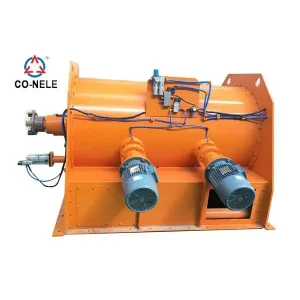
Utilizing counter-rotating twin horizontal shafts fitted with high-chromium mixing arms arranged at specific pitch angles. The overlapping turbulence zone subjects aggregate particles to severe mechanical shear, producing homogeneous wet concrete within 30 to 45 seconds of charge.
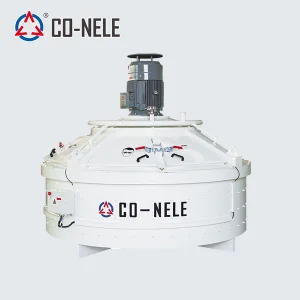
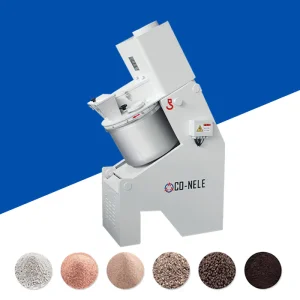
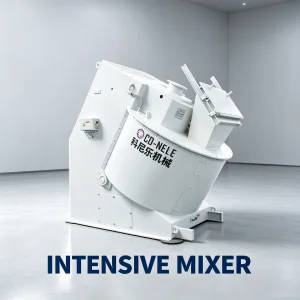
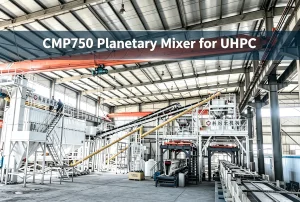
Designed for precast, dry-cast, and UHPC manufacturing. Planetary mixing arms rotate on their own axes while simultaneously revolving around the central axis of the mixing pan. This eliminates dead zones and guarantees uniform pigment and fiber dispersion across dry or stiff mixes.
| Performance Indicator | Twin-Shaft Stationary Plant | Planetary Counter-Current Plant | Legacy Drum Mixer Setup |
|---|---|---|---|
| Primary Application | Commercial Ready-Mix (RMC) & Mega Infrastructure | Precast Concrete, Pavers, Pipe, UHPC & Fiber Concrete | Low-grade structural fills & rural road paving |
| Typical Cycle Time | 30 – 45 Seconds | 60 – 90 Seconds | 120 – 180 Seconds |
| Mixing Homogeneity (CV) | < 5% Coefficient of Variation | < 3% Micro-Homogeneity | > 12% High dispersion variance |
| Slump Range Capability | Slump 50 mm – 240 mm (Flowable to Fluid) | Zero-slump (Dry-cast) up to fluid UHPC | High-slump wet concrete only (> 100 mm) |
| Dosing Precision Control | PLC Closed-loop (±1% Cement, ±2% Aggregate) | PLC Closed-loop (±0.5% Additives & Water) | Manual / Volumetric timer (±5% error) |
Evaluating Capital Expenditure (CapEx) against Operational Expenditure (OpEx) for commercial batching operations.
When procurement managers, plant operations directors, and EPC executives evaluate stationary concrete batching equipment from China, looking beyond initial machine price (CapEx) is critical. Total Cost of Ownership (TCO) across a 10-to-15-year lifecycle is governed by four primary parameters: power consumption per cubic meter, wear part replacement cycles, dosing accuracy savings, and plant uptime maintenance index.
Cement accounts for over 60% of concrete raw material costs. Modern China stationary plants utilize high-precision S-type load cells with multi-stage pneumatic butterfly valves. Preventing a 1.5% over-dosing error on cement saves over $45,000 annually on a standard HZS120 plant operating at 150,000 m³/year.
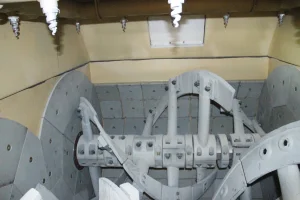
Mixer liner plates and mixing blades are continuously exposed to aggregate abrasion. Chinese leaders manufacture liners using Ni-Hard and high-chromium alloy casting (Cr > 20%, hardness > 60 HRC). Service lives exceeding 100,000 batches reduce maintenance downtime and part replacement costs.
Optimized drive kinematics, direct-coupled planetary reducers, and frequency-controlled belt conveyors minimize electrical losses. High-efficiency stationary plant designs achieve energy usage under 1.2 kWh per cubic meter of mixed concrete during continuous batching cycles.
How Chinese heavy machinery factories leverage robotics, vertical supply integration, and strict ISO/CE compliance to deliver world-class machinery.
The manufacturing capabilities of leading Chinese concrete machinery factories have advanced significantly. Facilities in industrial hubs such as Qingdao, Shandong Province, combine robotics with digital factory management. From automated fiber-laser cutting of heavy structural steel to robot-welded mixer frames and dedicated gear-testing benches, Chinese manufacturers enforce quality standards rivaling European suppliers at a more competitive cost structure.
Top Chinese factories design and manufacture proprietary planetary reducers specifically for high-torque mixer startup under full batch load. In-house gear cutting, heat treatment, and oil-leak pressure testing ensure long drive unit life.
Every structural component of a stationary plant—aggregate bins, belt conveyor trusses, mixer platform modules, and cement scale hoppers—is designed for standard 40ft Open-Top and High-Cube shipping containers. This minimizes ocean freight fees and protects structures from corrosion during transit.
Tailored stationary batching plant configurations designed for challenging operational environments.
Equipped with dual 3 m³ or 4.5 m³ twin-shaft mixers, inclined belt aggregate feeding, dual cement scales, and fully automated Siemens PLC controls. Designed for 24/7 continuous operation supplying multi-site transit mixer fleets in metropolitan areas.
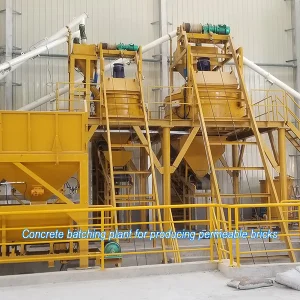
Built around a vertical planetary counter-current mixer. Integrated with flying bucket concrete distribution systems, color pigment dosing units, and dynamic moisture sensors to deliver consistent zero-slump concrete for pavers, precast wall panels, and utility pipes.
Configured with heavy-duty aggregate batching bins capable of handling large aggregate sizes (up to 120 mm). Features aggregate chilling/heating systems for mass concrete pours to manage hydration heat and prevent thermal cracking.
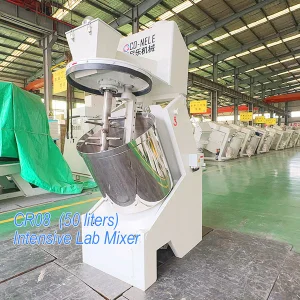
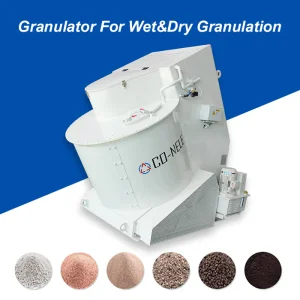
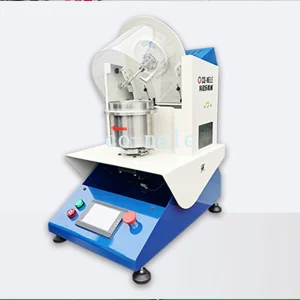
Explore our full line of industrial mixing systems, laboratory testing mixers, granulators, and specialized plant accessories.
Expert answers from our engineering team addressing common technical, installation, and procurement questions.
Stationary concrete batching plants are engineered for long-term installation, higher nominal output capacities (ranging from 60 m³/h to over 240 m³/h), superior structural rigidity, and comprehensive environmental enclosures. They allow for larger aggregate bin storage, multi-silo configurations for cement and pozzolans, integrated aggregate washing/chilling systems, and more complex forced-action mixing setups (such as planetary counter-current or large-volume twin-shaft mixers). Mobile plants are optimized for rapid deployment and short projects, whereas stationary plants deliver lower operational costs per cubic meter over multi-year commercial production runs.
A twin-shaft mixer uses two horizontal counter-rotating shafts equipped with mixing paddles. It creates high axial and radial turbulence, making it ideal for high-volume commercial ready-mixed wet concrete with fast discharge requirements (30–45 sec cycle times). A planetary mixer features vertical shafts where the mixing arms turn on their own axes while simultaneously revolving around the central pan axis. This counter-current kinematic path ensures 100% pan coverage with zero dead zones, making planetary mixers essential for stiff dry-cast concrete, precast elements, colored pavers, architectural concrete, and Ultra-High-Performance Concrete (UHPC) requiring micro-homogeneity under 3% CV.
Modern China stationary concrete batching plants utilize high-precision strain-gauge S-type load cells managed by digital signal microprocessors. Standard dosing tolerances meet or exceed global engineering standards (such as EN 206 and ASTM C94): Aggregates ±2%, Powder materials (Cement, Fly Ash, Slag) ±1%, Water ±1%, and Chemical Admixtures ±1%. Closed-loop PLC impulse dosing algorithms automatically calculate and compensate for free-fall material, ensuring batch-to-batch repeatability and preventing costly over-dosing of cementitious materials.
Wear part longevity depends on aggregate hardness (e.g., quartz vs. limestone content) and concrete mix stiffness. Chinese stationary plants equipped with high-chromium cast iron liners and blades (hardness rating > 60 HRC, Cr content > 20%) achieve typical service lives of 100,000 to 150,000 batches under standard commercial ready-mix operations. All liner plates are designed as standardized, bolt-on modular sections, enabling rapid replacement during scheduled routine maintenance without requiring welding inside the mixer pan.
All export-grade stationary plants come fully certified under European CE directives (Machinery Directive 2006/42/EC and Low Voltage Directive 2014/35/EU) and ISO 9001:2015 quality management systems. Electrical cabinets feature international components (such as Schneider, Siemens, and ABB) built to local voltage standards (e.g., 380V/415V/440V/480V at 50Hz or 60Hz). Buyers receive a comprehensive documentation suite including 3D civil foundation drawings, wiring schematics, English operator manuals, PLC source programming backups, and a recommended 2-year spare parts list.