CO-NELEMixing & Granulation
Explore our core engineering hardware designed for heavy-duty refractories, dense concrete mixes, advanced ceramics, and precision lab scaling.
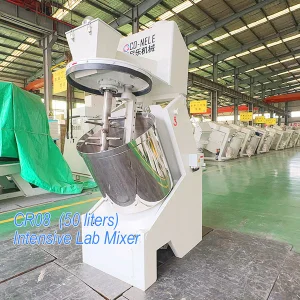
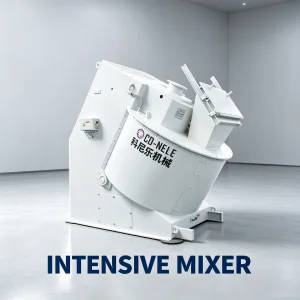
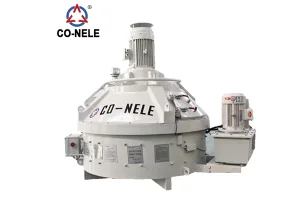
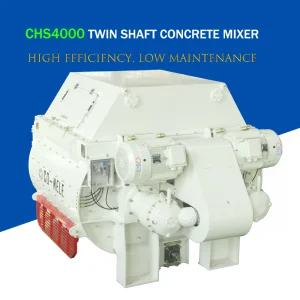
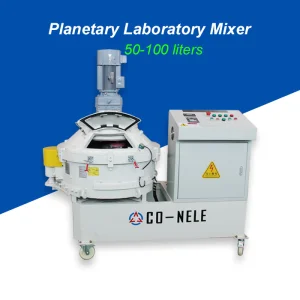
In high-temperature heavy industrial manufacturing, the homogeneity of refractory castables, ramming mixes, and shaped refractory bricks directly dictates the structural integrity and service life of blast furnace linings, steel ladles, cement kilns, and glass tank furnaces. Traditional horizontal twin-shaft or gravity drum mixers frequently fail when handling ultra-dense refractory formulations due to particle segregation, inadequate dispersion of micro-silica additives, and severe mechanical wear from abrasive aggregates like corundum, tabular alumina, and silicon carbide.
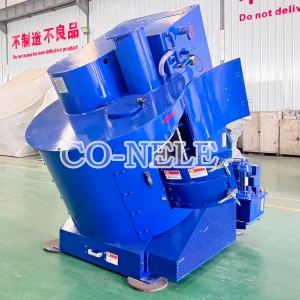
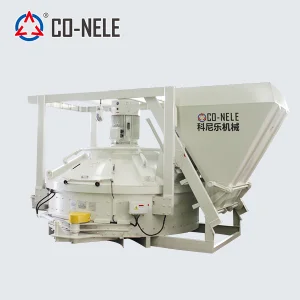
The China Refractory Planetary Mixer Factory & Machine architecture solves these rheological challenges through vertical-shaft counter-current mixing kinematics. Unlike conventional mixers, planetary mixing arms rotate on their own axis while simultaneously revolving around the central axis of the mixing pan. This dual-rotation vector path ensures 100% pan coverage without dead zones, creating high-shear intensity that rapidly breaks down agglomerates, homogenizes binders (such as calcium aluminate cement, colloidal silica, or liquid resin), and achieves a coefficient of variation ($CV$) of less than 3% within 60 to 90 seconds.
Information Gain Key Metric: Laboratory and field rheological evaluations confirm that counter-current planetary mixing reduces water addition requirements in low-cement (LCC) and ultra-low cement (ULCC) castables by up to 1.5% to 2.0% compared to horizontal mixers. This reduced water-to-cement ratio yields dense crystalline microstructures post-sintering, raising cold crushing strength (CCS) by 18-25%.
A macro perspective on supply chain demands, material shifts, and manufacturing modernization across primary metal and mineral sectors.
Global steelmakers and non-ferrous smelters are increasingly replacing fired refractory bricks with unshaped, monolithics, and self-flowing castables. This shift reduces furnace relining downtime by 40% but demands mixing machinery capable of perfectly wetting ultrafine powders without creating air pockets or micro-cracks.
Thermal processing plants require refractories with superior thermal shock resistance and minimal thermal conductivity loss. Achieving uniform bulk density during mixing directly prevents hot-spot formation and catastrophic shell deformation in high-temperature kilns and reactors.
Raw materials such as fused zirconia, synthetic mullite, and silicon carbide destroy standard steel mixing liners in weeks. China's leading manufacturing factories have responded by engineering modular, bolt-on high-chrome ceramic and tungsten carbide wear plates, extending component lifespan beyond 150,000 batches.
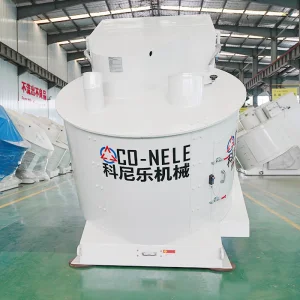
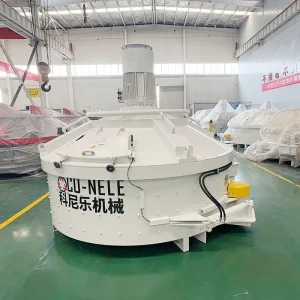
Precision-engineered in Qingdao, China, the CO-NELE Planetary Refractory Mixer platform integrates advanced mechanical drive trains, heavy-duty structural frames, and intelligent dosing automation built for continuous 24/7 industrial duty cycles.
| Engineering Specification | Standard Concrete Mixers | CO-NELE Planetary Refractory Mixer | Industrial Value Advantage |
|---|---|---|---|
| Drive Kinematics | Single-axis horizontal/vertical rotation | Dual-motion Counter-Current Planetary Rotation | Eliminates mixing dead spots; 100% active volume agitation. |
| Gearbox Transmission | Commercial off-the-shelf spur gearboxes | In-house designed single-body Planetary Reducer | Handles high starting torque under 100% dry-batch load. |
| Wear Liner Material | Q235 / AR400 Soft Steel Plates | High-Chrome Alloy (HRC ≥ 62) or Ceramic Tiles | Extends wear life by 300-500% under abrasive aggregate stress. |
| Micro-Silica Dispersion | Poor; prone to agglomerate lumps | High-shear star rotor micro-dispersion | Fully unlocks silica fume reactivity for maximum density. |
| Discharge Mechanism | Pneumatic single-gate gravity drop | Hydraulic multi-stage fast discharge door | Zero residual material carryover; reduces batch cycle times. |
| Moisture Dosing Control | Manual / Basic timed water meter | High-pressure microwave moisture sensor integration | Real-time slump/moisture adjustment to ±0.1% accuracy. |
The key differentiator of top-tier Chinese refractory mixer factories lies in the gearbox design. CO-NELE engineers a specialized planetary gearbox housed within a single-piece rigid cast frame. By distributing mechanical torque across multiple planetary gear sets, shock loads generated by large fused alumina lumps are dissipated evenly. This prevents gear teeth fractures common in imported standard commercial reducers, reducing maintenance interventions to simple scheduled oil changes.
Engineered to process complex formulations across metallurgy, technical ceramics, glass manufacturing, and infrastructure construction.
Handles low-cement (LCC), ultra-low cement (ULCC), and no-cement castables containing micro-silica, reactive alumina, and synthetic aggregates without balling or segregation.
Uniformly coats pitch, resin binders, and graphite powders onto oxide grains for Al2O3-C, MgO-C, and ZrO2-C bricks used in ladle linings and continuous casting nozzles.
Prevents iron contamination through optional ceramic lining tiles (Alumina/Zirconia) and stainless steel mixing arms, ensuring zero discoloration in optical glass and advanced ceramics.
Rapidly homogenizes fine quartz flour, steel fibers, and chemical superplasticizers to manufacture UHPC bridge decks, architectural panels, and security barriers.
A major steel manufacturer replaced traditional horizontal paddle mixers with CO-NELE CMP1000 Planetary Refractory Mixers for preparing tap-hole clay and ladle castables. The upgrade achieved a 35% reduction in mixing duration while eliminating dry-powder clumping. The ladle lining life expanded from 110 heats to 142 heats due to the improved density and micro-homogeneity of the castable.
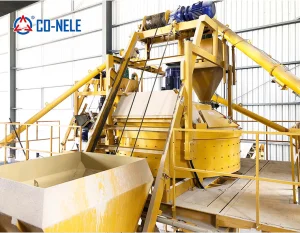
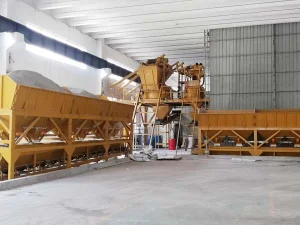
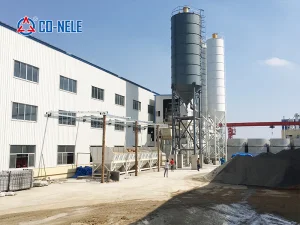
As documented in our international delivery projects, CO-NELE supplied an automated mixing station equipped with planetary mixers to a high-capacity concrete pipe and precast element facility in Vietnam. The planetary counter-current system successfully dispersed high-aspect-ratio steel fibers without balling, achieving structural tensile strength benchmarks exceeding 180 MPa.
Deploying CMP-series planetary mixers equipped with skip hoists allowed plant operators in Russia and Saudi Arabia to automate batch feeding for refractory block production. Real-time moisture measurement sensors integrated into the pan floor maintained batch-to-batch moisture variance within ±0.15%, yielding near-zero scrap rates prior to kiln firing.
As industrial automation shifts toward Industry 4.0 and smart manufacturing, Chinese machinery factories are pioneering intelligent, sensor-driven mixing environments.
Integration of dynamic torque-sensing algorithms that continuously measure slurry resistance during batch mixing. The system automatically adjusts rotor speeds and superplasticizer dosing in real time to match exact viscosity curves.
Deployment of IoT edge gateways inside planetary gearboxes to monitor bearing harmonics and lubricant degradation. Plant engineers receive automated maintenance alerts weeks before gear tooth fatigue occurs.
Implementation of direct-drive permanent magnet synchronous motors (PMSM), cutting electrical power consumption by up to 22% during heavy refractory batch start-ups while eliminating hydraulic fluid leakage risks.
Direct answers from our engineering team on mixer selection, wear liner maintenance, and raw material trial testing.
Twin-shaft mixers excel in high-volume, standard ready-mix concrete where cycle speed matters most. However, for dense refractory castables, dry-cast mortars, and fibre-reinforced materials, twin-shaft mixers create mechanical dead zones near shaft seals and pan corners. A planetary counter-current mixer rotates arms on dual axes, forcing 100% of the material through high-shear zones every revolution. This guarantees complete dispersion of microsilica, pigments, and steel fibers with lower water consumption.
CO-NELE offers multiple wear protection tiers tailored to material abrasiveness: Standard High-Chrome alloy plates (HRC ≥ 62), hard-faced tungsten carbide overlay plates, or fully non-metallic Alumina/Zirconia ceramic tiles. For extreme abrasive mixes like tabular alumina or fused silicon carbide, ceramic tiles prevent iron contamination while delivering a service life exceeding 150,000 batches.
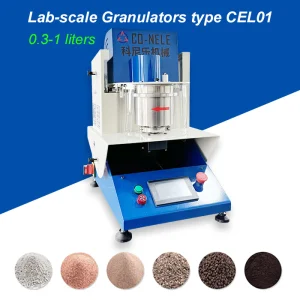
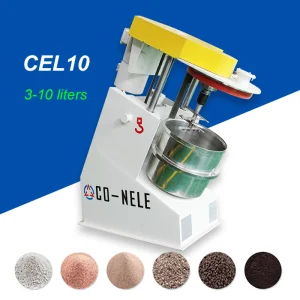
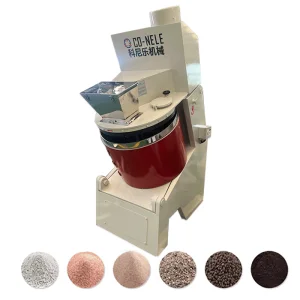
Yes. Our R&D testing center in Qingdao houses laboratory-scale planetary and intensive mixers ranging from 5L to 75L capacity (such as the CR08 and CEL10). Clients can ship 10–50 kg of raw material samples. Our process engineers conduct mixing trials, measure particle sphericity, density, and liquid binder uptake, and generate a comprehensive scale-up report prior to industrial equipment fabrication.
All machinery is built to customer site specifications (220V/380V/415V/440V/480V at 50Hz or 60Hz). Systems come standard with CE-compliant Siemens PLC electrical cabinets, Schneider low-voltage components, foundation schematics, and English user manuals. Global after-sales support includes remote real-time diagnostic connectivity, fast-dispatch spare parts from stock, and optional resident engineer field installation guidance.
Complete product lines engineered to support refractory brick plants, ceramic granulation lines, and heavy-duty precast block operations.