1 / 3

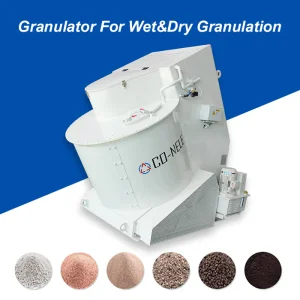
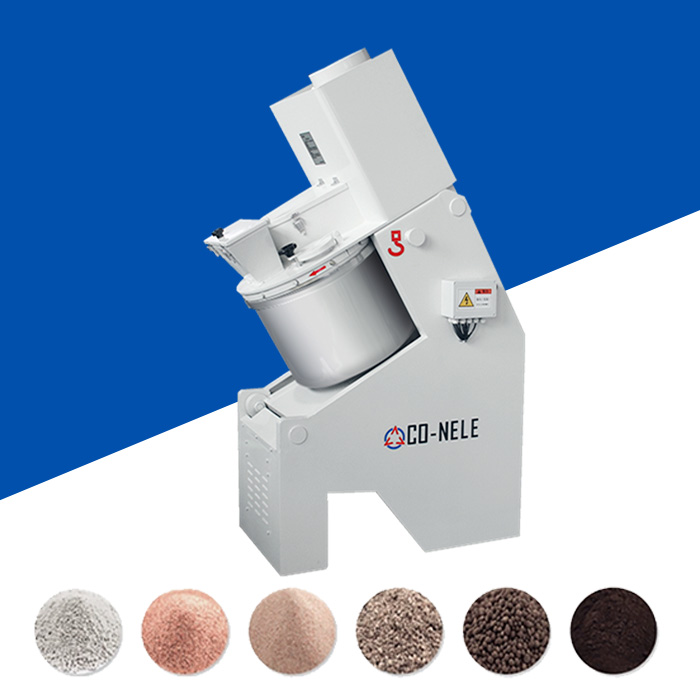
A powder granulator is a machine or system used to transform fine powders into larger, denser, free-flowing granules. This process (granulation) improves powder handling, reduces dust, enhances dissolution, and ensures uniformity in industries like pharmaceuticals, food, chemicals, and agriculture.
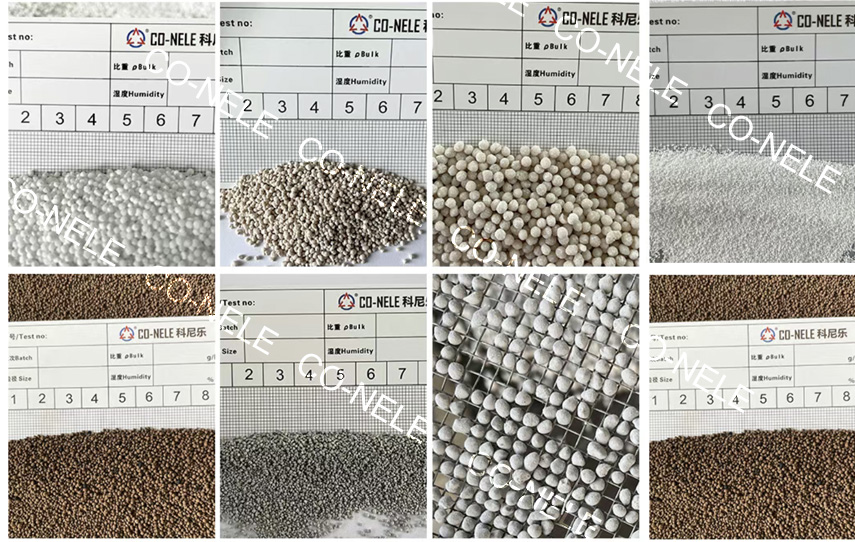
Advantages: This is one of the core advantages. When handling fine powders, flying dust is a serious problem, causing environmental pollution, waste of raw materials, equipment wear, cleaning difficulties, and most importantly, endangering the health of operators (respiratory diseases, explosion risks).
Granulation effect: Agglomerating fine powders into granules greatly reduces the generation and spread of dust, improves the working environment, and complies with safety and environmental regulations.
Advantages: Fine powders have poor fluidity and are prone to agglomeration and bridging, resulting in poor flow in silos, pipelines, and feeders, affecting production efficiency and metering accuracy.
Granulation effect: Granules have better flow characteristics and can flow smoothly like "sand", which is convenient for conveying, packaging, metering, filling molds (such as tablet presses) and automated operations, improving production speed and stability.
Advantages: Powders are usually fluffy, taking up a lot of storage and transportation space, increasing costs. Low density may also affect downstream processes (such as tablet strength, dissolution rate).
Granulation effect: The granulation process removes the air between powder particles through compression and agglomeration, significantly improving the bulk density of the material. This means:
Advantages: Some applications (such as instant beverages, granules, pesticide wettable powders, dyes) require materials to dissolve quickly or disperse evenly in water.
Granulation effect: By controlling the granulation process (such as wet granulation), porous and easily disintegrated particles can be produced, which have a larger specific surface area (relatively) than fine powder, thereby accelerating the dissolution or dispersion speed and improving product performance.
Advantages: In a powder mixture, differences in density and particle size of different ingredients may lead to stratification (segregation) during transportation or storage, affecting the quality consistency of the final product.
Granulation effect: Granulate the mixed powder into granules, "lock" multiple ingredients inside each granule, effectively prevent segregation, and ensure the high uniformity of the ingredients of the final product.
Advantages: Dust flying and adhesion will lead to raw material loss; poor fluidity will lead to more equipment residue and inaccurate metering.
Granulation effect: Reduce dust loss, improve fluidity, reduce equipment residue, and improve metering accuracy, all of which directly reduce raw material waste and production costs.
Advantages: Granular products usually look more regular, more professional, and more "advanced" than powders, and are more acceptable to consumers.
Granulation effect: It can produce particles with uniform size and regular shape (such as spherical and cylindrical), which can improve the appearance quality and market competitiveness of products (such as laundry detergent particles and instant coffee particles).
Advantages: In the fields of pharmaceuticals, fertilizers, pesticides, etc., active ingredients are sometimes required to be released slowly or at a specific rate.
Granulation effect: The granulation process (especially wet or melt granulation) provides a good basis for subsequent coating or controlled release by controlling particle density/porosity.
Advantages: In the fields of metallurgy (sintered ore), catalysts, etc., the size and pore structure of particles are more conducive to gas diffusion and chemical reaction than powders, which improves the reaction rate and efficiency.
Advantages: In metal powder metallurgy or 3D printing, unused fine powder needs to be recycled. It is difficult to recycle in powder state and the loss is large.
Granulation effect: After the fine powder is granulated, it is more convenient to recycle and the loss is lower.
| Intensive Mixer | Granulation/L | Pelletizing disc | Heating | Discharging |
|---|---|---|---|---|
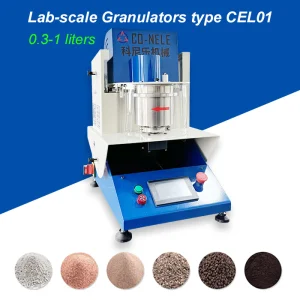
| CEL01 | 0.3-1 | 1 | - | Manual unloading |
| CEL05 | 2-5 | 1 | - | Manual unloading |
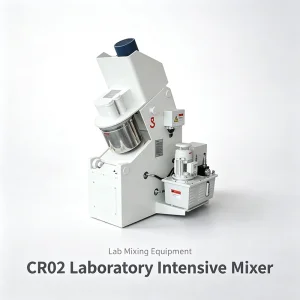
| CR02 | 2-5 | 1 | - | Cylinder flip discharge |
| CR04 | 5-10 | 1 | - | Cylinder flip discharge |
| CR05 | 12-25 | 1 | - | Cylinder flip discharge |
| CR08 | 25-50 | 1 | - | Cylinder flip discharge |
| CR09 | 50-100 | 1 | - | Hydraulic center discharge |
| CRV09 | 75-150 | 1 | - | Hydraulic center discharge |
| CR11 | 135-250 | 1 | - | Hydraulic center discharge |
| CR15M | 175-350 | 1 | - | Hydraulic center discharge |
| CR15 | 250-500 | 1 | - | Hydraulic center discharge |
| CRV15 | 300-600 | 1 | - | Hydraulic center discharge |
| CRV19 | 375-750 | 1 | - | Hydraulic center discharge |
| CR20 | 625-1250 | 1 | - | Hydraulic center discharge |
| CR24 | 750-1500 | 1 | - | Hydraulic center discharge |
| CRV24 | 100-2000 | 1 | - | Hydraulic center discharge |
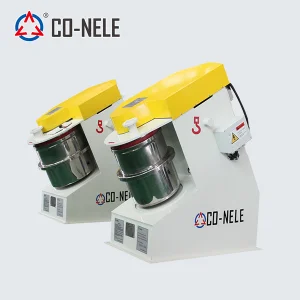
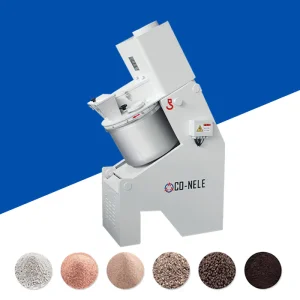
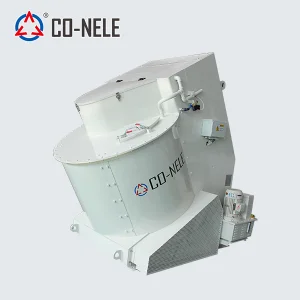
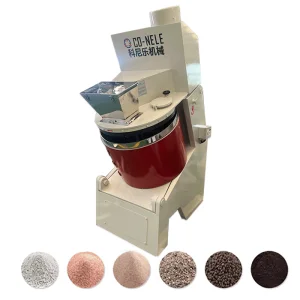
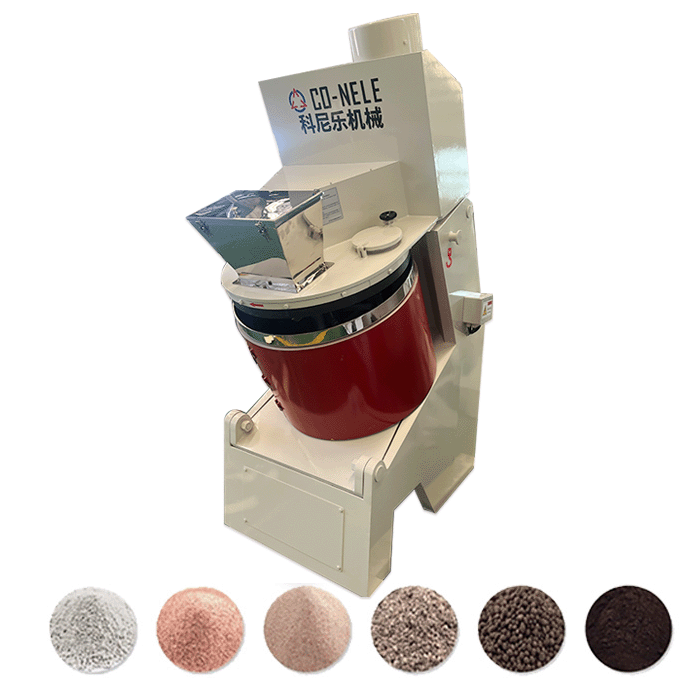
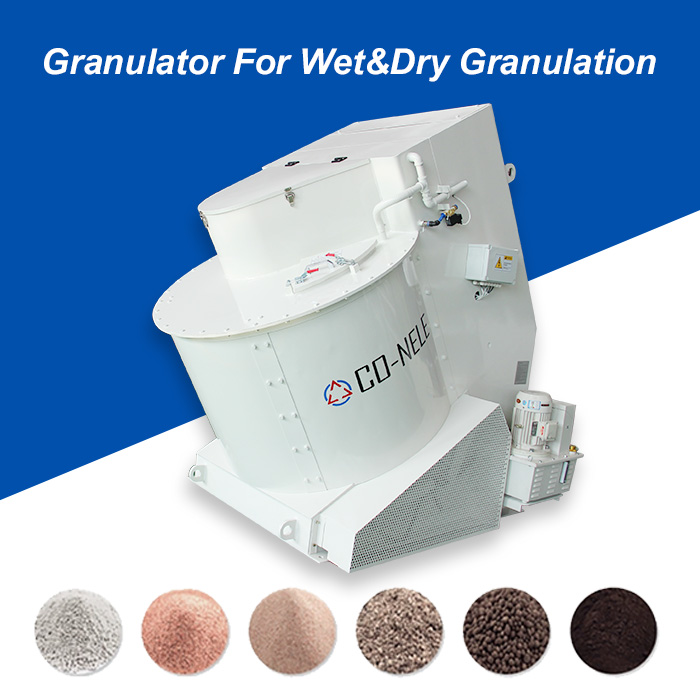
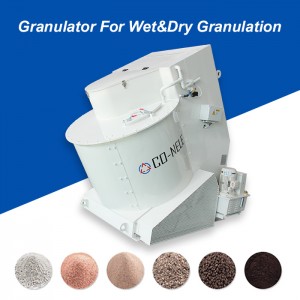
A powder granulator is industrial equipment that processes fine powders into uniform, dense granules. It operates through mechanical agitation, compression, or binder-assisted agglomeration to form consistent particle sizes, improving powder flow and reducing dust.
Powder granulators are widely utilized in pharmaceuticals, refractory materials, glass manufacturing, ceramics, metallurgy, fertilizers, catalysts, and food processing where material uniformity, dust-free operations, and precise dosage are required.
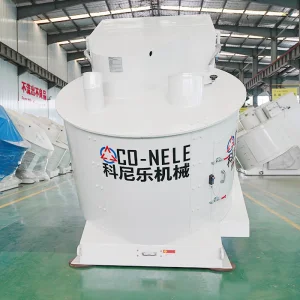
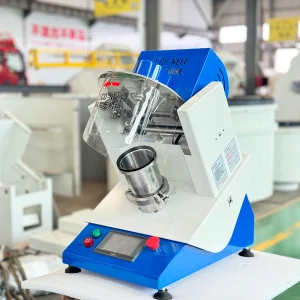
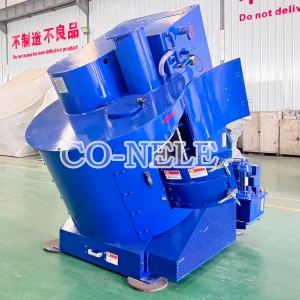
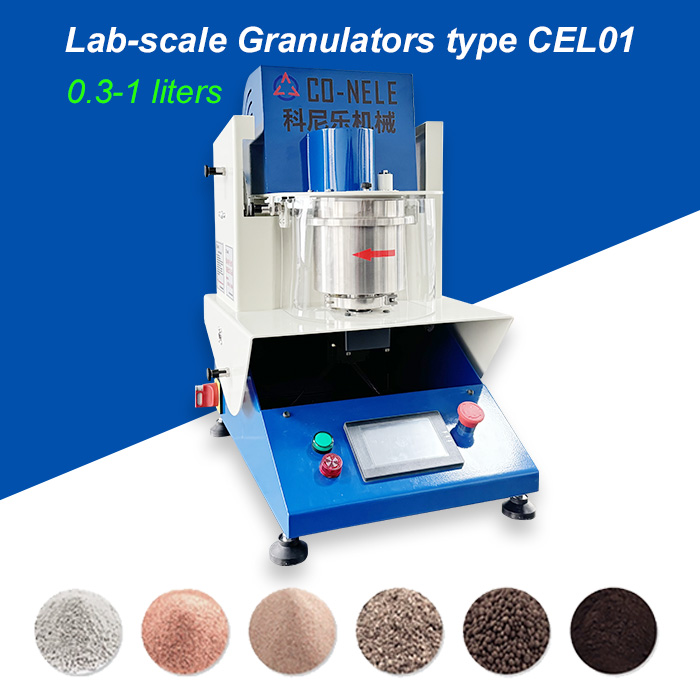
CO-NELE mixing granulators feature turbulent 3D mixing technology, cutting process times from hours to tens of minutes. Equipped with PLC touch screen controls and wear-resistant tool sets, they deliver higher batch-to-batch consistency and enhanced operational efficiency.
Selection depends on your required batch size and production volume. Lab-scale models like the CEL01 (0.3-1L) and CEL05 (2-5L) suit R&D and small batches, while large-scale models like the CR24 or CRV24 handle up to 2000L for high-capacity industrial production.
Dust reduction protects operator health by minimizing respiratory hazards, mitigates dust explosion risks, reduces raw material waste, decreases equipment wear, and ensures strict compliance with environmental regulations.