CO-NELEMixing & Granulation
Browse our certified planetary, twin-shaft, and granulator equipment engineered for intense abrasive materials, high-viscosity refractory slurries, and extreme shear compounding.
Modern pyrometallurgy, petrochemical synthesis, and mineral processing facilities operate under non-negotiable thermal thresholds exceeding 1400°C to 1800°C. Sourcing refractory cement mixes and compounding equipment requires strict adherence to physical, chemical, and rheological parameters.
Industrial buyers mandate CA-50, CA-70, and CA-80 calcium aluminate binder chemistries with tightly constrained Fe2O3 fractions (< 0.15% to 1.5%) to prevent carbon monoxide catalytic disintegration in reducing atmospheres. Equipment must prevent cross-contamination during batching.
Low-Cement (LCC) and Ultra-Low Cement Castables (ULCC) depend on nano-scale fumed silica and reactive alumina powders to achieve matrix density. Without planetary high-shear kinetics, micro-fines agglomerate, causing water demand spikes and catastrophic thermal spalling.
Refractory aggregate formulations utilize tabular alumina, silicon carbide (SiC), sintered mullite, and fused bauxite with Mohs hardness 8–9. Mixers must feature bolted high-chromium cast iron (Cr26+) or composite ceramic tile liners to withstand rapid mechanical abrasion.
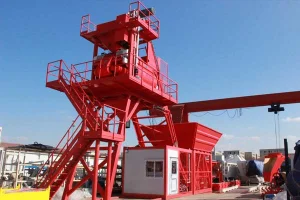
Refractory castables, gunning mixes, and ramming bodies form the thermal shield across core industrial assets. China CO-NELE designs specialized mixing solutions tailored to the mechanical shear demands of each processing sector.
Iron and steel plants require corundum-spinel castables and Al2O3-SiC-C trough mixes capable of enduring molten iron wash and aggressive slag erosion. Our high-torque planetary mixers disperse stainless steel reinforcing fibers without clustering, extending ladle campaign life.
Fluidized Catalytic Cracking Units (FCCU) subject cyclone diplegs and regenerator vessels to severe catalyst particle abrasion. We supply hexmetal-anchored erosion-resistant phosphate-bonded castables compounded in sealed, dust-tight mixers with automated dosing accuracy.
Alternative Fuel (AF) firing introduces alkali-chloride-sulfur circulation inside cement kilns. Our planetary mixers prepare alkali-resistant silicon carbide and low-porosity mullite mixes that resist ring formation, structural spalling, and rapid temperature excursions.
Waste incinerators battle severe chloride corrosion and molten heavy metal attack. Our high-shear intensive mixers allow rapid compounding of dense SiC castables, chrome-alumina mortars, and fused cast blocks, maintaining structural integrity across varying atmospheres.
| Refractory Formulation Class | Primary Mineral Phase | Recommended CO-NELE Mixer Core | Specific Mixing Energy | Critical Processing Metric |
|---|---|---|---|---|
| Ultra-Low Cement Castable (ULCC) | Tabular Alumina + Reactive Alpha-Al2O3 | CMP Planetary Counter-Current | 1.85 – 2.4 kW/100kg | Sub-micron de-agglomeration within 120s |
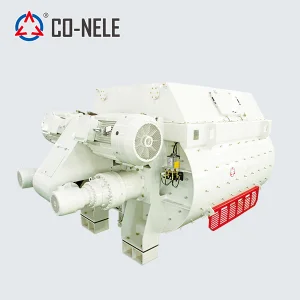
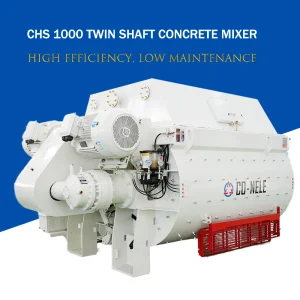
| Steel Fiber Reinforced Castable | Bauxite Aggregate + 310S / 446 Stainless Fibers | CHS Compulsory Dual-Shaft / CMP | 1.40 – 1.9 kW/100kg | Zero balling, uniform multi-directional fiber dispersion |
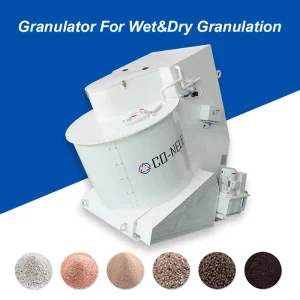
| Silicon Carbide Ramming Mix | Black / Green SiC + Carbonaceous Binder | Intensive Mixer Granulator | 2.20 – 3.1 kW/100kg | High bulk density, regulated plasticizer coating |
| Insulating Lightweight Castable | Expanded Vermiculite / Perlite / Bubble Alumina | Low-Shear Counter-Current CMP | 0.75 – 1.1 kW/100kg | Protection of fragile porous aggregate cell structures |
| Phosphate-Bonded Gunning Mix | Mullite + Mono-Aluminum Phosphate | CMP Counter-Current with Liquid Injection | 1.60 – 2.1 kW/100kg | Homogeneous liquid binder wetting without crusting |
As metallurgical operations transition to hydrogen-direct reduction (H-DRI) and carbon-neutral kiln heating, refractory matrix requirements grow increasingly demanding. CO-NELE continuously develops its kinematic drive architectures, wear-metallurgy, and digital integration.
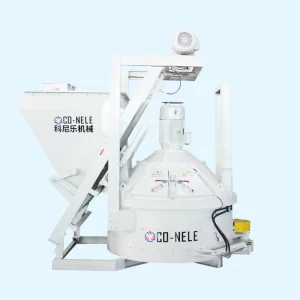
Patented planetary reducers drive twin or triple mixing stars on intersecting paths. Rotational and orbital motions generate micro-vortices that sweep the mixing pan entirely, eliminating dead angles and cutting cycle times by 35% compared to conventional pan mixers.
In-line optical and microwave ceramic sensors embedded in the pan floor sample moisture content at 200 Hz. The automated Siemens PLC modulates water and additive dosing in real time, maintaining rheological workability within ±0.15% moisture tolerance.
Moving beyond conventional Ni-Hard irons, CO-NELE integrates vacuum-brazed tungsten carbide edges, Cr28 high-molybdenum wear plates, and zirconia-toughened alumina (ZTA) composite wall tiles capable of handling high-tonnage silicon carbide and fused quartz.
Mixers feature edge computing interfaces that track motor power draw curves to detect the exact hydration inflection point. IoT gateways transmit thermal, torque, and vibration health metrics to plant DCS via Profinet, EtherNet/IP, or OPC-UA.
Operating across more than 80 countries, CO-NELE satisfies international electromechanical, environmental, and worker safety frameworks. We combine domestic manufacturing precision with regional field engineering.
All equipment complies with the European Machinery Directive 2006/42/EC, Low Voltage Directive 2014/35/EU, and electromagnetic compatibility standards. For facilities handling explosive dusts (such as graphite, aluminum powder, or silicon metal), we provide certified ATEX Zone 21/22 explosion-proof drive configurations.
Control panels for North American projects are engineered to NFPA 79 and UL 508A specifications with NEMA 4X enclosures. Every wiring run, breaker rating, and safety interlock conforms to regional inspection codes, accelerating local electrical sign-offs and plant commissioning.
We operate three specialized production facilities covering 30,000 m² in Qingdao, China. Standard replacement sets—including arms, liners, seal kits, and hydraulic valves—remain in stock for models produced since 2004, with fast dispatch to Asia, Europe, the Americas, and the Middle East.
Technical insights direct from our senior mechanical and material process engineers on refractory mixing, plant design, and equipment selection.
Traditional pan mixers rely on gravity and linear circular plows, which fail to break micro-silica agglomerates and leave stagnant material along the outer walls. Refractory castables—especially low-cement (LCC) and ultra-low-cement (ULCC) blends—require intense shear energy to disperse fine particles and activate plasticizers at low water-to-cement ratios (3.5%–5.5%). A planetary mixer rotates its blades on self-orbiting stars while revolving around the central pan, subjecting the batch to multi-dimensional shear and delivering a coefficient of variation (CoV) below 3.5%.
CO-NELE specifies high-chromium wear liners alloyed with molybdenum (Cr26-Cr28Mo), heat-treated to an operational hardness exceeding 62–65 HRC. For applications processing pure silicon carbide or tabular corundum, we fit composite zirconia-alumina ceramic plates or vacuum-welded tungsten carbide edges. Mixing arms feature an aerodynamically streamlined profile that reduces frontal impact while maintaining an adjustable trailing clearance (1.5–3 mm) to eliminate aggregate crushing.
Yes. Our mixing units are engineered for seamless integration into fully automated production plants. Standard configurations include air-balanced dust extraction hoods, pneumatic high-pressure cleaning nozzles, automated liquid and chemical dosing ports, load-cell mounting brackets, and pneumatic or hydraulic circular discharge gates with multi-position limit sensors connected via Profinet or Ethernet/IP.
Refractory formulations frequently incorporate stainless steel fibers (such as 304, 310, or 446 alloys) to prevent structural cracking, along with polypropylene fibers to create steam-release pores during pre-firing. Our planetary stars feature counter-directional blade pitches that generate a fluidizing vertical vortex. This action suspends and disperses fibers individually within 45 to 60 seconds, preventing balling, clumping, or damage to the blade assemblies.
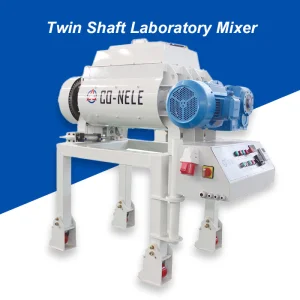
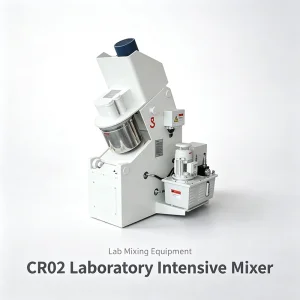
Explore our heavy-duty granulators, dry-mortar compounders, foundry sand mixers, and laboratory R&D units engineered for tough formulations and demanding thermal environments.