CO-NELEMixing & Granulation
Explore our export-grade industrial mixers, precast batching plants, and specialized granulating systems engineered for global infrastructure demanding zero margin for error.
A rigorous examination of mandatory fluid mechanics, shaft end sealing integrity, and shear rates in 1.0 m³ industrial mixing units.
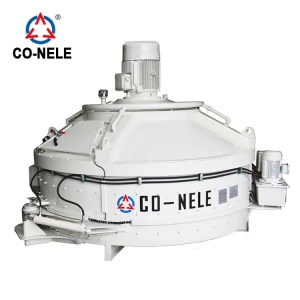
The JS1000 Concrete Mixer represents the benchmark mid-to-large capacity compulsory twin-shaft mixing system utilized across global infrastructure development. Designated under standard industrial classifications, "JS" indicates a compulsory twin-horizontal-shaft mechanism, while "1000" signifies a nominal compacted concrete discharge volume of 1000 liters (1.0 m³) per operational batch cycle. Designed to handle aggregate particle sizes up to 80 mm (pebble) or 60 mm (crushed stone), the JS1000 delivers a theoretical throughput capacity of 50 to 60 m³/h when fully integrated into automated HZS50 or HZS60 batching plant setups.
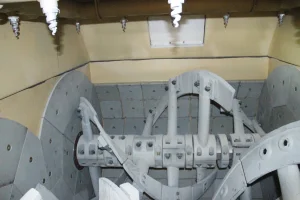
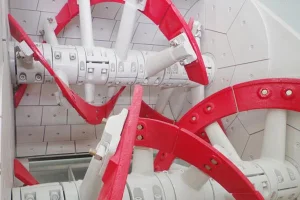
Counter-rotating twin shafts synchronized via precision-cut helical timing gears create a intensive 3D counter-current vortex, achieving homogeneous cement coating within 30 to 45 seconds of mixing time.
Features state-of-the-art floating ring seals backed by continuous automated hydraulic oil pressure lubrication, preventing cement slurry ingress into main bearing housings and reducing seal maintenance intervals by 300%.
Equipped with 26% Chromium (Cr26) cast iron liner plates and mixing blades offering a Brinell hardness rating exceeding HBW 600, guaranteeing service operational lifespans beyond 120,000 batch cycles.
To assist industrial buyers and procurement officers in validating machine suitability, the following table details the baseline mechanical and operational parameters of factory-standard China JS1000 units:
| Parameter / Metric | Standard Specification Value | Engineering Notes & Capabilities |
|---|---|---|
| Discharge Capacity (Compacted) | 1,000 Liters (1.0 m³) | Nominal volume per concrete discharge batch |
| Charging Capacity (Dry Material) | 1,500 Liters (1.5 m³) | Total dry aggregate and cement loading bin volume |
| Production Capacity (m³/h) | 50 – 60 m³/h | Based on a standard 60-second operational cycle time |
| Max Aggregate Size (Pebble/Crushed) | ≤ 80 mm / ≤ 60 mm | Requires heavy-duty reinforced mixer blade arms |
| Mixing Blade Rotation Speed | 25.5 RPM | Optimized tip velocity for low shear degradation |
| Main Drive Electric Motor Power | 2 × 18.5 kW or 37 kW | Dual motor synchronous drive or single large motor |
| Hydraulic Gate Motor Power | 2.2 kW | Three-stage gate position control (Full/Half/Closed) |
| Total Weight (Standard Configuration) | 8,500 kg – 9,800 kg | Varies based on skip hoist vs aggregate conveyor feed |
Unveiling the cost drivers, component configurations, and hidden OpEx factors determining genuine FOB/CIF pricing for international buyers.
When searching for a China JS1000 Concrete Mixer Price, procurement teams often encounter factory quotes ranging widely from $12,500 USD to $38,000 USD. This price divergence is not merely a profit margin artifact—it reflects fundamental differences in metallurgy, structural steel thickness, gearbox engineering, seal technology, and electrical component grade. Understanding these variables is critical to calculating Total Cost of Ownership (TCO) and avoiding premature gear failure or excessive downtime.
A $12,000 JS1000 mixer typically utilizes recycled alloy liners (Cr15), non-hardened gear reducers, and basic packing seals that require manual grease lubrication. A premium $28,000 - $35,000 unit incorporates 26% High-Chrome liners, imported SKF shaft bearings, planetary reduction gearboxes, automatic PLC-controlled hydraulic oil pressure pumps, and Schneider electrics. The operational cost saved over 3 years in maintenance and spare parts exceeds $22,000 USD.
The table below presents a comparative 5-year financial breakdown for operating a low-cost budget JS1000 vs. a heavy-duty premium engineered JS1000 mixer under continuous 10-hour daily duty cycles:
| Cost Component / Operational Metric | Budget Class JS1000 ($13,500 Base) | Premium Factory Grade JS1000 ($29,000 Base) |
|---|---|---|
| Initial Purchase Price (FOB Qingdao) | $13,500 USD | $29,000 USD |
| Shaft Seal Replacement Frequency | Every 4 to 6 months ($1,200/yr) | Every 24 to 36 months ($400/yr) |
| Wear Liner & Blade Life | 35,000 – 45,000 batches ($3,500/set) | 120,000 – 150,000 batches ($5,200/set) |
| Unscheduled Machine Downtime Cost | Est. 120 Hours/Year (~$18,000 lost production) | Est. 15 Hours/Year (~$2,250 lost production) |
| 5-Year Estimated Maintenance & Spares | $16,800 USD | $6,400 USD |
| Total 5-Year Net Operational Cost | $48,300 USD | $37,650 USD (Net Savings: $10,650) |
How specialized industrial clusters, complete supply chain integration, and rigorous testing infrastructure deliver world-class mixing machinery.
Concentrated industrial zones in Qingdao and Shandong provide immediate access to raw high-tensile steel mills, precision casting foundries, specialized gearbox plants, and automated heat-treatment centers—drastically reducing logistics overhead.
Leading factories utilize large-scale double-housing CNC boring and milling centers to machine dual shaft bearing seats simultaneously. This guarantees absolute concentricity (<0.02mm alignment tolerance), eliminating shaft bending stresses.
Prior to dispatch, export units undergo a 4-hour continuous no-load run-in, followed by a hydraulic discharge pressure test and shaft seal oil-leak check, accompanied by full material test certificates (MTC) for all casting parts.
A comparative structural guide for civil engineers and ready-mix producers matching mixer kinematics to specific recipe demands.
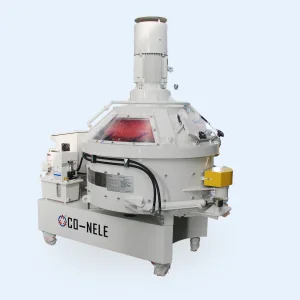
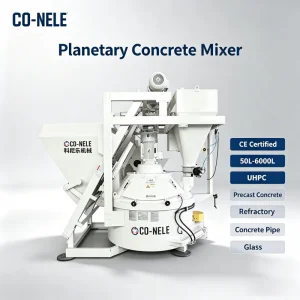
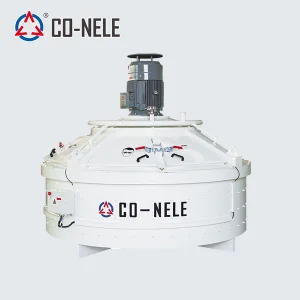
Selecting the optimal mixing machine requires matching the fluid rheology of your concrete mix design with the mechanical kinematics of the mixer. While the JS1000 Twin-Shaft Concrete Mixer is the undisputed workhorse for commercial ready-mix concrete and large-volume civil engineering, alternate designs such as vertical-shaft counter-current planetary mixers (CMP series) and double spiral mixers (CDS series) offer specific advantages for niche recipes.
| Criteria / Feature | JS1000 Twin-Shaft Mixer | CMP1000 Planetary Mixer | CDS1000 Double Spiral Mixer |
|---|---|---|---|
| Primary Mechanical Motion | Compulsory dual horizontal counter-rotating shafts | Vertical central axis with counter-current planetary star arms | Horizontal shafts with continuous ribbon/double spiral paddles |
| Best Suited Applications | Commercial Ready-Mix, Mass Foundations, HZS50/60 Plants | Precast Elements, UHPC, Block Machine Feeding, Refractory | High-Slump Ready-Mix, Self-Consolidating Concrete (SCC) |
| Mixing Speed & Discharge Cycle | Ultra-Fast (30 – 45 sec cycle time) | Medium-Fast (45 – 75 sec cycle time) | Fast (35 – 50 sec cycle time) |
| Micro-Homogeneity (Co-efficient) | CV ≤ 5% (Excellent for standard concrete) | CV ≤ 1.5% (Superior micro-dispersion) | CV ≤ 4% (Great bulk flow mixing) |
| Energy Consumption per m³ | Lowest (37kW total motor load) | Moderate (37kW – 45kW vertical drive) | Low-Moderate (37kW horizontal drive) |
| Maintenance Complexity | Low – Standardized external seals and bearings | Moderate – Requires specialized planetary gearbox oil care | Low – Simple spiral blade replacement |
If your project demands high hourly output (>50 m³/h) of standard wet concrete (slump 50mm - 200mm) for road foundations, bridges, or ready-mix trucks, choose the JS1000 Twin-Shaft Mixer. If you are manufacturing high-density pavers, dry-cast blocks, glass-fiber reinforced concrete (GFRC), or Ultra-High-Performance Concrete (UHPC) requiring zero pigment streakiness, specify a Planetary Counter-Current Mixer (such as the CMP1000 series).
Tailored mixing plant integration strategies for ready-mix suppliers, precast factories, and remote mega-infrastructure projects.
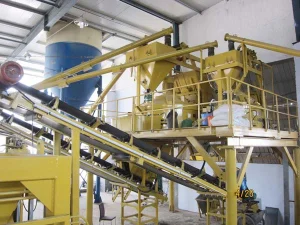
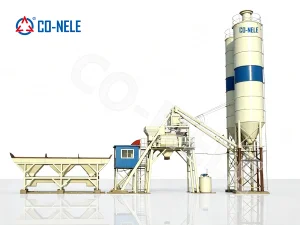
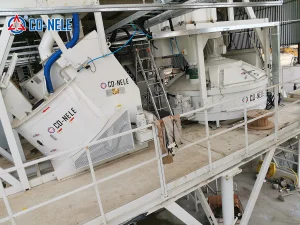
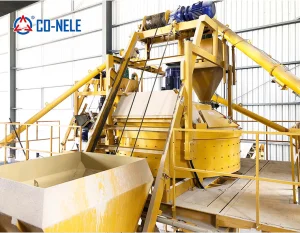
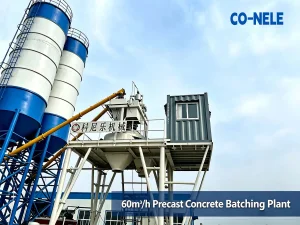
The JS1000 acts as the core mixing engine in stationary HZS50 (skip-hoist aggregate feeding) and HZS60 (belt-conveyor aggregate feeding) concrete plants. Integrated with cement silos, aggregate batching bins (PLD1600), and automated PLC weighing systems, it powers commercial ready-mix centers supplying urban expansion across Southeast Asia, Africa, and Latin America.
Megaprojects such as high-speed rail culverts, hydro-electric dam spillways, and bridge piers require zero segregation and precise water-cement ratios. The forced-action shearing of the JS1000 ensures uniform aggregate dispersion even when utilizing low-slump stiff concrete formulations.
Equipped with custom multi-stage pneumatic or hydraulic discharge gates, the JS1000 can feed concrete incrementally into skip cars or distribution hoppers. This controlled discharge capability is essential for feeding precast pipe machines, hollow-core slab extruders, and utility box culvert molds.
How international buyers can mitigate risk, verify electrical compliance, and manage shipping logistics when importing JS1000 mixers from China.
China standard industrial power is 380V, 50Hz, 3-Phase. International buyers must specify their site electrical requirements during the initial RFQ stage:
A standalone JS1000 concrete mixer (without skip hoist frame) has overall dimensions of approximately 3,100 mm × 2,200 mm × 2,300 mm and weighs roughly 8.5 metric tons. When planning shipping logistics:
Before issuing the final balance payment, insist on reviewing a comprehensive quality inspection package containing:
Integrating microwave moisture telemetry, AI load monitoring, and low-carbon transmission systems into modern concrete mixing equipment.
Modern JS1000 mixers are equipped with floor-mounted ceramic microwave moisture sensors (such as Hydronix or Franz Ludwig probes). Connected directly to the plant PLC, these sensors measure aggregate moisture content 25 times per second, automatically adjusting added mixing water in real-time to guarantee consistent target slump.
By monitoring the hydraulic back-pressure of the automatic grease lubrication system, smart IoT modules installed on high-spec China JS1000 mixers alert site engineers via mobile app or SCADA interface before a shaft seal breach occurs, eliminating catastrophic slurry ingress into main bearings.
Adopting variable-frequency direct drives (VFD) paired with permanent-magnet synchronous motors reduces electrical energy consumption per m³ of mixed concrete by up to 18%, while softening peak starting current demand on remote diesel generator sets.
In-depth technical answers addressing real buyer search intent, engineering standards, and post-purchase support.
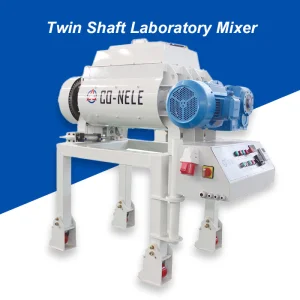
Explore our extended catalog of laboratory mixers, double screw mixers, block batching plants, and industrial intensive mixers.