CO-NELEMixing & Granulation
Explore high-performance mobile units, intensive mixers, laboratory testing units, and stationary plants.
Analyzing the paradigm shift toward pre-blended dry mortars, specialized UHPC formulations, and high-efficiency batching infrastructure.
The global construction sector is undergoing a profound structural evolution. Driven by strict urban environmental regulations, micro-structural concrete demands, and escalating field labor costs, traditional site-mixed concrete is rapidly being superseded by factory-controlled dry-mix formulations and automated concrete batching plants. A modern Dry Mix Concrete Plant functions as the foundational nucleus for modern civil engineering, producing precise pre-blended dry mortars, tile adhesives, masonry plasters, self-leveling compounds, and Ultra-High-Performance Concrete (UHPC) dry premixes.
In mature markets across North America and Western Europe, strict environmental compliance mandates dust-free, fully enclosed batching systems with automated pneumatic conveying. Meanwhile, rapid infrastructure expansion across Southeast Asia, the Middle East, and Latin America has fueled an unprecedented surge in demand for high-throughput mobile batching plants and versatile dry powder mortar units. Global EPC contractors now prioritize equipment that guarantees absolute batch repeatability, seamless integration with PLC process controls, and high wear resistance against abrasive silica aggregates.
SEO Information Gain Insight: Unlike standard ready-mix setups that rely purely on macro-mixing, modern dry-mix production requires multi-stage micro-homogenization. Raw materials ranging from 200-mesh fine calcium powder to 5mm quartz sand and chemical additives (RDP, HPMC, PP fibers) must achieve a Coefficient of Variation (CV) below 5% within short mixing cycles to prevent segregative settling during transport.
Why leading global construction enterprises rely on China's integrated industrial supply chain for high-tier mixing machinery.
Chinese mixing specialists like CO-NELE design and manufacture proprietary vertical-shaft planetary gearboxes in-house. Designed to withstand asymmetric torsional stresses without fatigue, these gear reducers offer superior mechanical torque transfer compared to assembled off-the-shelf commercial gearboxes.
Utilizing proprietary Ni-Hard and high-chromium alloy matrices (Cr26+), Chinese manufacturing foundries produce mixing blades, wear liners, and scraper arms with hardness ratings exceeding HRC 60. This extends operational life up to 150,000 cycles under heavy abrasive stress.
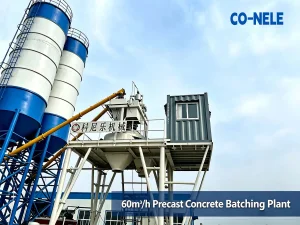
By housing laser cutting, robotic welding, CNC machining, automated sandblasting, and electrical panel assembly within 30,000m² localized production bases, Chinese plants deliver customized 60m³/h to 180m³/h batching facilities at 40-60% reduced lead times vs European OEMs.
Understanding shear dynamics, particle trajectory physics, and energy dissipation in dry powder mortar mixing.
Selecting the optimal mixing heart for a batching plant requires a mechanical evaluation of material physics. Two primary compulsory mixing technologies dominate high-spec industrial applications: Vertical Shaft Counter-Current Planetary Mixers and Horizontal Twin Shaft Compulsory Mixers.
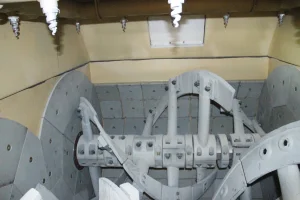
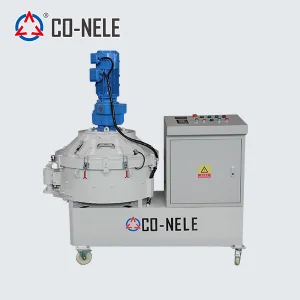
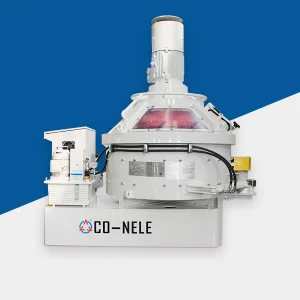
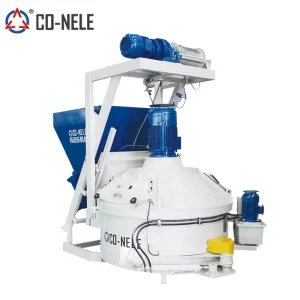
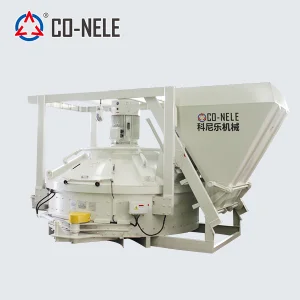
In a vertical planetary counter-current mixer (such as the CO-NELE CMP Series), mixing star arms rotate on a central vertical axis while simultaneously orbiting around the mixing pan center at calculated velocity ratios. This complex trajectory ensures that within a single revolution of the drive head, mixing blades sweep the entire floor and sidewall area without dead zones.
Eliminates material clustering along wall radii, essential for pigments, silica fume, and micro-chemical additives.
High impact energy disperses steel and synthetic fibers in UHPC mixtures without balling or crushing delicate aggregates.
Hydraulic discharge doors with mechanical clean-sweep scrapers ensure fast batch cycling (60-90 seconds total).
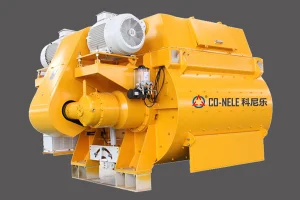
Twin shaft compulsory mixers (CHS Series) utilize dual counter-rotating horizontal shafts equipped with synchronized mixing paddles. Operating primarily in high-volume ready-mix concrete plants (above 2m³ batch output), twin shaft units generate strong axial and radial turbulence, rapidly coating coarse aggregate fractions with cement paste in continuous 30-45 second cycles.
Engineered configuration solutions tailored to distinct material recipes, production environments, and final product requirements.
For architectural precast wall panels, prestressed girders, kerbs, and concrete pipes, color consistency and surface finish dictate market value. Planetary mixing batch plants deliver homogenous binder distribution, preventing surface pitting and chromatic variation.
Bridge joint grouting, marine wind turbine foundations, and thin-shell architectural façades demand compressive strengths >150 MPa. CO-NELE dedicated UHPC mixers feature high-torque drives and intensive shear blade geometries to break up silica agglomerates.
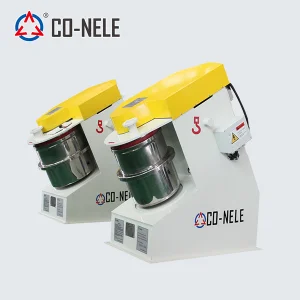
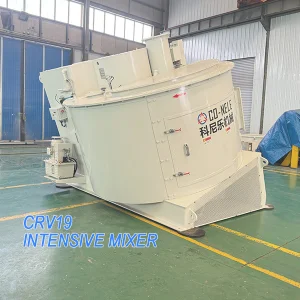
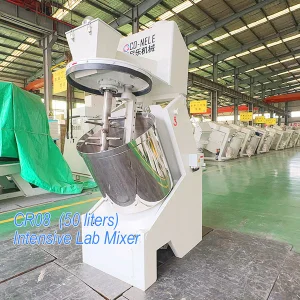
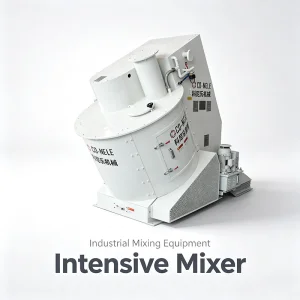
Operating under severe thermal stress, refractory bricks and monolithics require high-density mixing of heavy corundum, silicon carbide, and graphite powders. CO-NELE intensive laboratory and production mixers withstand extreme abrasion while preventing batch contamination.
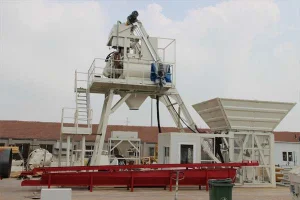
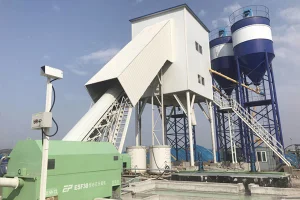
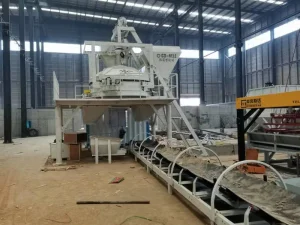
Integrated dry mortar batching plants aggregate fine sand drying, screening, automated powder dosing, additive micro-dosing, twin-spiral mixing, and valve-bag packaging into a fully enclosed vertical tower or step-type layout.
How AI telemetry, green concrete formulation, and energy optimization are reshaping concrete plant engineering.
The concrete batching industry is experiencing a technological transformation focused on digitalization and decarbonization. Modern procurement specifications no longer evaluate equipment based solely on raw output volume; life-cycle energy consumption, dust emission limits, and smart batching intelligence have become decisive purchase criteria.
Integrating microwave moisture probes directly into aggregate bins and mixer discharge paths allows the PLC control system to automatically recalculate water-cement ratios in real time, guaranteeing slump consistency regardless of raw material humidity spikes.
As concrete producers replace traditional Portland cement with Supplementary Cementitious Materials (SCMs) like blast furnace slag, fly ash, and calcined clays, batching plants require high-intensity shear kinematics to fully activate alternative binder chemistries.
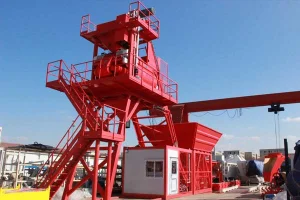
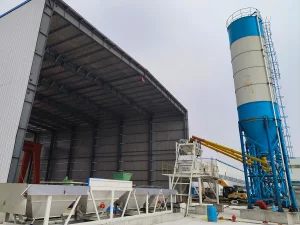
To reduce civil engineering setup costs, next-generation batching plants feature containerized, foundationless frame designs. Steel pin-connection structures allow rapid assembly and disassembly within 3-5 days, supporting remote project mobility.
Essential engineering standards, electrical compliance, and logistical factors for international B2B equipment buyers.
Procuring a complete dry mix concrete plant or industrial mixer from China involves rigorous technical evaluation to ensure local regulatory compliance and long-term operational viability. Below are critical engineering standards verified by CO-NELE export specialists:
Export equipment must accommodate global industrial voltages (220V, 380V, 415V, 440V, 480V at 50Hz or 60Hz). Motor drives should utilize IE3/IE4 high-efficiency ratings with IP55 dust and water ingress protection, equipped with Schneider or Siemens VFD frequency controllers.
Welding standards should comply with ISO 3834 and EN 1090 structural steel execution. Mixers targeted for European or North American deployment must include CE safety interlocks, automatic hydraulic pressure release valves, and dual-channel emergency stop safety relays.
Maintainable design requires bolt-on, segmented floor and wall liners. CO-NELE guarantees standardized interchangeability on high-chrome mixing blades and scraper arms for all plant models manufactured over the last 20 years, ensuring rapid dispatch from global parts stocks.
Explore heavy stationary ready-mix lines, precast panel batching plants, and high-intensity refractory mixers.
Direct technical answers from CO-NELE senior mixing and plant application engineers.
Partner with Qingdao CO-NELE Machinery Co., Ltd. — 20+ years of industrial mixing innovation, 80+ patents, and 10,000+ active global installations.