CO-NELEMixing & Granulation
Explore our flagship industrial concrete mixers, intensive granulators, and batching plant systems engineered for extreme homogeneity and industrial uptime.
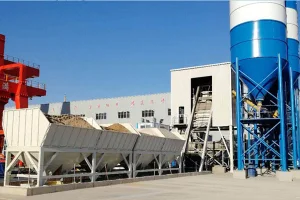
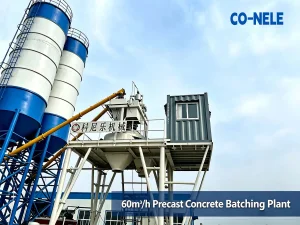
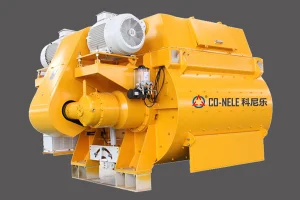
In modern industrial civil engineering, precast concrete manufacturing, and dam infrastructure development, concrete mixing is no longer merely a process of mechanical blending; it is a complex multiphase fluid mechanics operation. The China Twin Shaft Paddle Concrete Mixer represents a paradigm shift away from traditional gravity-drop or single-shaft mixing systems. By utilizing dual synchronized horizontally aligned counter-rotating shafts equipped with high-pitch paddle arms, this compulsory mixing machine generates an intense three-dimensional turbulence zone inside the mixing trough.
The core technological innovation lies in the overlapping circular paths of the paddle arms arranged at precise spatial angles (typically 60° or 90° intervals along the shaft axis). As the twin shafts rotate synchronously via heavy-duty timing gearboxes, the paddles sweep through the charge material, lifting coarse aggregates, fine sand, cementitious powders, silica fume, and liquid additives into a fluidic, weightless state within the central mixing vortex. This dynamic intersection eliminates dead zones completely, forcing micro-particles into intense friction and collision, thereby shearing cement agglomerates in seconds.
Information Gain Metric: Traditional pan or single-shaft mixers require between 60 to 90 seconds to achieve acceptable concrete homogeneity, often leaving unhydrated cement pockets. Modern twin shaft paddle mixers achieve a Variance Coefficient ($CV \le 3.5\%$) in as little as 30 to 45 seconds, accelerating cement hydration kinetics and boosting 28-day compressive strength by 8% to 12% for equal binder formulations.
A critical engineering trade-off in high-throughput concrete batching is avoiding aggregate degradation while ensuring uniform dispersion of ultrafine cementitious materials. The twin-shaft paddle architecture resolves this through optimized peripheral blade speed (typically calibrated between $1.4 \text{ m/s}$ and $1.8 \text{ m/s}$). Rather than relying on brutal impacts that break friable coarse aggregates, the paddle design induces continuous high-shear counter-flows that strip the water boundary layer from aggregate surfaces, dramatically improving Interfacial Transition Zone (ITZ) bond density.
A granular breakdown of the structural, hydraulic, and metallurgical breakthroughs embedded into modern twin shaft paddle machinery.
Combines floating mechanical face seals, labyrinth rubber rings, and automatic continuous grease injection pumps. Prevents aggressive micro-silica slurry from penetrating bearings even under 2.5 bar hydraulic head pressure.
Trough interior and paddle tips are cast from Ni-Hard IV and high-chromium alloy matrices ($HRC \ge 62$). Provides exceptional abrasion resistance against crushed granite, quartz sand, and basalt aggregates.
Custom-built planetary/spur gear speed reducers integrated with a rigid torque arm suspension. Ensures 100% phase synchronization between parallel shafts, dampening sudden load shocks during full-charge restarts.
Features eccentric seal rotary discharge gates actuated by high-pressure hydraulic cylinders with multi-position limit sensors. Allows fast, zero-drip dumping into transit mixers or concrete pump hoppers.
Integrated micro-vibration, temperature, and current feedback sensors linked to a Siemens PLC. Provides real-time predictive analytics on bearing fatigue, lubricant degradation, and batch viscosity changes.
Equipped with 360-degree rotating high-pressure water nozzles positioned along the upper housing header. Reduces manual wash-out labor by 75% and prevents hardened slurry buildup on mixer arms.
The global dominance of Chinese machinery manufacturing in the mixing equipment domain—exemplified by industrial clusters in Qingdao, Shandong—is founded on unmatched ecosystem integration. Producing a world-class twin shaft paddle concrete mixer requires seamless synergy between heavy steel casting foundries, precision gear cutting facilities, automated robotic welding lines, and specialized heat treatment plants.
Chinese OEM factories have transitioned from basic mechanical assembly to full Industry 4.0 manufacturing execution systems (MES). Troughs are bored using 5-axis CNC portal milling centers to ensure center-distance tolerances of less than $0.05 \text{ mm}$ between the twin drive shafts. This hyper-precise shaft alignment is essential for eliminating parasitic friction, minimizing oil-seal wear, and guaranteeing that mixing paddles maintain exact $5 \text{ mm}$ clearances from side liners.
For international EPC contractors, ready-mix concrete suppliers, and precast plant managers, procurement decisions are guided by strict financial and operational metrics. Evaluating a China Twin Shaft Paddle Mixer against European or North American counterparts demonstrates substantial TCO advantages without compromising engineering standards.
| Evaluation Parameter | Standard Chinese Industry 4.0 Mixer | Traditional European Brand | Operational Impact / ROI Advantage |
|---|---|---|---|
| Initial Capital Expenditure (CapEx) | Baseline Investment (100%) | 220% – 280% Premium | Frees capital for plant automation & logistics fleet expansion |
| Shaft Alignment Tolerance | ≤ 0.05 mm (5-Axis CNC Mill) | ≤ 0.04 mm (5-Axis CNC Mill) | Identical mechanical alignment; prevents bearing failure |
| Wear Parts Availability | Global Direct Dispatch (3-5 Days) | Regional Distributors (High Markup) | 70% lower replacement wear part costs over 5 years |
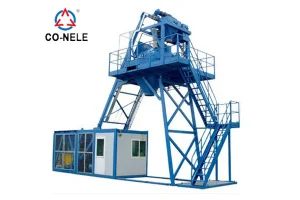
| Custom Engineering Flexibility | Rapid Modular Adaptation | Fixed Standard Catalogs | Easily adapts to low headroom or retrofit batching towers |
| PLC & Electrical Integration | Open Architecture (Siemens/Schneider) | Proprietary Locked Software | Zero vendor lock-in; easy local technician troubleshooting |
Beyond capital savings, Chinese manufacturers offer flexible OEM/ODM customization. Troughs can be fabricated with stainless steel claddings for corrosive chemical or glass aggregate applications, equipped with heating jackets for sub-zero winter batching in Northern Europe/North America, or outfitted with high-temperature thermal insulation for desert projects in the Middle East.
From massive hydromechanical dams to ultra-precise precast segment production, twin shaft paddle machinery is tailored to specialized concrete formulations.
High-throughput commercial batching plants demand reliable, rapid cycle times. Twin shaft paddle mixers discharge a standard $3 \text{ m}^3$ to $6 \text{ m}^3$ batch in under 12 seconds, allowing transit mix trucks to load rapidly without material segregation or throat clogging.
RCC involves extremely low slump, harsh dry mixes with large aggregate sizes up to $80 \text{ mm}$. The compulsory paddle geometry exerts massive vertical and horizontal shear forces, forcing water through zero-slump pastes where gravity mixers fail completely.
Bridge segments and tunnel vault liners require high early strength and zero surface voids. Twin shaft paddle units incorporate vacuum degassing ports and high-shear liquid additive injection manifolds to yield flawless structural precast finishes.
UHPC formulations contain dense micro-silica matrix powders and up to 3% by volume steel micro-fibers. Specialized twin shaft paddle configurations prevent steel fiber balling, distributing fibers homogeneously throughout the dense cement paste.
Industrial waste recycling, fly ash stabilization, and steel mill refractory lining batching present brutal abrasive wear conditions. Reinforced twin shaft mixers with thick ceramic/metallic liners handle extreme temperatures and abrasive feeds continuously.
Precision mixing of aluminum powder pastes with sand/lime slurries requires controlled gentle folding action after high-speed premixing. Dual-speed motor configurations allow smooth speed transitions to preserve delicate air bubble distributions.
Unplanned downtime in a concrete batching facility can cost thousands of dollars per hour in delayed transit mixers and cold-joint risks on job sites. Maximizing the operational availability of a twin shaft paddle mixer requires a rigorous understanding of component wear mechanisms and predictive maintenance schedule execution.
Frictional wear inside the mixing trough occurs primarily via three-body abrasion, where mineral particles (silica quartz, granite dust) slide between the moving paddle blade and the stationary trough liner. High-chromium cast irons ($Cr \ge 26\%$) form hard chromium carbides ($M_{7}C_{3}$) embedded within a martensitic matrix. This metallurgical micro-structure resists scratch cutting from hard aggregates up to 7 Mohs hardness.
To optimize wear distribution across the mixer trough, Chinese engineers design paddle blades with symmetrical, reversible mounting brackets. When the leading edge of a paddle tip wears by 15-20 mm, field maintenance crews can unbolt the paddle, rotate it 180 degrees, and reinstall it on the arm. This simple design feature effectively doubles component service life before requiring complete blade replacement.
Factory Best Practice: Always check paddle-to-liner clearances during weekly maintenance inspections. Maintaining an optimal gap between $3 \text{ mm}$ and $5 \text{ mm}$ prevents aggregate wedging—a major cause of micro-cracking in paddle arms and unnecessary electrical current spikes in the main drive motors.
The single most critical vulnerability in any horizontal compulsory concrete mixer is the shaft-end seal. If cementitious slurry bypasses the primary seal, it quickly destroys the main spherical roller bearings. Modern Chinese factories employ an active pressure grease barrier system. An automated electric grease pump injects high-viscosity NLGI Grade 2 or Grade 3 lithium-based lubricant into four independent seal chambers continuously whenever the drive motors are running.
The positive grease pressure creates an outward barrier flow, flushing out any fine dust particles attempting to migrate along the drive shaft. Visual flow indicators and electronic pressure transducers trigger immediate PLC alarm warnings if grease pressure drops below 15 bar, allowing operators to fix lubricant blockages long before seal contamination occurs.
Explore specialized industrial equipment, granulating mixers, mobile batching plants, and lab-scale testing systems engineered for global exports.
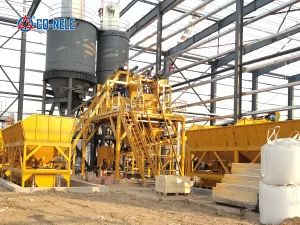
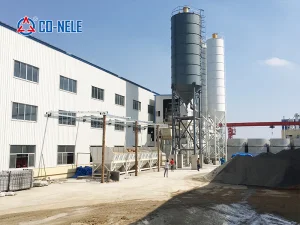
In-depth responses compiled by senior process engineers covering selection criteria, maintenance, electrical compatibility, and performance verification.
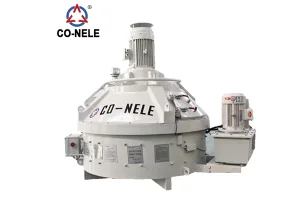
The primary distinction lies in batch throughput versus micro-homogeneity for specialized recipes. A Twin Shaft Paddle Mixer operates horizontally with dual counter-rotating shafts, producing massive 3D counter-current vortex flow. It is optimized for high-volume commercial ready-mix concrete ($1.0 \text{ m}^3$ to $6.0 \text{ m}^3$ per batch) and heavy aggregate mixes where rapid 30-45 second cycle times are required. A Vertical Shaft Planetary Mixer utilizes counter-current star kinematics, making it preferred for dry-cast paving blocks, colored concrete, UHPC, and refractory castables requiring absolute micro-homogeneity ($CV < 2.0\%$) at smaller batch sizes.
Modern Chinese mixing machinery uses a quad-seal protection system. This consists of: (1) replaceable floating mechanical tungsten-carbide face seals, (2) flexible multi-groove rubber labyrinth rings, (3) steel seal rings, and (4) an automated electric lubrication pump that continuously forces grease into the sealing cavities under high pressure. This continuous outward grease pressure flushes away fine aggregate dust and cement paste, keeping the main spherical roller bearings isolated from slurry contamination.
With standard High-Chromium Alloy wear liners and blades ($HRC \ge 62$), a twin shaft paddle mixer typically achieves between 80,000 to 120,000 batches on standard commercial ready-mix concrete. When handling highly abrasive quartz aggregate, gravel, or refractory mixtures, component lifespan ranges from 40,000 to 60,000 batches. All interior trough liners are designed as standardized, bolt-on rectangular tiles, allowing individual worn tiles to be replaced in the field within hours without cutting or welding.
Yes. Leading Chinese export manufacturers build electrical control cabinets to international standards (CE, UL, CSA compliance on request). Mixers are routinely fitted with Siemens S7-1200/1500 PLC systems, Schneider low-voltage breaker components, and Danfoss or ABB Variable Frequency Drives (VFDs). Proximity sensors, hydraulic gate position limit switches, and motor thermistors use standardized PROFINET, Modbus, or Ethernet/IP communication protocols for plug-and-play connection to existing batching plant software.
Motors and hydraulic pump stations are custom-wound to match the destination country's grid supply. Standard export options include 380V/50Hz (China/Europe/SE Asia), 415V/50Hz (Australia/UK/India), 460V/60Hz or 480V/60Hz (North America), and 220V/380V/60Hz (South America/Philippines). Dual-voltage tropicalized motors with IP55/IP65 ingress protection ratings are standard for extreme humidity or desert job site deployments.
Before dispatch, every mixer undergoes a mandatory 4-hour dry-run and wet-load factory test bench evaluation in Qingdao. Engineers monitor vibration spectrums across drive gearboxes, check current draw balance between twin drive motors, test hydraulic gate opening/closing speeds under pressure, and verify zero oil leakage across shaft end seals. Comprehensive test certificates, video recordings, and dimensional inspection reports are provided to overseas procurement teams prior to packing in heavy sea-worthy open-top containers or flat racks.