CO-NELEMixing & Granulation
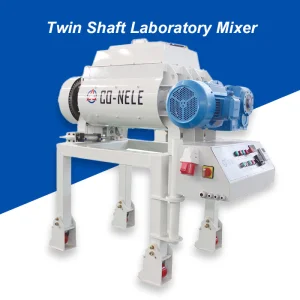
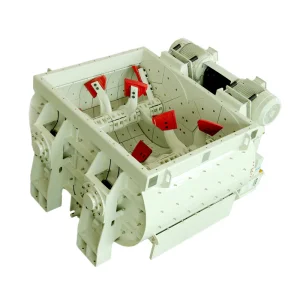
In modern industrial concrete manufacturing, the twin shaft concrete mixer represents the pinnacle of compulsory forced-mixing technology. Unlike traditional gravity-feed tilter drums or single-shaft mixers, twin shaft mixers utilize two horizontally mounted counter-rotating shafts fitted with synchronized mixing arms and paddles. This mechanical configuration creates a high-intensity 3D turbulent mixing zone where materials are subjected to intense axial, radial, and cross-directional shears simultaneously.
The core mechanism of the CHS Twin Shaft Concrete Mixer Series manufactured by Qingdao CO-NELE Machinery relies on precisely calculated paddle angles (set at $45^\circ$ to $60^\circ$ pitch angles relative to the shaft axis). As the twin shafts spin synchronously in opposite directions—powered by a dual-motor drive coupled with an integrated synchronous gearbox—the mixing arms sweep through overlapping arcs. This creates continuous helical ribbon movements that drive material from the ends of the mixing trough to the center, and from the bottom to the top surface.
Historically, the weakest point of any industrial twin shaft mixer has been shaft-end slurry leakage. Cement slurry penetrating the shaft bearing assemblies causes catastrophic mechanical failure, high maintenance costs, and operational downtime. China's leading twin shaft mixer factories have solved this engineering bottleneck through multi-stage sealing architectures:
Global decarbonization mandates require mixers capable of handling low-binder, high-slag, fly ash, and Calcined Clay Limestone Cement (LC3) mixes. Twin shaft mixers offer superior shear to disperse ultrafine pozzolans with low water-cement ratios.
Modern factories integrate real-time torque monitoring, inline microwave moisture sensors, and dynamic slump estimation. Embedded sensors continuously output data to PLC controllers to automatically adjust water/admixture dosing mid-cycle.
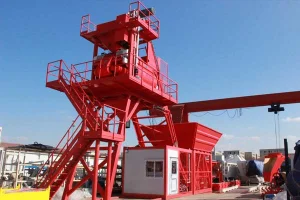
Global infrastructure contracts demand foundationless and mobile batching plants. Twin shaft mixers are now engineered with compact footprints, integrated discharge hoppers, and containerized transport dimensions (20ft/40ft HQ).
The commercial viability of a twin shaft mixer in high-volume ready-mix or dam construction depends heavily on maintenance downtime. China's top mixing machinery producers have shifted from standard manganese steel liners to ultra-hard alloy castings. Liners and paddles manufactured from High-Chromium Alloy Cast Iron ($Cr26$, hardness $\ge 60-64 \text{ HRC}$) offer service lives exceeding 150,000 batch operations under standard aggregate abrasion, drastically reducing operational expenditure (OPEX).
When international procurement teams evaluate China Twin Shaft Concrete Mixer Hot Sale Factory & Machine options, purchasing decisions have evolved beyond initial purchase price (CAPEX). Senior project managers evaluate Total Cost of Ownership (TCO), power efficiency per cubic meter ($kWh/m^3$), wear replacement speed, and cross-border spare parts logistics availability.
| Evaluation Parameter | Standard Single-Shaft / Drum Mixer | CO-NELE CHS Twin Shaft Concrete Mixer | Direct Operational Advantage |
|---|---|---|---|
| Mixing Cycle Time | 75 – 120 Seconds | 30 – 45 Seconds | +60% Plant Batch Capacity per Hour |
| Concrete Homogeneity (CV) | ≤ 10% Variation | ≤ 4.5% Micro-Variation | Lower cement consumption by 5-8% for same target strength |
| Specific Power Consumption | 1.8 – 2.4 kWh / m³ | 1.1 – 1.4 kWh / m³ | Up to 35% reduction in electricity costs per batch |
| Shaft Seal Service Life | 15,000 – 30,000 Batches | 100,000+ Batches | Eliminates frequent emergency downtime and bearing replacements |
| Discharge Gate System | Pneumatic Single position | Hydraulic Multi-Position Sensor Controlled | Adjustable discharge velocity; prevents segregration in truck mixers |
China's industrial machinery manufacturing sector in Qingdao has matured into a global center for mixing technology innovation. Qingdao CO-NELE Machinery Co., Ltd. combines advanced European mixing kinematics with local supply chain scale. Possessing over 80 national patents and three dedicated production facilities covering 30,000 m², CO-NELE controls every aspect of fabrication—from laser cutting and automatic robotic welding to in-house planetary and synchronous gearbox bench testing.
For commercial concrete suppliers operating HZS120 to HZS240 plants, CHS twin shaft mixers deliver continuous output up to 240 m³/h. High-throughput hydraulic discharge gates allow rapid loading of transit mixers without slurry splash or segregation.
Precast structural elements (beams, hollow core slabs, wall panels, paver blocks) demand zero-slump or semi-dry concrete. The compulsory high-shear action eliminates dry lumps and aggregate balling, ensuring pristine surface finish and high structural density.
Dam foundations, nuclear power containment structures, and marine anti-scour blocks require aggregate sizes up to 120mm-150mm. CO-NELE engineers heavy-duty reinforced mixer models equipped with high-torque gearboxes designed for extreme aggregate mass.
| Model Designation | Charging Capacity (L) | Discharging Capacity (L) | Mixing Motor Power (kW) | Max Aggregate Size (Slump / Dry) | Hydraulic Gate Power |
|---|---|---|---|---|---|
| CHS 750 / 500 | 750 L | 500 L (0.5 m³) | 18.5 kW | 60 mm / 40 mm | 2.2 kW |
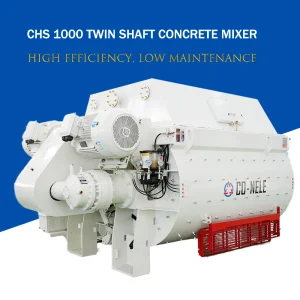
| CHS 1500 / 1000 | 1500 L | 1000 L (1.0 m³) | 2 x 18.5 kW | 80 mm / 60 mm | 3.0 kW |
| CHS 2250 / 1500 | 2250 L | 1500 L (1.5 m³) | 2 x 30 kW | 80 mm / 60 mm | 3.0 kW |
| CHS 3000 / 2000 | 3000 L | 2000 L (2.0 m³) | 2 x 37 kW | 100 mm / 80 mm | 3.7 kW |
| CHS 4500 / 3000 | 4500 L | 3000 L (3.0 m³) | 2 x 55 kW | 120 mm / 80 mm | 5.5 kW |
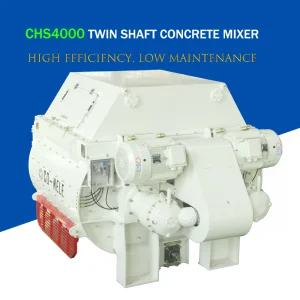
| CHS 6000 / 4000 | 6000 L | 4000 L (4.0 m³) | 2 x 75 kW | 150 mm / 100 mm | 7.5 kW |
To meet global regulatory mandates, CO-NELE twin shaft mixers and automated concrete batching plants comply fully with regional engineering standards:
One of the major concerns for international equipment buyers is long-term spare part availability. Qingdao CO-NELE maintains an archived inventory of engineering blueprints and bolt-on wear parts for every mixer model produced since 2004. High-chrome mixing arms, side liners, floor liners, shaft seals, and discharge rubber seals ship directly from stock in Qingdao within 24 to 48 hours via DHL/FedEx or consolidated containerized freight.
Next-gen twin shaft mixers will integrate vibration acoustic sensors into main drive gearboxes and shaft bearings. Edge-AI modules process real-time harmonics to detect micro-wear weeks before mechanical breakdown occurs.
By pairing VFD-controlled heavy-duty motors with dynamic recipe algorithms, mixing speed automatically adjusts dynamically during loading, intensive shearing, and discharge phases—saving up to 22% total energy per batch.
As UHPC and 3D concrete printing gain global momentum, specialized twin shaft mixers with high shear mixing arms and high RPM rotors are being designed to disperse micro-steel fibers uniformly without fiber clumping.