CO-NELEMixing & Granulation
Precision-engineered mixing solutions manufactured directly at our Qingdao industrial production facility.
The global construction, ready-mix concrete (RMC), and precast infrastructure sectors have undergone a fundamental paradigm shift over the last two decades. As modern civil engineering projects demand higher compressive strength grades (ranging from conventional C30/C40 mixes up to C80+ high-performance concrete and Ultra-High-Performance Concrete - UHPC), the choice of concrete mixing machinery directly determines project structural integrity, cement hydration efficiency, and operational profitability.
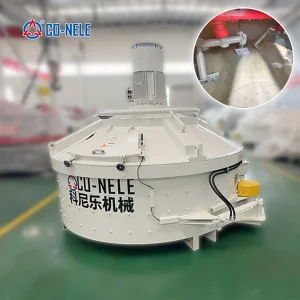
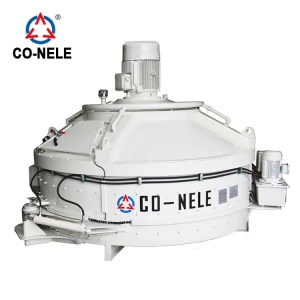
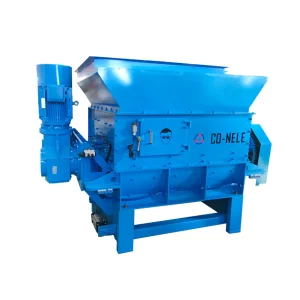
Searching for a high-performance China Twin Shaft Concrete Mixer For Sale Manufacturer & Factory is no longer merely a low-cost procurement exercise for global engineering firms. Instead, it represents a strategic decision to partner with technologically advanced, vertically integrated manufacturing hubs capable of supplying compulsory mixing machinery that meets European CE standards, American ASTM metrics, and ISO9001 quality management guidelines.
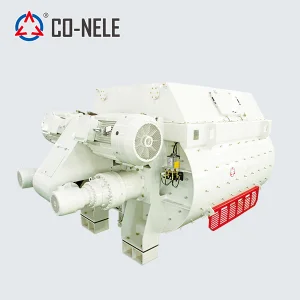
Technical Information Gain: Unlike traditional tilting drum mixers that rely on gravitational falling action, compulsory horizontal twin shaft concrete mixers utilize counter-rotating dual shafts fitted with overlapping mixing arms. This configuration subjects coarse aggregate, fine sand, cementitious powder, water, and chemical admixtures to severe three-dimensional counter-current turbulent shear zones, achieving micro-homogeneity within 30 to 45 seconds per batch cycle.
Manufacturers based in Qingdao, Shandong Province—most notably QINGDAO CO-NELE MACHINERY CO., LTD. (established in 2004)—have pioneered key breakthroughs in heavy-duty twin shaft mixing hydraulics, shaft-end seal isolation technology, and wear-resistant alloy metallurgy. As global demand for ready-mix infrastructure accelerates across North America, Europe, the Middle East, Southeast Asia, and Latin America, Chinese twin shaft concrete mixers have captured a commanding share of the commercial batching plant equipment export market.
To evaluate why commercial ready-mix suppliers and precast concrete plants overwhelmingly select twin shaft compulsory mixers over single-shaft or vertical drum alternatives, one must examine the fluid dynamics and mechanical forces inside the mixing trough during high-speed batch execution.
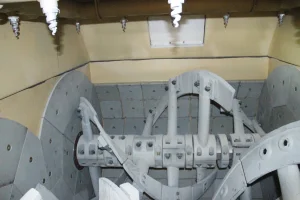
Two horizontal shafts rotate inward toward one another at controlled angular velocities (typically 24–32 RPM). The arrangement creates intense axial and radial material turbulence, eliminating localized segregation of heavy aggregates.
Mixing paddles mounted at calculated 45-degree and 60-degree pitch angles force the charge to flow in a continuous double-spiral vortex. Aggregate particles collide in mid-air, stripping water-film barriers off cement particles for rapid chemical reaction.
By maximizing mechanical friction dissipation inside the aggregate mass, total mixing cycle times drop to 30–45 seconds. This reduces electrical consumption per cubic meter of concrete by up to 18–25% compared to single-shaft setups.
| Performance Parameter | Twin Shaft Concrete Mixer (CHS Series) | Vertical Planetary Mixer (CMP Series) | Legacy Tilting Drum Mixer | Single Horizontal Shaft Mixer |
|---|---|---|---|---|
| Mixing Kinematics | Dual Horizontal Counter-Rotating Shear | Counter-Current Vertical Planetary Rotation | Gravity Free-Fall Cascade | Single Shaft Radial Displacement |
| Homogeneity Coefficient (CV%) | < 5% within 30-45 Seconds | < 3% within 60-90 Seconds (Micro-mixing) | > 12% (Requires 120-180 sec) | < 8% within 60-90 Seconds |
| Target Applications | High-Throughput RMC, Infrastructure, Mass Dams | Precast, UHPC, GFRC, Block Bricks, Glass | Small Construction, Low-Grade Site Mix | Medium Ready-Mix, Asphalt Base Mortar |
| Max Coarse Aggregate Size | Up to 80 mm - 120 mm (High Clearance) | Up to 40 mm - 60 mm | Up to 60 mm | Up to 60 mm |
| Wear Part Longevity (Batches) | 90,000 – 150,000 (High-Chrome Alloys) | 100,000 – 160,000 (Field Replaceable) | 15,000 – 30,000 (Low Alloy Plate) | 40,000 – 70,000 (Standard Manganese) |
When enterprise buyers submit inquiries for a China Twin Shaft Concrete Mixer For Sale Manufacturer & Factory, they are assessing not only unit purchase prices, but the complete ecosystem of precision manufacturing, engineering expertise, and quality verification backed by Chinese heavy machinery clusters.
Unlike assembler factories that procure white-label gearboxes, leading manufacturers like CO-NELE design and build synchronized planetary reducers and heavy-duty gearboxes in-house. Every gearbox undergoes strict load bench testing to ensure long-term torque transfer under continuous full-capacity operation.
The single most critical failure point in legacy horizontal concrete mixers is cement slurry penetrating the shaft-end bearings. Chinese twin shaft mixer factories have developed multi-stage floating seal rings, auto-greasing hydraulic lubrication pumps, and mechanical air-pressure purge systems that guarantee zero slurry ingress.
Mixing paddles and pan liners are cast from ultra-high-chrome alloy irons (Cr26/Cr28 grade) with a Rockwell hardness rating exceeding HRC ≥62. This metallurgy delivers exceptional resistance against quartz sand abrasion, extending wear component life past 120,000 batch cycles.
Qingdao’s industrial supply chain integrates raw steel processing, automated robotic welding, CNC boring mills, and heat treatment facilities within a 50-kilometer radius. This geographic integration cuts production overhead by 30-40% compared to Western European machinery builders without sacrificing engineering tolerances.
Twin shaft concrete compulsory mixers exported from China serve diverse civil engineering sectors worldwide. Below are four primary field application categories where forced twin-shaft mixing drives measurable project savings:
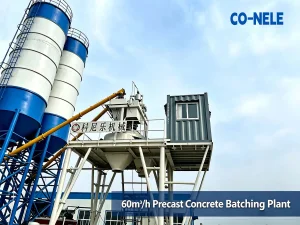
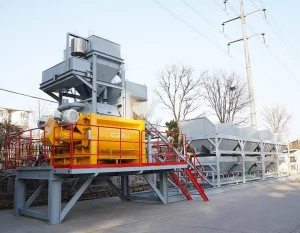
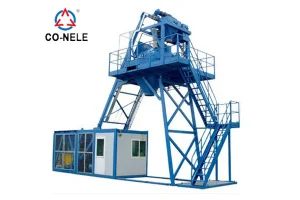
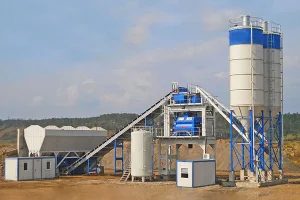
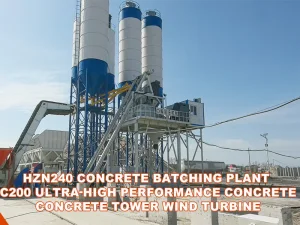
Integrated as the mixing core inside stationary concrete batching plants ranging from HZS60 (60 m³/h) to HZS180 (180 m³/h). Dual hydraulic discharge gates allow rapid dumping into transit mixer trucks, keeping plant cycle times tight and preventing truck bottlenecks.
Infrastructure construction demands large aggregate sizes (60mm to 120mm) and Roller-Compacted Concrete (RCC). CO-NELE twin shaft mixers feature enlarged tub volumes and reinforced arms to handle heavy rock loads without stalling or causing mechanical binding.
From precast concrete wind turbine towers to bridge girders and metro tunnel lining segments, twin shaft mixers deliver uniform slump and air-entraintment parameters, guaranteeing zero honeycombing or structural voiding upon formwork stripping.
Specialized twin shaft designs are deployed in dry-powder mortar production and batch asphalt lines, utilizing wear-resistant spirals to process hot sand, bitumen binders, fine fillers, and chemical add-ins under elevated process temperatures.
International equipment buyers must evaluate equipment acquisitions using a holistic 10-year Total Cost of Ownership framework rather than focusing solely on upfront FOB machinery quotes. When calculating long-term ROI for twin shaft mixers, engineering decision-makers should evaluate five core factors:
Always size mixers based on net compacted batch output (e.g., CHS2000 produces 2.0 m³ per batch of finished concrete), not dry feed volume. Ensure batch cycles sync with aggregate hopper weighing speeds.
Opt for premium energy-efficiency electric motors coupled with variable frequency drives (VFDs). Soft-starting under full batch load reduces peak current spikes on job site generators by up to 40%.
Verify that replacement wear blades, liner plates, and seals are standardized and field-replaceable with bolt-on designs. CO-NELE maintains interchangeable spare stock for all machine models produced since 2004.
Total Cost of Ownership Equation: TCO = Capital Purchase Cost + (Power kW/h × Operating Hours) + (Wear Part Replacement Rate × Tonnes Mixed) - Scrap Residual Value. Operating a high-efficiency Chinese twin shaft mixer with high-chrome alloy wear parts typically yields full payback within 14 to 18 months of continuous production.
As the international construction industry pivots toward net-zero carbon goals and digital job site monitoring, concrete mixing machinery must evolve. Chinese twin shaft mixer manufacturers are leading the integration of next-generation digital tech into mixing hardware:
Modern twin shaft mixers incorporate embedded vibration sensors, bearing temperature probes, and oil quality transducers. Real-time telemetry alerts maintenance teams to shaft seal wear or gearbox thermal shifts before mechanical failure occurs.
Integrated high-frequency microwave moisture probes mounted inside the mixing pan continuously monitor fine aggregate water content. The PLC automatically adjusts water dosing mid-cycle to guarantee exact target slump consistency.
Blending high-volume supplementary cementitious materials (SCMs) such as fly ash, blast furnace slag, and calcined clays requires intense shear energy to break powder agglomerates. Forced twin shaft mixers ensure complete chemical dispersion in low-cement mixes.
Choose a twin shaft concrete mixer when your operational primary goal is high-volume output (above 1.0 m³ to 6.0 m³ per batch) for ready-mix concrete, road base, dams, or heavy civil infrastructure where rapid cycle times of 30–45 seconds matter most. Choose a vertical planetary mixer when working with specialty ultra-high-performance recipes (UHPC, GFRC, refractory castables, pigmented paving blocks) requiring micro-homogeneity below a 3% coefficient of variation.
CO-NELE twin shaft mixers utilize a proprietary 5-stage mechanical seal system combining floating face seal rings, labyrinth seal chambers, high-pressure greasing ports fed by an automatic electric lubrication pump, and outer seal rings. This setup maintains constant outward hydraulic pressure, preventing abrasive cement slurry from contacting outer spherical roller bearings.
All machines manufactured at our Qingdao facility are custom-built to match international job site electrical standards, including 220V, 380V, 415V, 440V, 460V, and 480V at 50 Hz or 60 Hz. Electrical control cabinets feature Siemens or Schneider PLCs with optional CE certification, touch-screen HMIs, and multi-language software (English, Spanish, Russian, French, Arabic).
Under standard operating conditions using high-chrome alloy wear components (Cr26/Cr28), liner plates and mixing arms routinely exceed 90,000 to 150,000 batch cycles on standard ready-mix aggregates. For highly abrasive quartz gravel or crushed granite, lifespans average 50,000 to 80,000 batches. All wear parts are 100% bolt-on for fast field replacement.
Yes. CO-NELE CHS series twin shaft concrete mixers feature an open-trough geometry with extended clearance between mixing paddle tips and inner liners. Models engineered for heavy infrastructure can handle maximum aggregate particle sizes up to 80 mm (standard) and up to 120 mm with reinforced arm configurations.
Every mixer ships with a standard 12-month structural and drive warranty. Critical spare parts (seal kits, liner bolts, blades, sensors) are supplied in a sea-worthy spare kit included with the machinery shipment. Replacement orders ship directly from stock at our Qingdao air/sea port hubs within 24 to 48 hours via DHL, FedEx, or fast sea freight.
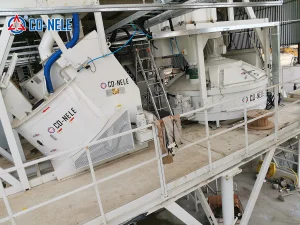
Absolutely. CO-NELE provides detailed CAD foundation layout drawings, bolt hole mounting dimensions, and hopper discharge transition dimensions. Our engineering department routinely assists global contractors with retrofit projects, replacing worn-out mixers with modern twin shaft units inside existing batching towers.
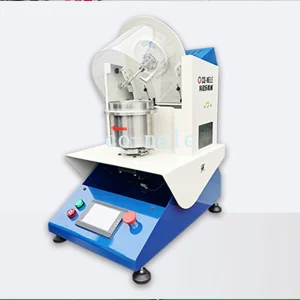
Explore specialized machinery lines, dry mortar setups, asphalt mixers, and laboratory equipment.