
CO-NELEMixing & Granulation
Explore premier industrial mixing machinery engineered for planetary concrete production, intensive refractory blending, and high-precision sand batching plants.
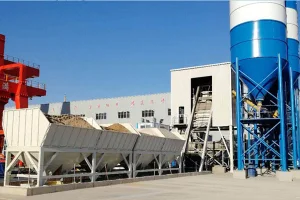
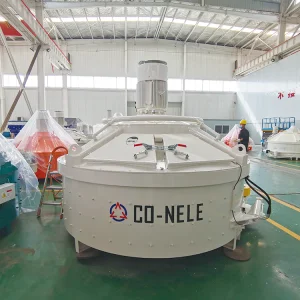
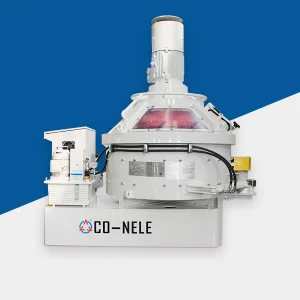
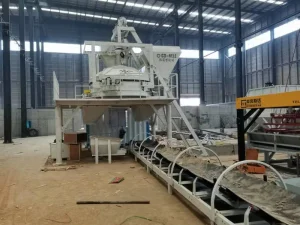
In modern heavy industry, material processing efficiency relies heavily on industrial mixing systems. From green sand casting foundries and silica-glass production to Ultra-High Performance Concrete (UHPC) and refractory liner manufacturing, mixing homogeneity dictates end-product structural integrity. The global market for industrial sand mixers has undergone a paradigm shift, transitioning from basic gravity-assisted tilting drum mixers to high-shear compulsory planetary and intensive mixer-granulators.
In foundry environments, improper sand preparation—specifically uneven distribution of bentonite clay, water, and carbonaceous additives—leads directly to casting defects such as pinholes, sand burn-on, and scabbing. In civil engineering and precast concrete manufacturing, inadequate dispersion of silica sand fine aggregates yields micro-voids, compromising compressive strength and freeze-thaw resistance. As global infrastructure specifications tighten under ISO and ASTM standards, industrial buyers are phasing out legacy mixing machinery in favor of counter-current planetary sand mixers that achieve a Coefficient of Variation (CV) below 3% within rapid mixing cycles.
The economic trajectory of sand mixing machinery is defined by automated batch control, extreme wear resistance, and optimized kilowatt-per-ton energy efficiency. Industrial operations are no longer seeking merely a mixing container, but an integrated processing system capable of real-time moisture monitoring, dynamic shear adjustment, and dust-tight environmental sealing.
Evaluating a **China Sand Mixer Price** requires a comprehensive understanding of the Total Cost of Ownership (TCO), capital expenditure (CAPEX), and operational expenditure (OPEX). Sourcing an industrial sand mixer directly from a Tier-1 China factory provides a typical 30% to 50% cost advantage over Western European or North American OEMs without compromising structural component reliability or mixing mechanics.
The primary cost determinant is the planetary transmission gearbox. Proprietary heavy-duty co-axial planetary reducers withstand high torsional loads during dry-sand startup compared to standard commercial speed reducers.
Abrasive silica sand severely erodes interior contact surfaces. Premium China mixers utilize high-chrome alloy plates (HRC ≥ 62) or cast tungsten-carbide mixing blades, shifting upfront price but extending liner life past 120,000 batches.
Integration of microwave moisture probes, automated liquid dosing valves, and Siemens S7-1500 PLC control panels accounts for 15-25% of overall plant equipment expenditure.
The table below outlines international price distribution across standard sand mixer machine categories originating from top-tier Chinese manufacturing hubs versus European benchmark pricing.
| Mixer Type & Output Capacity | Primary Industrial Application | China Factory Direct Price Range (USD) | Western European OEM Price Range (USD) | Expected Wear Part Lifespan |
|---|---|---|---|---|
| Laboratory Intensive Sand Mixer (50L - 150L) | Foundry R&D, Refractory Formula Testing | $8,000 – $18,000 | $28,000 – $55,000 | 50,000 Batches |
| Medium Planetary Sand Mixer (500L - 1000L) | Precast Concrete, Resin Sand Foundry Lines | $22,000 – $45,000 | $65,000 – $120,000 | 100,000 Batches |
| Heavy Duty Intensive Mixer (1500L - 3000L) | Glass Batching, High-Volume Refractories | $55,000 – $110,000 | $160,000 – $320,000 | 150,000 Batches |
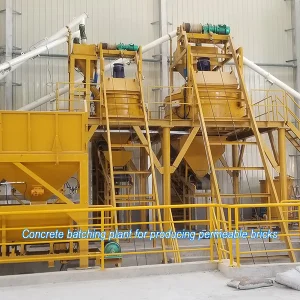
| Complete Sand Batching & Mixing Plant | Turnkey Permeable Brick & Dry Mortar Plants | $120,000 – $350,000 | $400,000 – $950,000 | Full Plant Lifecycle Maintenance |
The competitiveness of Chinese sand mixer machinery is rooted in advanced manufacturing ecosystems, particularly within industrial hubs like Qingdao, Shandong Province. Over two decades of industrial modernization have established a vertically integrated supply chain where raw steel, precision machining, heat treatment, and gearbox assembly occur within tight geographical radii.
Leading Chinese manufacturers, such as CO-NELE, do not assemble bought-in components. They design and machine proprietary planetary gearboxes in-house using 5-axis CNC machining centers. Gear grinding, carburizing heat treatment, and static/dynamic load testing are conducted internally, ensuring gear accuracy meets DIN Class 6 standards while mitigating foreign supply chain bottlenecks.
Every sand mixer undergoes non-destructive weld testing, ultrasonic gear flaw detection, and a 48-hour continuous wet-load bench test prior to export packaging.
With 30,000 m² of centralized manufacturing capacity across multiple production bases, Chinese factories can deliver standard planetary mixers within 20-30 days of order confirmation—compared to 16-24 week lead times common in Western markets. The resilience of China's domestic steel industry further shields global buyers from wild raw-material price surges.
For procurement directors, plant managers, and EPC engineering firms, selecting the correct industrial sand mixer requires evaluating key technical criteria beyond upfront machine price. Matching machine kinematics to material properties is critical to avoiding post-installation downtime.
Evaluate whether your raw material requires compulsory low-shear folding (e.g., fragile aggregate concrete) or high-energy shear dispersion (e.g., bentonite resin sand, ceramic powders). Planetary counter-current arms sweep 100% of the pan floor every 4 revolutions.
Hydraulically operated discharge doors equipped with rubber wiper seals prevent fine sand slurry leakage. Multi-point discharge options allow dual feeding into block-making machines or bucket conveyors.
Ensure global electrical compatibility (220V/380V/415V/440V at 50Hz or 60Hz). Demand CE certification, IP65 dust-proof motor enclosures, and dual safety-interlocked access hatches.
Industrial sand mixers are non-standard processing units tailored to specific material characteristics. Below are five verified industrial applications where planetary counter-current and intensive mixing technology deliver operational gains.
In iron and steel foundries, sand reconditioning requires rapid coating of silica sand grains with liquid resin, hardeners, or bentonite clay. Intensive mixers utilize dynamic rotor tools that shear agglomerates without crushing primary sand grains, achieving uniform bench life and optimal mold permeability.
UHPC formulations mix quartz sand, micro-silica powders, and steel fibers with low water-cement ratios (< 0.20). Standard twin-shaft mixers often create balling of steel fibers. Planetary counter-current mixers ensure complete fiber dispersion and void elimination, delivering compressive strengths exceeding 150 MPa.
Refractory bricks and monolithic castables combine heavy corundum aggregates with ultra-fine silica sand. Intensive pan mixers eliminate dead zones at pan walls, preventing matrix segregation during high-temperature furnace lining production.
Glass manufacturing demands complete homogenization of silica sand, soda ash, limestone, and cullet with micro-dosed liquid moisture. Stainless-steel lined planetary mixers prevent iron contamination in clear glass production lines.
Selecting the optimal sand mixer requires matching mechanical kinematics to the physical rheology of the mixture. The figure below compares key mechanical properties across three main compulsory industrial mixing architectures.
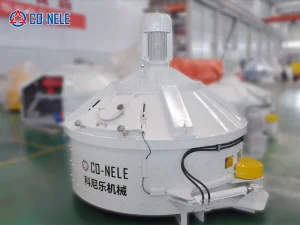
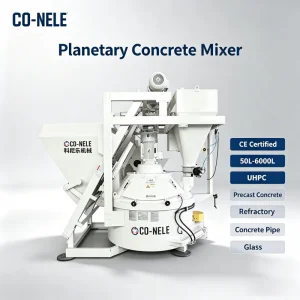
Planetary Counter-Current Mixing: Mixing stars rotate on a central axis while revolving in the opposite direction. No mechanical dead zones. Ideal for dry-cast sand, color pigments, and fine powders.
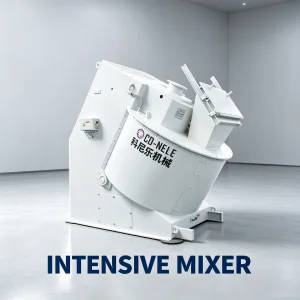
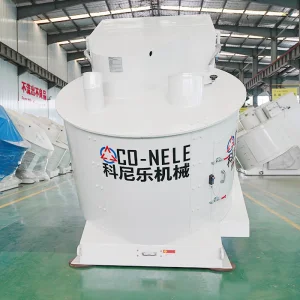
Intensive Rotor Mixing: An inclined, rotating pan transports material to a high-speed rotating tool. Separates pan drive from rotor drive for independent shear adjustment.
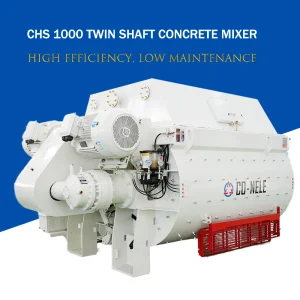
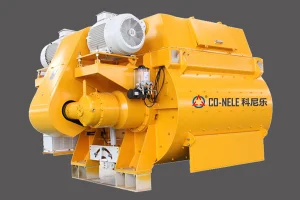
Twin-Shaft Horizontal Mixing: Dual horizontal shafts create a counter-rotating turbulence zone. Best suited for high-volume wet ready-mix concrete with coarse aggregates above 40mm.
Clear technical answers provided by CO-NELE mixing process engineers to streamline international machine evaluation.
A China Sand Mixer price depends primarily on mixing pan volume (liters/cubic meters), drive motor power (kW), internal wear liner material (high-chrome alloy plates vs. standard manganese steel), gearbox specification (proprietary planetary vs. commercial helical), and optional automation features like microwave moisture sensors and automated lubricators.
Planetary counter-current mixers eliminate material dead zones by ensuring mixing blades cover the entire pan area every few revolutions. This is critical for dry-cast concrete, pigmented paving blocks, glass sand batching, and UHPC where micro-homogeneity (< 3% CV) is required. Twin-shaft mixers excel at wet aggregate ready-mix concrete where speed supersedes fine dispersion.
When mixing highly abrasive quartz sand or refractory aggregates, standard manganese liners last approximately 30,000 to 50,000 batches. Upgrading to high-chrome alloy liners (HRC ≥ 62) or cast tungsten-carbide blade tips extends operational lifespan to 120,000–150,000 batches. All wear components in CO-NELE mixers are bolt-on for rapid field replacement.
Yes. Machinery is built to order according to local site electrical standards (e.g., 380V 50Hz, 415V 50Hz, 460V 60Hz, or 220V 60Hz). Motors can be specified to NEMA, IEC, or ATEX explosion-proof ratings. PLC control interfaces support multi-language navigation (English, Spanish, Russian, Portuguese, Arabic) and feature Siemens or Schneider electrical components.
CO-NELE operates an advanced material testing laboratory in Qingdao, China. Prospective international clients can ship 10–50 kg of raw sand, aggregates, or powders to our engineering facility. Our laboratory mixers conduct trial runs to analyze moisture curves, granule sphericity, mixing cycles, and energy consumption, delivering a technical test report prior to commercial contract signing.
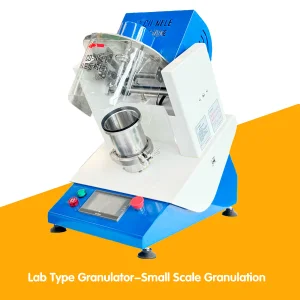
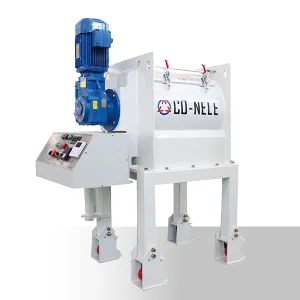
Explore specialized lab mixers, twin-shaft concrete machinery, granulators, and UHPC forced mixing solutions manufactured directly in Qingdao, China.
Contact our Qingdao engineering office to request technical specifications, custom CAD layout drawings, and competitive direct factory pricing for your upcoming project.
Request Custom Engineering Quote