
CO-NELEMixing & Granulation
Engineered with heavy-duty vertical shaft reducers, counter-current blade trajectories, and high-chrome wear resistance for zero-dead-zone batching.
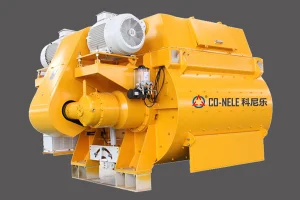
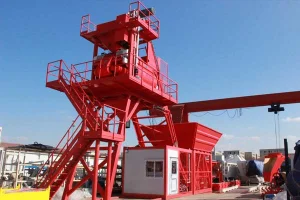
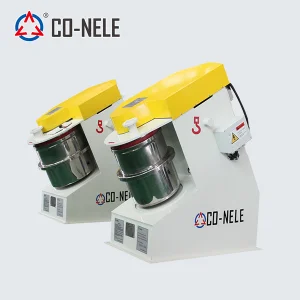
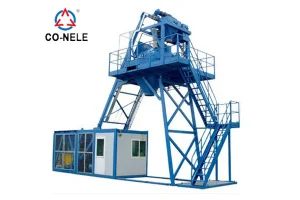
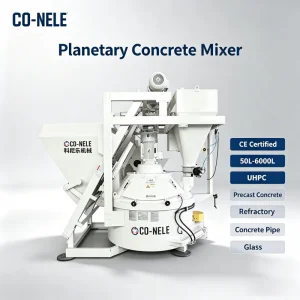
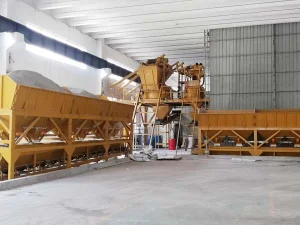
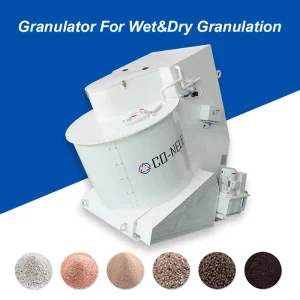
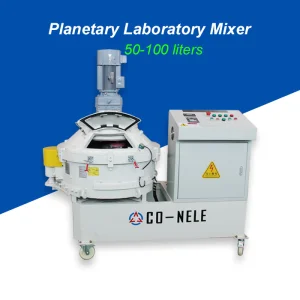
In modern industrial engineering, the demand for ultra-high strength, low-water-binder ratio, and micro-homogeneous concrete has exposed the physical limitations of traditional horizontal twin-shaft mixers. Planetary counter-current mixing represents the apex of forced-action mixing technology.
For decades, commercial ready-mix concrete plants relied heavily on twin-shaft horizontal mixers due to their high volumetric throughput. However, as civil infrastructure projects demand high-performance formulations—such as Ultra-High-Performance Concrete (UHPC), Glass Fiber Reinforced Concrete (GFRC), self-compacting concrete (SCC), and pigmented dry-cast paving blocks—conventional mixing dynamics fall short.
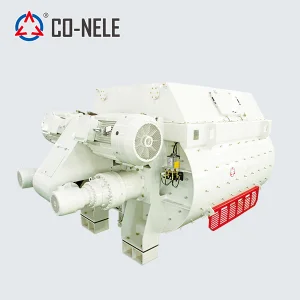
Horizontal twin-shaft mixers rely on overlapping paddle arcs that push aggregate laterally. While effective for wet mixes with large aggregates, they fail to achieve aggregate-matrix micro-homogeneity when handling micro-silica fumes, steel fibers, color pigments, and fine powders with low water-cement ratios (w/c < 0.25). Segregation, balling of fibers, and unmixed binder pockets routinely occur, resulting in compressive strength degradation.
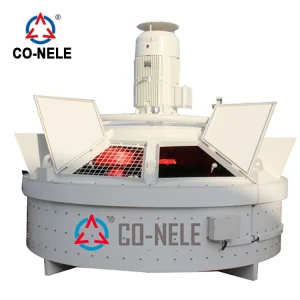
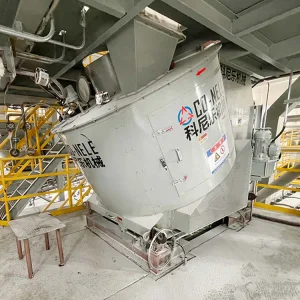
Conversely, a China planetary counter-current concrete mixer operates on a dual-motion mechanical principle: the mixing arms rotate around their own axes while simultaneously revolving around the central axis of the mixing pan. This overlapping kinematic path ensures that within a single revolution cycle, every millimeter of the mixing pan is swept. The counter-current interaction creates intense shear forces, rapidly breaking up agglomerates, dispersing micro-additives, and ensuring uniform coating of aggregate particles without mechanical crushing.
| Performance Metrics | Planetary Counter-Current Mixer | Horizontal Twin-Shaft Mixer | Conventional Pan Mixer |
|---|---|---|---|
| Mixing Homogeneity (CV) | Ultra-High (< 3%) | Moderate (5% - 8%) | Low (> 10%) |
| Dead Zone Elimination | 100% Complete Coverage | 15% - 20% Shaft End Dead Zones | 20% Center Core Dead Zone |
| Fiber & Pigment Dispersion | Ideal (Zero fiber balling) | Poor (Prone to fiber clumping) | Very Poor |
| Low W/C Ratio Adaptability | Excellent (W/C down to 0.18) | Struggles below W/C 0.35 | Unsuitable |
| Drive Reducer Life Expectancy | Heavy Duty (Designed for high torque) | Moderate (Shaft seal leakage risk) | Low (Standard bevel gear wear) |
| Primary Target Application | UHPC, Precast, Block, Refractory | Commercial Wet Ready-Mix | Basic On-site Wet Mixing |
Why Tier-1 global EPC contractors, concrete precast groups, and refractory producers select leading Chinese planetary concrete mixer manufacturers for critical installations.
Unlike assemblers who outsource critical drive components, top Chinese planetary mixer factories engineer and machine their own planetary gearboxes in-house. Utilizing high-alloy carburized steel gear teeth hardened to HRC 58-62, these reducers withstand extreme torsional shocks caused by dry concrete batches and fiber interlocking.
The mixing floor and sidewalls are protected by high-chrome alloy wear plates (Ni-Hard and Cr26 with hardness >60 HRC) and diamond-hard cast ceramic tiles. This delivers an operational service life exceeding 150,000 batches under high-abrasion silica and granite aggregate conditions, drastically reducing downtime.
Equipped with native Siemens S7 PLC integration, real-time microwave moisture sensors, torque-load feedback monitoring, and automated high-pressure washdown systems. The mixing cycle dynamically adjusts rotor speed based on batch viscosity to preserve electrical energy.
China’s fully integrated industrial ecosystem—spanning raw steel rolling, precision gear grinding, specialized foundry casting, and robotic welding—enables Chinese planetary mixer manufacturers to offer a total cost of ownership (TCO) that is 35% to 50% lower than Western European counterparts, without compromising on component quality or engineering tolerances. Spare parts are standardized and stocked globally, ensuring rapid dispatch within 24 to 48 hours.
Evaluating planetary concrete mixers requires matching structural parameters against aggregate sizing, moisture curves, discharge speeds, and target plant cycle times.
Planetary mixers are rated by dry charge capacity (L) and compacted concrete output (L). Model designations such as CMP500 (750/500L) or CMP3000 (4500/3000L) reflect the maximum batch volume. Overfilling leads to mechanical strain on the planetary stars, while underfilling reduces shear energy transfer.
Hydraulically operated discharge doors with multi-stage position sensors allow regulated dosing into bucket conveyors, block machines, or truck mixers. Dual-gate configurations enable simultaneous feeding to separate production lines, eliminating batch bottlenecks.
High-pressure liquid distribution rings spray water and liquid admixtures across the entire kinetic path rather than pouring into a central point. For fiber-reinforced concrete (UHPC/GFRC), high-speed chopper rotors are optionally integrated to de-agglomerate synthetic or steel fibers instantaneously.
From architectural precast concrete in Dubai to refractory brick manufacturing in Brazil, Chinese planetary mixers drive critical production processes across diverse operational environments.
Scenario: High-end bridge girders, segment rings, facade panels, and sound barriers requiring surface perfection and extreme strength (>150 MPa).
Why Planetary: Rapid dispersion of silica fume, nano-additives, and 2% steel fibers without fiber clump formations. Achieve smooth aesthetic surface finishes with zero air voids.
Scenario: Automated block machine plants producing double-layer colored pavers, kerbstones, and permeable ecological bricks in Eurasia, Africa, and Southeast Asia.
Why Planetary: Dry-cast concrete requires fast cycle times (45-60s) with low moisture (w/c 0.22-0.28). Planetary action provides uniform pigment distribution for vibrant, non-fading block colors.
Scenario: Sintering plants, blast furnace linings, ladle castables, and alumina-silicate brick raw material preparation in high-temperature industrial metallurgy.
Why Planetary: Handles ultra-dense, highly abrasive dry minerals without blade fracture. Specialized ceramic tiles and extra-heavy drive motors handle viscous thermal binders.
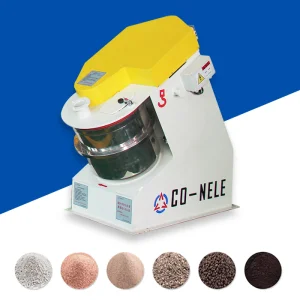
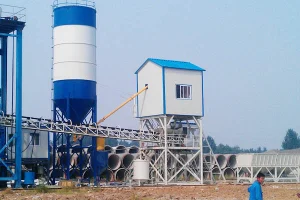
Explore our full range of concrete batching infrastructure, mobile plants, lab intensive mixers, and custom industrial pelletizing equipment.
Comprehensive engineering clarity from our Senior SEO Growth & Process Engineering Team.
A planetary mixer utilizes a single vertical shaft driving dual or triple star mixing arms that revolve around the pan while rotating on their own axes. This complex kinematic pattern covers 100% of the mixing floor every 4 revolutions, preventing dry material from sticking to walls or settling at shaft dead zones. Twin-shaft mixers rely on horizontal displacement, leaving up to 15% of material unmixed at shaft seals under dry-cast conditions (low w/c ratio < 0.25).
Direct factory procurement eliminates distributor margins (saving 30-40% on initial CAPEX). Leading Chinese manufacturers maintain complete modular spare part standardization. High-chrome wear plates, scraper arms, and planetary gear sets ship directly from Qingdao stock within 24-48 hours. Furthermore, standard CNC manufacturing tolerances ensure exact bolt-on alignment for field replacements without custom fitting.
Yes. All export machinery is custom-built to match regional power standards (e.g., 380V/50Hz, 415V/50Hz, 460V/60Hz, or 220V/60Hz 3-Phase). Mechanical configurations offer customizable discharge door heights, skip-hoist vs. belt-conveyed incline feeding, anti-dust extraction hoods, and low-headroom frame adaptations designed to slide seamlessly into existing batching towers.
Under standard precast concrete mixing, premium Cr26 high-chrome cast liners (HRC 60-65) achieve between 120,000 to 150,000 cycles. When processing highly abrasive materials such as quartz sand UHPC or refractory minerals, wear life averages 50,000 to 70,000 cycles. Optional tungsten-carbide coated blades and cast-diamond ceramic tile liners are available to double operational longevity under harsh conditions.
Mixers undergo stringent dry and wet batch testing using multi-point sampling across the mixing pan radius. Homogeneity is calculated via the Coefficient of Variation (CV) of cement concentration and aggregate distribution. A CV below 3% certifies micro-homogeneity. Factory acceptance tests (FAT) include full-load motor vibration monitoring, gearbox oil temperature testing, and hydraulic gate pressure testing, with complete video documentation provided to international buyers.