CO-NELEMixing & Granulation
Explore our top-tier planetary mixers, compact batching plants, and specialized material processing machinery engineered for global infrastructure standards.
An engineering breakdown of counter-current planetary kinematics, torque transfer dynamics, and structural reliability designed for demanding industrial mixing applications.
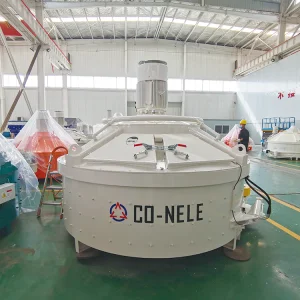
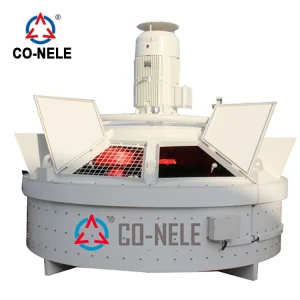
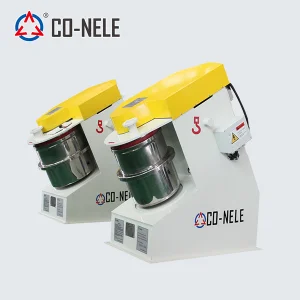
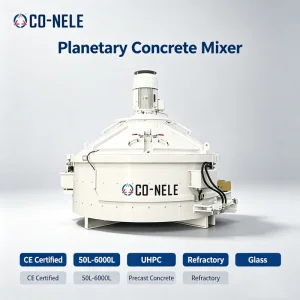
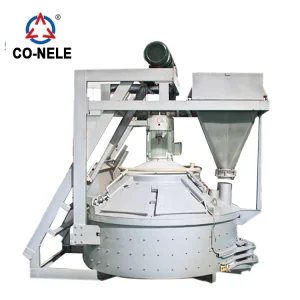
The MP2000 Planetary Concrete Mixer represents a paradigm shift from traditional horizontal twin-shaft and gravity-based mixing systems. Engineered specifically for complex mix designs requiring micro-homogeneity, the MP2000 utilizes vertical counter-current planetary mixing arms combined with outer wall scrapers.
During operation, the mixing stars rotate on their own central axis while simultaneously revolving around the main drive center column. This dual-kinematic motion ensures that the mixing blades sweep every square millimeter of the mixing pan within seconds, eliminating "dead zones" and preventing material agglomeration—a critical necessity when mixing Ultra-High-Performance Concrete (UHPC), fiber-reinforced concrete, and dense refractory mortars.
Selecting the correct mixing architecture directly dictates cement operational costs, cycle times, and ultimate structural integrity.
| Performance Metric | MP2000 Planetary Mixer | Standard Twin-Shaft Mixer | Traditional Ring-Pan Mixer |
|---|---|---|---|
| Mixing Kinematics | Epicyclic Planetary Counter-Current | Parallel Twin-Axis Counter-Rotating | Single Vertical Shaft Fixed Arms |
| Homogeneity (Coeff. of Variation) | ≤ 3% (Micro-Homogeneous) | ≤ 5% to 8% (Standard Wet Mix) | ≥ 10% (Frequent Dead Zones) |
| Dry Concrete & Semi-Dry Mix Suitability | Exceptional (Optimal for Precast/Blocks) | Moderate (Prone to shaft binding) | Poor (High wear on center hub) |
| UHPC & Fiber Dispersion Capability | Superior (Zero fiber balling) | Limited (Requires specialized high-speed chop) | Unsuitable |
| Discharge Speed & Cleanliness | 100% Bottom Gate Sweep (<15 sec) | Dual Gate Rapid (Residual build-up) | Slow Side Gate Drain |
| Energy Efficiency per Batch | High (Low energy loss to friction) | Medium (High torque for heavy aggregates) | Low (Inefficient fluid motion) |
Because the MP2000 breaks down fine aggregate agglomerations so efficiently, water-reducing admixtures and cementitious materials hydrate completely, allowing mix designers to cut 15-20% of expensive cement binder while exceeding 28-day strength targets.
Unlike twin-shaft mixers whose seals are continuously submerged under slurry pressure, the MP2000 gearbox drive is situated fully above the liquid mixing zone, completely eliminating slurry-leak gearbox contamination.
Equipped with high-pressure automatic washout nozzles and self-cleaning scraper kinematics, the MP2000 enables precast manufacturers to switch between pigmented architectural concrete batches without cross-contamination.
How tightening environmental regulations, smart precast automation, and mega-infrastructure projects are driving global demand for 2.0m³ planetary concrete mixers.
The global construction equipment market is witnessing an unprecedented transition from conventional ready-mix concrete production to high-precision, low-carbon precast elements. Urbanization demands rapid construction methods, such as modular precast building wall panels, prestressed concrete sleepers, bridge girders, and segment blocks for underground rail tunnels.
These applications demand concrete mixes with ultra-low water-to-cement ratios (w/c down to 0.18-0.24) heavily dosed with mineral admixtures (fly ash, ground granulated blast furnace slag, silica fume). Standard twin-shaft mixers fail under the high viscosity and severe shear resistance of these recipes. Consequently, global EPC contractors and precast producers in Europe, North America, the Middle East, and Southeast Asia are standardizing on the 2000L planetary concrete mixer as their primary batching engine.
Under tight carbon taxation regimes (such as the EU's CBAM and global net-zero targets), concrete manufacturers are legally compelled to reduce the clinker factor in their formulations. Activating alternative binder systems requires significantly higher mechanical shear energy during the initial mixing phase.
The MP2000 provides the exact kinetic energy input necessary to mechanically activate pozzolanic materials. Industrial batching plants equipped with MP2000 mixers achieve identical 28-day compressive strengths while utilizing up to 50 kg less Portland cement per cubic meter compared to legacy mixing machinery, delivering both immediate bottom-line savings and carbon credit compliance.
Real-world operational engineering deployment across diverse regional industrial settings.
In high-spec architectural plants across the USA and Germany, color consistency across precast wall panels is mandatory. The MP2000 ensures complete dispersion of iron oxide pigments within 45 seconds of dry mixing, eliminating color streaking across large exterior facade panels.
In Saudi Arabia and UAE metallurgical plants, refractory castables with high corundum and silicon carbide content demand immense mixing torque under ambient temperatures reaching 50°C. The MP2000 features air-cooled gearboxes and heavy-duty 90kW drives designed for 24/7 continuous operation.
Automated block machines in Thailand, Indonesia, and Kenya require rapid batching of zero-slump dry-cast concrete. The MP2000 provides rapid moisture homogenization (±0.2% moisture accuracy), allowing block machines to achieve maximum density and edge sharpness on pavers and kerbstones.
Major high-speed rail bridge projects demand Ultra-High-Performance Concrete reaching compressive strengths >150 MPa. Integrated inside mobile mixing plants, the MP2000 seamlessly incorporates micro steel fibers at 2-3% volume without fiber clumping.
How Qingdao’s industrial ecosystem enables world-class quality at disruptive commercial value.
Based in Qingdao, China's mixing machinery engineering hub, our 30,000 m² manufacturing facilities house end-to-end production: from heavy plate plasma cutting, robotized frame welding, and stress-relieving heat treatment, to precision gear hobbing and dynamic gear load testing.
Rather than relying on outsourced generic reducers, our dedicated gear research center developed the hardened-gear epicyclic planetary reducer. Designed with heavy overload safety factors (SF ≥ 2.5), our gearboxes handle sudden aggregate jams without shaft shearing.
By leveraging complete domestic supply chains for high-chrome wear alloys, heavy forging steel, and Siemens PLC automation, our MP2000 delivers 100% European-equivalent performance at 40-50% lower initial capital expenditure and significantly lower lifetime wear part costs.
Integrating IoT telemetry, AI moisture compensation, and sustainable eco-drive systems into next-generation industrial mixers.
Future iterations of the MP2000 feature embedded optical and microwave probe arrays inside the mixing pan. Connected to deep-learning algorithms, the system measures concrete slump and dynamic viscosity in real-time, automatically adjusting chemical admixture dosing mid-cycle to ensure 100% batch consistency.
To minimize unpredicted plant shutdowns, smart wear liners embedded with ultrasonic sensors continuously stream thickness data to the plant control room. Plant engineers receive automated maintenance alerts when liner thickness drops below 20%, scheduling replacement during planned downtime.
Rigorous quality assurance standards paired with responsive global aftermarket engineering services.
Every MP2000 planetary concrete mixer complies fully with European CE directives (Machinery Directive 2006/42/EC, EN 12151), ISO9001 quality management systems, and optional UL/CSA electrical control cabinet configurations for North American installations.
We integrate globally recognized standardized sub-components including SKF/FAG bearings, Schneider electrics, Siemens PLCs, and Rexroth hydraulics, ensuring local maintenance crews can source emergency electrical or hydraulic spares immediately.
Our field engineering team provides remote commissioning assistance, 3D foundation installation drawings, and resident engineering dispatch. Interchangeable wear liners and blade spares are maintained in strategic regional hubs for 48-hour delivery.
Detailed technical answers to common buyer queries regarding MP2000 sizing, operational lifespan, and material compatibility.
The MP2000 has a discharged batch capacity of 2.0 m³ (2000 Liters). Assuming a standard 60 to 75-second complete mixing cycle (including batching, dry mixing, wet mixing, and hydraulic discharge), the MP2000 delivers 45 to 50 batches per hour, yielding an actual hourly concrete output of 80 m³/h to 100 m³/h of compacted high-homogeneity concrete.
For highly abrasive materials, the MP2000 is equipped with modular high-chrome cast iron floor and wall liners with a surface hardness rating of ≥ 60 HRC, or optional tungsten carbide overlay scrapers. These liners typically last between 100,000 to 150,000 batches under standard concrete production and 50,000+ batches under aggressive refractory castable production.
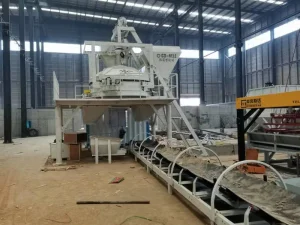
Yes. The MP2000 features a compact vertical cylinder envelope and standardized mounting points. Our engineering team provides custom transition hoppers, discharge chute adapters, and 3D CAD/BIM models to ensure seamless retrofitting into existing BHS, Liebhert, or custom batching tower structures without requiring major structural modifications.
China's advanced industrial ecosystem allows top-tier OEMs to utilize identical tier-1 components (Siemens motors, Hardox wear plate, Schneider controls) and precision CNC manufacturing processes at significantly lower capital costs. Furthermore, Chinese manufacturers maintain faster delivery lead times (4 to 6 weeks vs. 6 months) and offer highly competitive lifetime spare parts pricing.
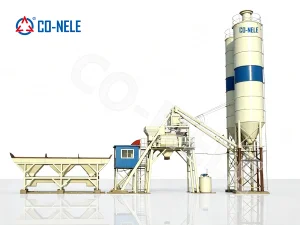
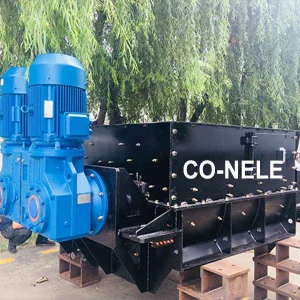
Discover our comprehensive range of specialized granulators, laboratory mixers, and mobile batching plants.