CO-NELEMixing & Granulation
Explore our baseline high-performance mixing equipment engineered in Qingdao, China for global industrial research and heavy-duty manufacturing.
In the contemporary advanced manufacturing landscape, the transition from material formulation to full-scale commercial yield represents one of the most capital-intensive risk vectors for engineering teams. Precision laboratory mixers serve as the foundational gateway for this technical validation. Whether formulating Ultra-High-Performance Concrete (UHPC), technical ceramics, refractory castables, powder metallurgy compounds, or lithium-battery slurries, raw mixing homogeneity directly governs final compressive strength, flexural resistance, dielectric properties, and microstructural integrity.
China’s industrial sector has undergone a profound structural shift from high-volume standardized machinery fabrication to advanced, process-led engineering. As a primary global hub for laboratory mixer manufacturing, specialized Chinese facilities integrate cutting-edge rheological monitoring, computational fluid dynamics (CFD) impeller modeling, and heavy-duty mechanical engineering. This synthesis enables global enterprise buyers to secure laboratory equipment that guarantees seamless scale-up fidelity—matching pilot test parameters directly to industrial-scale mixing plants.
Achieve deterministic distribution of nano-silica, steel micro-fibers, and active chemical additives across small batch samples without thermal degradation or particle agglomeration.
Match tip speeds, Froude numbers, and power density curves between 5L–75L laboratory units and 1,500L–6,000L industrial production mixers.
Single-vessel execution of dry homogenization, liquid dispersion, wet granulation, kneading, and spherical pelletizing under controlled atmosphere settings.
Global research institutions, concrete component producers, and chemical conglomerates increasingly benchmark Chinese OEM mixing technology against traditional European alternatives. This transition is propelled by four distinct engineering and supply chain catalysts:
| Evaluation Vector | Chinese OEM Leaders (e.g. CO-NELE) | Legacy European Brands | Impact on R&D / Production Operations |
|---|---|---|---|
| CAPEX Investment | Baseline Cost Efficiency (1.0x) | High Cost Premium (2.2x – 3.1x) | Dramatically reduces hurdle rate for pilot lab setup |
| Customization Lead Time | 4 to 6 Weeks | 16 to 24 Weeks | Accelerates formulation discovery and market entry |
| Reducer & Drive Engineering | In-House Heavy-Duty Planetary Reducers | Third-party Sourced Reducers | Higher shock-load tolerance against abrasive dry mixes |
| Wear Component Availability | Direct Factory Stock (24-48h dispatch) | Regional Distributor Markup / Lead Time | Eliminates unpredicted laboratory maintenance downtime |
| Scale-Up Correlation | Direct Mathematical Model (Lab to Plant) | Proprietary Closed Ecosystem | Enables open integration with custom PLC batch plants |
The laboratory mixing landscape is undergoing a technological convergence driven by artificial intelligence, real-time sensory telemetry, and advanced material physics. Laboratory mixers are transitioning from static mechanical agitators into intelligent process diagnostics tools.
Modern lab mixers incorporate high-frequency torque feedback sensors embedded directly into the planetary drive shaft. By recording real-time resistance curves during water/binder addition, process engineers can pinpoint the exact plasticization moment, workability limits, and hydration initiation points of high-performance concrete or refractory pastes.
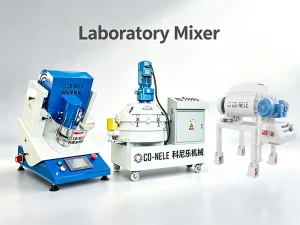
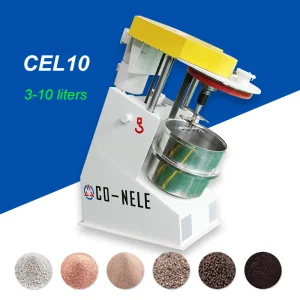
By decoupling pan rotation speed from variable rotor speed, intensive lab granulators (such as the CEL series) generate localized shear forces up to 30 m/s tip speed. This enables precise particle size growth, transformation of fine metallic or ceramic powders into highly flowable spheres, and complete elimination of airborne dust particles in cleanroom environments.
The mechanical demand placed on a laboratory mixer varies dramatically depending on the physical state, abrasiveness, and rheological behavior of the input materials. Below are primary industry verticals where specialized Chinese lab mixers are deployed:
Challenge: UHPC mixes feature extremely low water-binder ratios (< 0.18), high silica fume concentration, and steel fiber reinforcement (up to 3% volume). Standard gravity mixers fail to break down binder agglomerates, resulting in fiber balling and dry pockets.
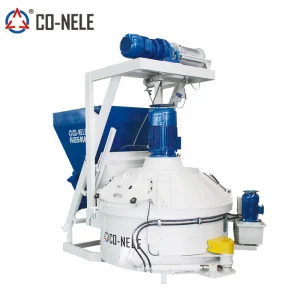
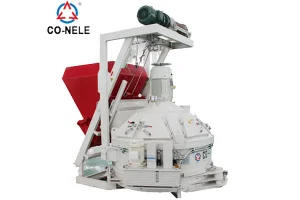
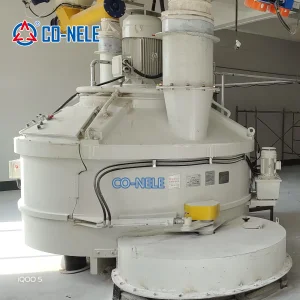
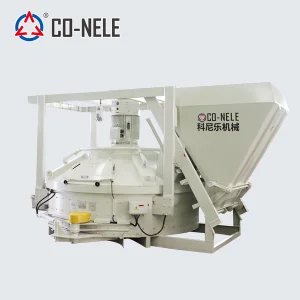
Solution: High-energy vertical shaft laboratory planetary mixers (e.g., CMP lab series). Counter-current planetary motion creates intense intense mechanical shear, fully dispersing fibers and coating every micro-particle within 90 to 120 seconds.
Challenge: Synthetic corundum, silicon carbide, and alumina oxides possess extreme Mohs hardness (8.5–9.0), causing high wear on mixing tools and introducing iron contamination into high-purity formulas.
Solution: Intensive laboratory mixers outfitted with customizable ceramic wear-protection—such as tungsten carbide coating, polyurethane lining, or sintered alumina tiles—ensuring absolute purity for refractory brick and technical ceramic production.
Challenge: Mixing ultra-fine metallic powders (iron, copper, zinc) or battery cathode materials requires void-free wet binder dispersion without micro-segregation during subsequent die compaction.
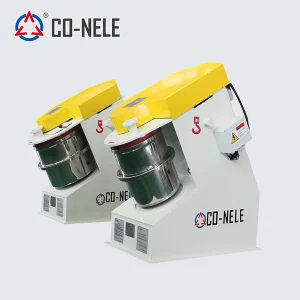
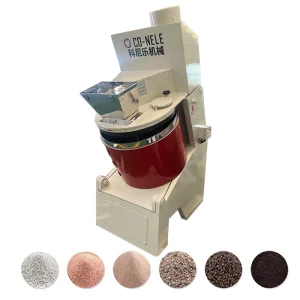
Solution: Lab-scale granulator mixers type CEL05/CEL10. The combination of an inclined rotating vessel and adjustable high-speed rotor homogenizes powders and binder solutions, yielding spherical granules with 90%+ target size distribution.
One of the primary failure points in industrial plant design is the non-linear scaling behavior of complex fluid and powder mixtures. A mix recipe that performs perfectly in a basic laboratory beaker frequently segregates, overheats, or fails to discharge when scaled up to a 3m³ industrial twin-shaft or planetary mixer. Chinese engineering leaders resolve this risk through unified kinematic modeling.
To transfer mixing parameters accurately, laboratory mixers must maintain identical kinematic relationships with full-scale production units. This includes maintaining proportional ratio limits between rotational rotor speed ($\omega_1$) and pan revolving speed ($\omega_2$). By calculating the exact Froude Number ($Fr = \frac{v^2}{g \cdot r}$), engineers ensure that centrifugal forces and gravimetric discharge conditions match perfectly across equipment sizes.
When scaling up UHPC or dry-mortar recipes, energy input per unit volume ($kWh/m^3$) serves as the governing control variable. Laboratory mixers equipped with integrated power meters allow researchers to establish the precise cumulative mixing energy required to achieve complete micro-dispersal.
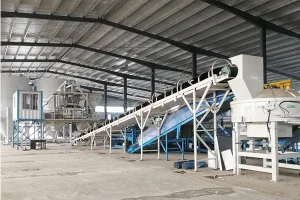
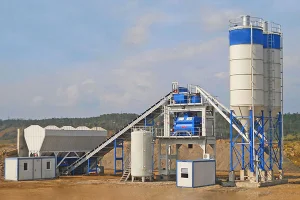
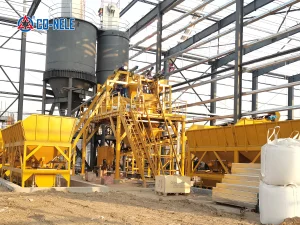
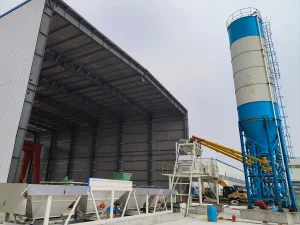
A laboratory mixer is rarely an isolated purchasing decision; it represents the R&D core for upcoming batch plant installations. Leading Chinese factories offer modular, foundationless, and quick-moving batching plant solutions (such as HZS, CMP, and mobile mixing stations) designed to mirror the control algorithms established in the laboratory.
By utilizing identical Siemens PLC hardware, batch recipe software, and pneumatic discharge mechanisms across both lab and plant units, operators eliminate scale-up calibration errors during commercial plant commissioning.
Procuring heavy equipment or specialized laboratory apparatus from overseas suppliers requires structured risk management. Enterprise procurement officers should follow this 4-phase Standard Operating Procedure (SOP) when sourcing laboratory mixers from China:
Send 10kg–20kg raw samples to the manufacturer’s Qingdao test lab. Require a certified trial report detailing torque logs, moisture response curves, and particle size distribution.
Specify local site electrical requirements: voltage (220V/380V/415V/440V), frequency (50Hz/60Hz), CE compliance, ISO 9001 certification, and UL/CSA motor component standards.
Conduct live video or third-party (SGS/TÜV) FAT inspects. Verify gearbox noise levels (< 75 dB), dynamic balance, zero oil leakage, and emergency stop reaction times.
Ensure seaworthy ISPM-15 wooden crate packaging. Order a 2-year wear kit (mixing blades, scraper tips, seals) to ship inside the unit container to minimize air-freight costs later.
Browse specialized batch mixing systems, glass industry mixers, lab-scale granulators, and heavy-duty planetary equipment engineered for specialized industries.
Detailed responses to critical process engineering, machinery selection, and maintenance queries answered directly by our senior technical staff in Qingdao.
A planetary laboratory mixer uses vertical shafts with mixing star arms that rotate around their own axes while simultaneously revolving around a central point (counter-current motion). This design is optimized for high-viscosity pastes, heavy UHPC concrete, and fiber dispersion. An intensive granulating mixer (such as the CEL series) utilizes an inclined rotating pan combined with a high-speed rotor turning in the opposite direction. This creates a high kinetic differential that promotes rapid liquid-solid agglomeration, wet granulation, and spherical particle rounding.
To prevent iron metallic contamination during high-energy mixing of hard materials (Mohs 8+), Chinese factories offer full internal lining customization. Options include high-density polyurethane (PU) linings, sintered alumina ceramic tiles, tungsten carbide thermal spray coatings on rotor arms, and non-magnetic stainless steel (SS316L) contact surfaces.
Yes. Modern laboratory mixers produced in China are equipped with Siemens or Mitsubishi PLC systems featuring Ethernet/Profinet capabilities. Real-time operational data—including rotor drive torque, pan speed, dynamic material temperature (via infrared bottom sensors), and active power density—can be exported via Modbus, CSV format, or integrated into LabVIEW systems for academic modeling.
Standard laboratory mixer models (e.g., CEL05, CEL10, CMP50) typically ship within 25 to 35 calendar days from order confirmation. Fully customized vacuum-rated or explosion-proof units take 45 days. Equipment is wrapped in vapor-barrier film, packed inside ISPM-15 compliant heat-treated wooden cases, and shipped directly via sea container or air transport.
Leading manufacturers maintain direct 24/7 technical support engineering desks in China, providing remote PLC diagnostic access. Critical replacement items (such as mechanical seals, drive belts, and wear tips) use standardized international component brands (e.g., SKF bearings, Schneider electrics, SEW drives), allowing local procurement, alongside guaranteed 48-hour factory air-freight dispatch from Qingdao.