CO-NELEMixing & Granulation
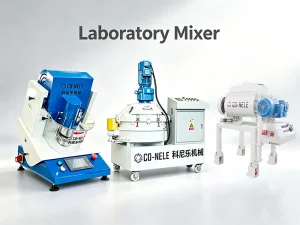
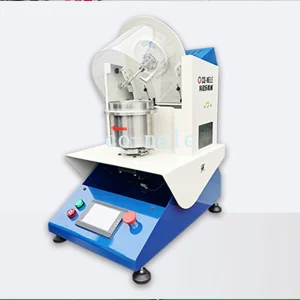
Explore our core engineering lineup featuring laboratory R&D mixers, double-spiral systems, dry mortar units, and specialized precast block mixing plants.
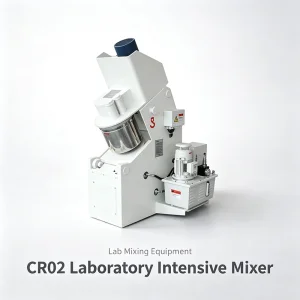
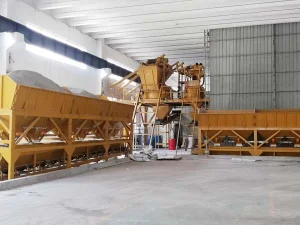
An in-depth evaluation of compulsory mixing kinematics, tribological wear resistance, hydraulic discharge efficiency, and macro-economic factors driving China's mixing technology exports.
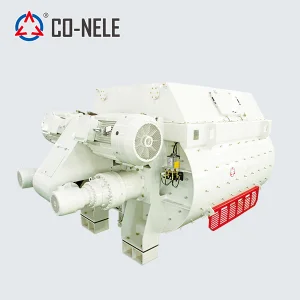
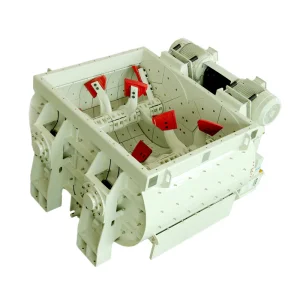
The JS1000 concrete mixer represents the global workhorse of modern civil infrastructure and commercial ready-mix concrete batching plants (notably the HZS50 and HZS60 concrete batching plants). Classified as a double-horizontal-shaft compulsory forced mixer, the JS1000 is engineered to process 1,600 liters of dry aggregate, cementitious binders, and water per charge, delivering a compacted, homogenized discharge volume of exactly 1,000 liters (1.0 cubic meter) per batch cycle.
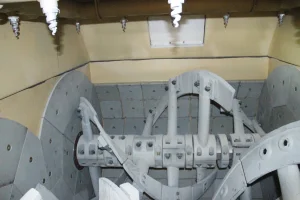
Unlike legacy gravity-drop drum mixers or single-shaft continuous mixers, the compulsory twin-shaft architecture utilizes counter-rotating synchronized horizontal shafts fitted with high-torque mixing arms and hydrodynamic paddle blades. These paddles rotate at synchronized angular velocity, generating severe radial, axial, and turbulent shear zones inside the mixing trough. This double-loop mechanical flow pattern forces aggregate particles into dense interaction, shearing agglomerated cement particles, dispersing micro-silica or mineral admixtures, and stripping entrained air pockets within 30 to 35 seconds of wet mixing time.
The structural strength of hardened concrete directly depends on the microscopic distribution of cement paste over aggregate surfaces. JS1000 twin-shaft mixers maintain a Coefficient of Variation (CV) ≤ 5% across random core samples, meeting ultra-strict international standards including EN 206-1, ASTM C94, and GB/T 9142-2000.
The demand for Chinese manufactured JS1000 concrete mixers and total concrete batching plants has experienced exponential growth across Southeast Asia, the Middle East, Central Asia, Latin America, and Africa. As mega-infrastructure programs—such as high-speed rail networks, deep-water port facilities, hydroelectric dams, and modular urban precast developments—accelerate worldwide, contractors require mixing machinery that balances extreme durability with cost efficiency.
Leading Chinese mixing machinery manufacturers (such as Qingdao CO-NELE Machinery Co., Ltd.) have reshaped global market expectations by bridging high-precision European tribological designs with automated, large-scale manufacturing. Chinese JS1000 units are no longer judged solely on price points; they lead in custom mechanical engineering, offering features such as multi-stage floating seal assemblies, integrated planetary reducers, high-chrome alloy wear liners (Brinell Hardness HB > 600), and automated PLC moisture feedback loop systems.
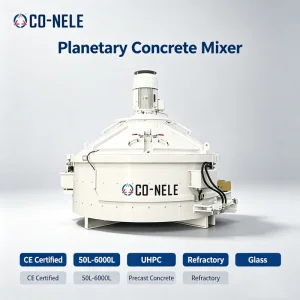
When engineering a concrete production facility, process engineers must select between twin-horizontal-shaft mixers (JS series) and vertical-shaft planetary mixers (CMP series). The selection criteria depend heavily on aggregate sizing, concrete viscosity, target output volume, and application domain:
| Technical Parameter | JS1000 Twin-Shaft Compulsory Mixer | CMP1000 Planetary Counter-Current Mixer | Intensive Mixer / Granulator |
|---|---|---|---|
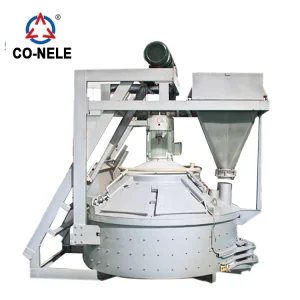
| Primary Mechanism | Horizontal dual counter-rotating shear blades | Vertical shaft planetary rotation + revolution | High-speed rotor + inclined rotating pan |
| Target Applications | Ready-mix, commercial batching, HZS60 plants, mass concrete | Precast elements, UHPC, dry-cast pavers, refractory blocks | Powder metallurgy, ceramic granulation, chemical slurries |
| Max Aggregate Size | 60 mm – 80 mm (Pebble / Crushed Stone) | 40 mm – 50 mm | < 10 mm (Powder / Fine Granules) |
| Mixing Homogeneity | High (CV ≤ 5%) | Ultra-High Micro-homogeneity (CV ≤ 3%) | Extreme Dispersion / Particle Coating |
| Discharge Velocity | Rapid hydraulic drop gate (3–5 seconds) | Pneumatic bottom sector gate (6–10 seconds) | Center discharge or bottom tilting |
Discover how precision metallurgy, automated hydraulic controls, and IoT sensor integration ensure 99.8% operational uptime in harsh field environments.
Eliminates slurry leakage—the single largest cause of gearbox breakdown. Features a 5-layer floating ring mechanical seal supported by an automatic electric grease lubrication pump that maintains continuous counter-pressure.
Mixing paddles and drum liners are cast from Ni-Hard and High-Chrome alloy steel (Cr15Mo3). Yielding a Brinell Hardness rating exceeding HB 600, wear parts withstand over 100,000 continuous discharge cycles under severe aggregate friction.
Dual electric drives (typically 2x 18.5 kW or 2x 22 kW) are connected via a heavy-duty synchronized planetary reducer box. Ensures absolute phase alignment between counter-rotating mixing arms without torque lag.
Equipped with a triple-position hydraulic discharge gate powered by an independent hydraulic station. In case of emergency grid failure, a manual hand-pump override allows clean batch discharge, preventing concrete setting inside the tub.
By engineering bolt-on replaceable liner tiles and standardized mixing blade dimensions, maintenance crews can replace individual high-wear zones within 2 hours, minimizing plant downtime and spare-part freight costs.
Integrates high-frequency microwave moisture sensors directly through the side liner wall. Transmits real-time water-cement ratio dynamics to the Siemens PLC, automatically trimming water injection during active mixing.
From high-volume commercial ready-mix plants to specialized precast segment yards, see how the JS1000 adapts to diverse structural requirements.
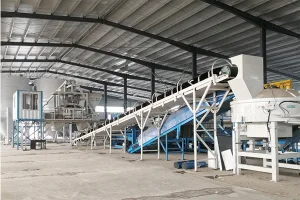
In standard commercial ready-mix plants, the JS1000 concrete mixer serves as the primary mixing engine. Integrated with an aggregate batching machine (PLD1600), cement weighing hoppers, water dosing scales, additive meters, and cement storage silos, an HZS60 plant reliably yields 50 to 60 m³/h of C15 to C60 structural grade concrete.
The compact design permits mounting on elevated steel support structures with clearance for transit mixer trucks (3.8m to 4.2m discharge height). The rapid loading and discharging cycle allows continuous dispatch during peak construction windows.
Precast yards demanding low-slump or semi-dry concrete rely on modified JS1000 units fitted with dual discharge gates or variable-frequency drive (VFD) motors. The high shear intensity breaks down zero-slump mixes (slump 0–3 cm), ensuring that wet cement paste thoroughly coats coarse aggregate surfaces. This prevents honeycombing, void formation, and structural surface defects in prestressed bridge girders, concrete utility poles, and architectural wall panels.
For Roller-Compacted Concrete (RCC) applications in hydroelectric dams or heavy highway paving, the JS1000 is upgraded with reinforced mixing arms and thick wear plates. RCC recipes contain low cementitious content and large maximum aggregate sizes (up to 80 mm). The high mechanical force of the compulsory twin shafts prevents aggregate segregation during rapid discharge into dump trucks.
Transitioning from basic timer-based mixing to neural-network torque monitoring. The PLC calculates mix viscosity dynamically by reading motor amperage curves, ensuring optimal slump before opening the discharge door.
Optimizing paddle blade attack angles to process high-viscosity green concrete formulations, including limestone calcined clay cement (LC3), alkali-activated geopolymers, and high-volume fly ash recipes.
Mounting wireless tri-axial vibration and thermal sensors onto planetary reducer housings to detect bearing micro-fractures weeks before mechanical failure occurs, enabling zero-unplanned-downtime operations.
Expert guidance compiled by senior engineering directors to help site managers, procurement chiefs, and plant operators evaluate JS1000 machinery.
Explore our heavy-duty industrial mixing machinery, granulating equipment, and mobile batching solutions engineered for global export.
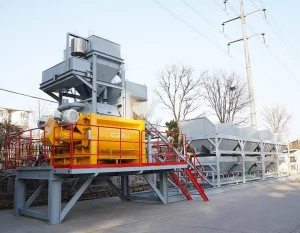
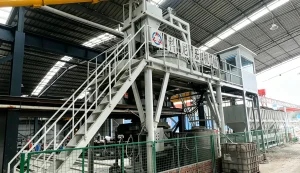
Planning a new commercial concrete batching plant or upgrading an existing mixing line? Contact our process engineering team in Qingdao for complete technical proposals, recipe testing, and factory-direct quotation.