CO-NELEMixing & Granulation
Engineered for extreme material homogeneity, maximum operational uptime, and targeted industrial formulations.
An authoritative evaluation of intensive counter-current mixing technology, rheological energy input optimization, and total cost of ownership (TCO) dynamics in global industrial processing.
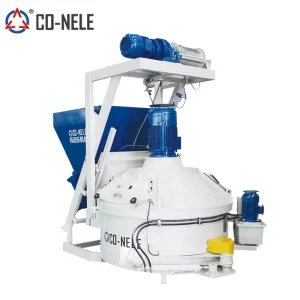
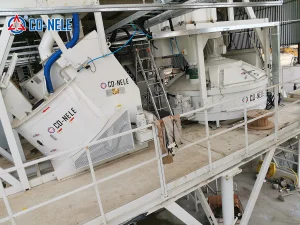
In modern industrial processing, material dispersion quality directly dictates product structural integrity, thermal resistance, and chemical stability. For decades, the benchmark for high-shear, micro-homogeneous mixing has been established by pioneering designs such as the Eirich Mixer Germany technology platform. Featuring an inclined rotating mixing container and high-speed rotor tools running counter-currently, intensive mixers separate material transport from the mixing energy input—a fundamental kinematic departure from conventional twin-shaft or standard vertical pan mixers.
Today, global procurement paradigms are undergoing a structural shift. Industrial buyers across refractory manufacturing, lithium-ion battery cathode processing, technical ceramics, glass batching, and ultra-high-performance concrete (UHPC) increasingly seek equipment that delivers the precise physical mixing results of German intensive mixers, paired with the rapid scalability, cost efficiency, and agile customization of advanced Chinese heavy-machinery manufacturing hubs like Qingdao CO-NELE Machinery Co., Ltd.
In an intensive counter-current mixer, the rotating pan moves 100% of the batch material into the working range of the high-speed rotor. The rotor speed can be controlled independently from slow homogenizing (0.5 m/s) to intense high-shear micro-dispersion and pelletizing (up to 40 m/s), eliminating dead zones and reducing process cycle times by up to 60% compared to conventional mixing geometry.
By preventing centrifugal material segregation, counter-current technology forces micro-additives, pigments, and nano-silica fibers into uniform dispersion within 60 to 90 seconds, achieving a Coefficient of Variation (CV) under 3%.
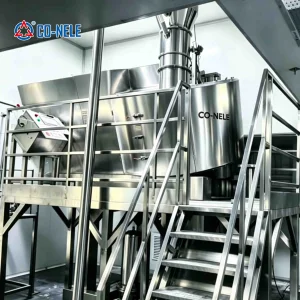
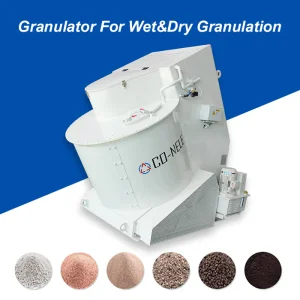
Beyond liquid-solid dispersion, changing the rotor kinematics enables controlled wet granulation and micro-pelletizing in the same vessel, achieving 90%+ granule sphericity without requiring separate pelletizing discs.
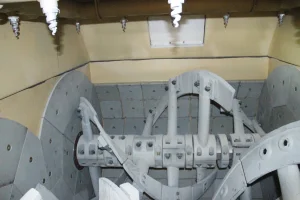
Equipped with customizable tungsten carbide hardfacing, high-chrome alloy pan liners, and ceramic armor, ensuring robust performance against abrasive quartz, corundum, and metal oxides.
Evaluating operational parameters between Traditional Planetary Mixers, Twin-Shaft Systems, and German-Kinematic Intensive Counter-Current Mixers.
| Performance Criteria | Intensive Counter-Current Mixer (Eirich Type) | Planetary Counter-Current Mixer | Twin-Shaft Compulsory Mixer |
|---|---|---|---|
| Pan & Tool Kinematics | Tilted/Vertical Rotating Pan + High-Speed Rotor | Fixed Pan + Rotating Star Arms & Fly-Cutters | Fixed Horizontal Trough + Dual Parallel Shafts |
| Mixing Homogeneity (CV) | < 1.5% - 3.0% (Micro-level) | < 3.0% - 5.0% (Batch-level) | < 5.0% - 8.0% (Macro-level) |
| Energy Input Control | Fully decoupled tool speed (0.5 to 40 m/s) | Fixed gear ratio linked to main motor | Constant speed shear profile |
| Typical Cycle Time | 45 – 90 Seconds | 60 – 120 Seconds | 30 – 45 Seconds |
| Key Applications | Refractories, Ceramics, Granulation, UHPC, Battery Materials | Precast Concrete, Pavers, Blocks, Refractory Mortars | Mass Commercial Ready-Mix Concrete, Infrastructure |
| TCO Savings (China Supply Chain) | 40% - 60% Equipment Capex Reduction | Baseline Standard Cost | Low Initial Capex |
Leveraging complete industrial supply chains, internal gearbox manufacturing, and rigorous quality control to deliver German-standard engineering at competitive price points.
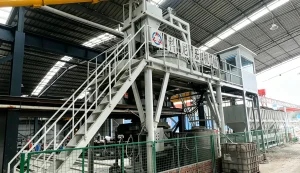
The global heavy machinery sector has transformed over the past decade. China’s advanced industrial centers, particularly Qingdao, have integrated complete manufacturing ecosystems—spanning heavy-duty CNC machining, gear grinding, automated robot welding, and specialized surface thermal treatment. This allows Chinese manufacturers to produce intensive counter-current mixers that meet stringent European engineering tolerances (including ISO9001 and CE compliance) while dramatically reducing production lead times and capital expenditure.
By maintaining direct control over planetary gearbox manufacturing, drive-shaft forging, and wear-component metallurgy, Chinese intensive mixer suppliers ensure complete component interchangeability, field serviceability, and long-term spare parts availability for international plant operators.
Customized rotor kinematics, temperature control jacket integration, and lining options tailored to modern material science requirements.
Processing high-alumina, silicon carbide, and magnesia refractory compositions requires rapid wetting of fine powders without breaking fragile lightweight aggregates. Counter-current intensive mixers ensure zero dry pockets and uniform binder distribution.
UHPC recipes incorporate ultra-fine silica fume, steel fibers, and chemical superplasticizers with minimal water-cement ratios ($w/c < 0.18$). High-shear rotor tools rapidly de-agglomerate micro-silica and evenly distribute steel fibers without balling.
Achieving uniform density in dry-pressed ceramic components mandates dust-free wet granulation. Intensive mixers process ceramic slurries and binders into spherical granules with high flowability and bulk density in a single closed vessel.
Precision mixing of lithium carbonate, nickel-manganese-cobalt (NMC), and conductive graphite requires hermetically sealed mixing vessels with vacuum capabilities and non-contaminating ceramic or polyurethane protective liners.
Eliminating segregation of heavy quartz sand, soda ash, and micro-additives prior to furnace feeding. Homogeneous glass batching prevents seeds, stones, and cords in high-grade architectural and container glass production.
Homogenizing dense metallic powders (tungsten, cobalt, iron) with organic binders for diamond tool segment manufacturing, ensuring consistent diamond grit distribution and uniform sintered matrix hardness.
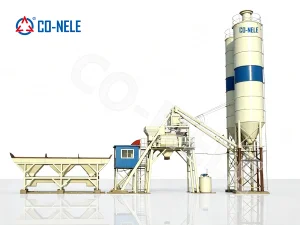
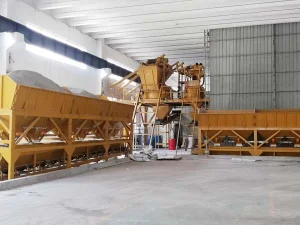
Browse our extended product range including mobile mixing stations, high-shear granulators, and complete concrete batching infrastructure.
Direct technical answers from CO-NELE mixing process engineers regarding design standards, scale-up testing, and wear component lifespans.
Functionally, high-quality intensive counter-current mixers manufactured in China utilize the exact same kinematic principles developed in Germany: an inclined or vertical rotating mixing pan combined with independently driven high-speed rotor tools. The rotating pan transports 100% of the material into the active zone of the rotor, achieving complete micro-homogeneity without centrifugal dead zones. Chinese manufacturers like CO-NELE have optimized the heavy-duty drive systems, seal assemblies, and structural steel fabrication to deliver identical rheological mixing results at significantly reduced capital expenditure.
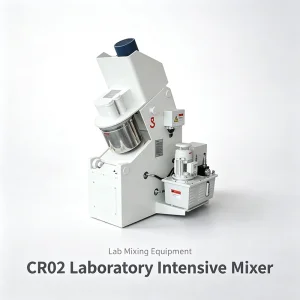
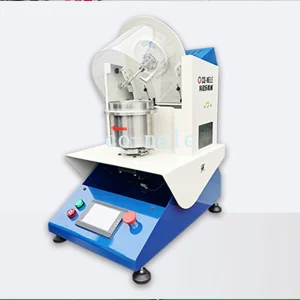
Yes. CO-NELE operates an advanced materials testing laboratory in Qingdao equipped with lab-scale intensive mixers and granulators ranging from 5 to 75 liters (such as the CEL01 series). International clients can ship 10–50 kg of raw powder, aggregate, or slurry to our test facility. Our process engineers analyze moisture absorption curves, bulk density, granule sphericity, and mixing cycle times, providing a comprehensive engineering report and scale-up calculations prior to commercial contract signing.
Wear component longevity depends heavily on material abrasiveness (e.g., quartz content, grain hardness, thermal conditions). When equipped with standard high-chrome alloy liners, wear parts typically sustain 90,000 to 150,000 batches under standard concrete production. For highly abrasive applications such as refractory castables or corundum ceramic powders, CO-NELE provides bolt-on tungsten carbide hardfaced rotor blades and ceramic composite liners, extending component lifespan to 50,000–80,000 heavy-wear cycles. All wear components are standardized and field-replaceable.
All machinery exported globally is engineered to match local power supply requirements (220V, 380V, 415V, 440V, 480V at 50Hz or 60Hz). Systems come equipped with Siemens S7-1500 or Allen-Bradley PLC automation, custom touch-screen HMI, multi-language software interface, and real-time batch reporting. Electrical cabinets comply with CE and UL standards. Full documentation includes certified foundation drawings, P&ID diagrams, English operation & maintenance manuals, and complete spare-part identification catalogues.
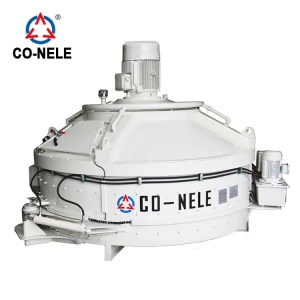
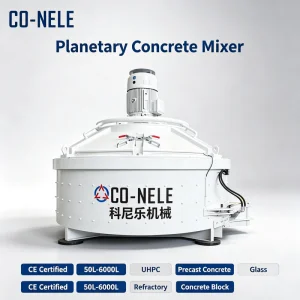
While vertical planetary counter-current mixers (like the CMP series) perform exceptionally well for standard precast, dry-cast blocks, and GFRC with moderate fiber content ($CV < 5\%$), intensive mixers with high-speed rotor tools are preferred for specialized UHPC formulations ($w/c < 0.18$, steel fiber content $> 2\%$). The high-shear rotor de-agglomerates micro-silica fume rapidly and prevents steel fiber clumping, yielding superior compressive and flexural tensile strength in finished precast elements.