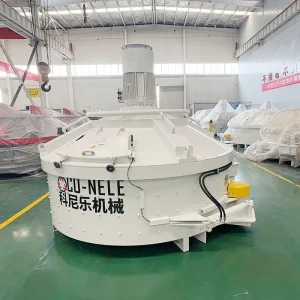
CO-NELEMixing & Granulation
Explore our core planetary mixers, compulsory twin-shaft systems, and specialized industrial mixing units engineered for maximum batch repeatability.
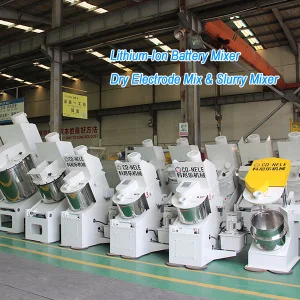
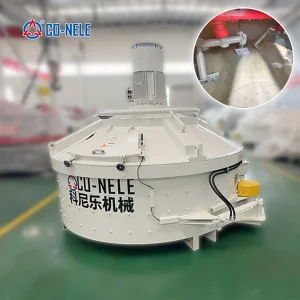
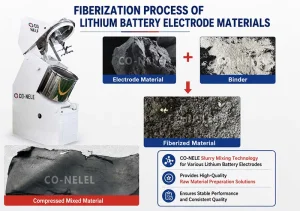
China Lithium-Ion Battery Mixer | Dry Electrode Mix & Slurry Mixer Factory, Machine
View Product Details →Analyzing market shift from commodity ready-mix concrete production to high-precision, low-variance precast batching architectures across global infrastructure sectors.
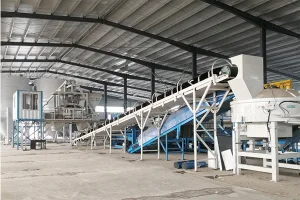
The global construction landscape is experiencing a paradigm shift towards industrial prefabrication, modular off-site building (PPVC), and mega-infrastructure development. Amid tightening labor markets, stringent carbon emissions standards (such as ISO 14067 life-cycle carbon tracking), and demand for longer asset design life (100+ years for bridges and tunnels), precast concrete elements have become the preferred structural medium. At the center of modern precast manufacturing facilities sits the 90m³/h precast batching plant—an engineering feat engineered to provide rapid, perfectly homogeneous concrete batches round-the-clock.
Historically, precast plants operated either small-scale dedicated mixers ($0.5\text{ m}^3$ to $1.0\text{ m}^3$ per batch, resulting in capacity bottlenecks) or oversized ready-mix plants ($3.0\text{ m}^3+$ twin-shaft units that failed to produce dry-cast or fiber-reinforced mixes cleanly). A 90m³/h configuration—typically operating twin 1.5m³ or 2.25m³ planetary counter-current mixing units—solves this operational dilemma. It supplies continuous, multi-shuttle distribution systems feeding multiple precast casting beds, hollow-core slab extruders, and pipe casting machines simultaneously.
Inside the mechanical, electrical, and kinetic systems that differentiate specialized precast batching plants from conventional concrete mixing stations.
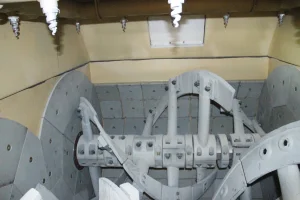
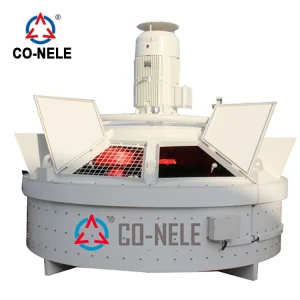
Utilizes vertical-shaft planetary motion where mixing stars rotate on their own axes while revolving around the central axis. This complex trajectory guarantees 100% pan coverage within 18 seconds, eliminating dead zones and ensuring perfect dispersion of micro-silica, pigments, and steel fibers.
Real-time optical and high-frequency microwave moisture probes installed inside aggregate bins and mixer pans measure sand and gravel moisture levels 50 times per second. System automatically recalculates target water additions instantly, guaranteeing constant water-cement ($w/c$) ratio.
Integrated multi-channel liquid admixture scales and iron-oxide powder pigment dosing systems permit continuous production of decorative facade concrete, architectural paving blocks, and colored precast panels with zero batch-to-batch color drift.
| Engineering Parameter | Technical Specification | Operational Impact & Advantage |
|---|---|---|
| Theoretical Capacity | 90 m³/h (Wet Concrete Output) | Delivers continuous high output matching multi-line casting bed demands. |
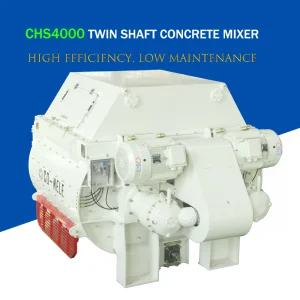
| Mixer Type Options | CMP1500 / CMP2000 Planetary or CHS Twin-Shaft | Planetary used for dry-cast & UHPC; Twin-Shaft used for high-slump elements. |
| Mixer Charging Volume | 2,250 L Aggregate / 1,500 L Discharged Concrete per batch | Rapid cycle times (60 to 90 seconds per complete mixing cycle). |
| Aggregate Batching Bins | 4 to 6 In-Line Bins ($4 \times 20\text{ m}^3 = 80\text{ m}^3$ total) | Supports multiple sand sizes, coarse aggregates, and expanded clay. |
| Weighing Accuracy | Aggregates: ±1.0% | Cement/Fly Ash: ±0.5% | Water: ±0.5% | Exceeds ASTM C94 and EN 206 industrial batching precision requirements. |
| Discharge Gates | Hydraulic Multi-Position Gates with Rubber Seal Liners | Prevents slurry leakage; permits controlled partial discharge to shuttle cars. |
| Power Rating | Total Installed Power ~180 kW (380V/415V/440V, 50/60 Hz) | High energy efficiency per cubic meter of mixed concrete ($<1.8\text{ kWh/m}^3$). |
How Chinese machinery OEMs are leading global transformation through AI-assisted batching, low-carbon binder integration, and modular foundationless engineering.
Global net-zero mandates are forcing precast manufacturers to replace standard Portland cement (OPC) with Supplementary Cementitious Materials (SCMs)—including blast-furnace slag (GGBS), calcined clay, fly ash, and silica fume. SCM-heavy recipes require extended mixing energy and higher shear rates to break down agglomerates. Modern 90m³/h Chinese planetary plants utilize optimized blade angles and speed-controlled VFD drives designed specifically to activate low-clinker cement matrices cleanly.
Traditional precast plants required months of heavy civil foundation work. Leading Chinese manufacturers now design modular 90m³/h plants supported on heavy-duty steel skid frames and containerized bin modules. These units can be fully assembled on a simple reinforced concrete slab in under 7 days, reducing civil investment by up to 60% and enabling plant relocation upon project completion.
Modern Chinese batching control systems incorporate Siemens or Schneider PLC architectures coupled with cloud-based SCADA software. Operations managers can remotely track batch accuracy, material inventory levels, motor power consumption, and wear-plate erosion in real time, featuring auto-calibration algorithms that adjust for aggregate moisture drift dynamically.
Handling highly abrasive quartz sand, crushed granite, and ceramic aggregates degrades mixer liners quickly. Advanced 90m³/h batching plants feature replaceable Rhombohedral-pattern Ni-Hard and High-Chrome cast iron wear plates ($\ge 60\text{ HRC}$ hardness), delivering operational lifespans exceeding 150,000 batches under normal precast duty cycles.
Demonstrating how the 90m³/h precast concrete batching plant performs across distinct climate zones and engineering disciplines worldwide.
Operational Context: Extreme ambient temperatures ($>45^\circ\text{C}$) in regions like Saudi Arabia and UAE require batching plants equipped with ice-chilled water dosing units, aggregate shading covers, and nitrogen cooling jackets. The 90m³/h precast plant supplies 3D volumetric concrete pod factories and insulated wall panel lines. The precise planetary counter-current action prevents premature slump loss, ensuring seamless placement into complex formwork without honeycomb defects.
Operational Context: Infrastructure megaprojects across Thailand, Indonesia, and Vietnam demand precast concrete railway sleepers and segmental viaduct girders complying with strict structural fatigue limits. A 90m³/h plant configured with double discharge gates supplies continuous batches to automated prestressed wire tensioning beds. Batching repeatability ensures zero variance in 28-day compressive strength ($C60/75$ standard).
Operational Context: Offshore wind farm foundations and anti-scour protection blocks mandate Ultra-High Performance Concrete (UHPC) containing up to 2% steel fiber content by volume. The 90m³/h batching plant utilizes reinforced high-torque planetary drives capable of mixing zero-slump, high-shear matrices without blade jamming or fiber balling, meeting DNV offshore engineering certifications.
Operational Context: Urban paving block factories require extremely dry, zero-slump concrete mixed with exact earth-moisture ratios ($w/c \approx 0.26$ to $0.30$). The 90m³/h plant's dual-shaft moisture compensation system ensures every batch fed to the block-making machine achieves identical compaction density, eliminating product height variance and edge chipping.
Strategic development milestones for Chinese concrete batching plant engineering over the next decade.
Integration of motor torque monitoring and acoustic sensor arrays inside planetary mixing pans. AI models will estimate concrete slump and viscosity in real time during the mixing cycle, automatically making micro-water additions prior to discharge without operator intervention.
Direct injection of liquid $CO_2$ into the mixer during batching. The carbon dioxide reacts with calcium ions to form permanent nano-calcium carbonate crystals, increasing 3-day compressive strength by 15% while permanently sequestering $10\text{ kg}$ to $20\text{ kg}$ of $CO_2$ per cubic meter of precast concrete.
Fully autonomous precast batching hubs connected directly to BIM (Building Information Modeling) execution networks. AGV shuttle cars, automated aggregate stockpile management via LiDAR drones, and self-healing diagnostic planetary gearboxes.
Evaluating the direct financial and operational benefits of investing in a Chinese 90m³/h precast batching plant over a 10-year operational lifecycle.
Precision batching scales reduce cement over-dosing. In conventional plants, operators add 3% to 5% extra cement to guarantee strength margins. A 90m³/h plant with ±0.5% scale precision saves up to $150,000 annually in binder costs alone for a factory producing $150,000\text{ m}^3/\text{year}$.
In precast element manufacturing, a single bad batch can ruin an entire prestressed girder or wall panel, costing thousands of dollars in lost labor and steel strand. High-homogeneity planetary mixing reduces scrap rates from standard industry averages of ~2.5% down to under 0.2%.
Due to competitive capital expenditure (CapEx) from Chinese manufacturing clusters combined with low operating maintenance expenditure (OpEx), precast producers typically achieve full capital payback on a 90m³/h plant installation within 11 to 16 months of commissioning.
Detailed answers to critical procurement, operational, and maintenance questions raised by global EPC contractors and plant managers.
While twin-shaft mixers excel at mass ready-mix production ($>2.0\text{ m}^3$ wet mixes), planetary counter-current mixers are mathematically superior for precast applications. The dual rotation-revolution motion ensures that mixing arms sweep the entire pan floor every few seconds. This high kinetic energy dispersion is vital for dry-cast concrete, low-slump mixes ($<30\text{ mm}$), pigmented architectural concrete, and fiber-reinforced formulations where twin-shaft mixers suffer from dead-zone accumulation and fiber clumping.
The plant utilizes integrated high-frequency microwave moisture sensors embedded in the discharge gates of aggregate bins and inside the mixing pan. The batching computer continuously samples sand moisture levels in real time. Before water injection, the system automatically subtracts free water present in wet sand from the recipe target and adjusts cement scaling slightly to maintain absolute water-cement ratio consistency ($w/c \pm 0.005$).
Export-grade plants manufactured in China comply fully with international electrical and machinery safety standards. Standard configurations feature CE-marked components, Siemens PLC hardware, Schneider low-voltage control gear, IP65-rated enclosures, emergency stop safety loops, mixer access door safety interlocks (Castell key or proximity sensor systems), and compliance with UL/CSA standards for North American deployments.
Daily maintenance involves automated high-pressure water washout cycle (100–150 bar cleaning heads). Weekly checks include gearbox oil level inspection and mixing arm blade gap adjustment ($3\text{ mm}$ to $5\text{ mm}$ distance from pan floor). High-chrome lining tiles ($\ge 60\text{ HRC}$) typically require replacement after 100,000 to 150,000 batches under standard aggregate wear conditions, while bolt-on mixing blades are replaced every 40,000 to 60,000 batches.
Yes. When configured with upgraded heavy-duty planetary gearboxes, enlarged motor drive powers (+25% torque margin), and high-shear mixing blades, the plant can seamlessly transition between standard C30/40 precast concrete and UHPC ($>150\text{ MPa}$ compressive strength) without requiring a separate dedicated mixing plant.
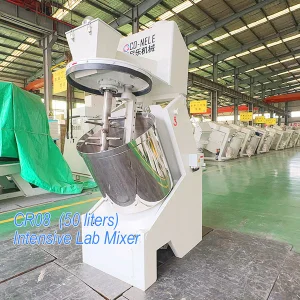
Explore specialized refractory mixers, high-capacity twin-shaft units, and lab-scale test mixers for concrete manufacturing facilities.
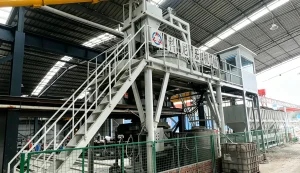
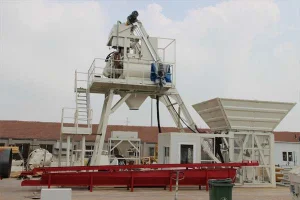
China 60m³/h Precast Concrete Batching Plant for Concrete Pole - China Factory Price Manufacturer, Factory
View Product Details →