
CO-NELEMixing & Granulation
Explore high-homogeneity forced-action mixers, planetary batching systems, and specialized granulation technology engineered in China.
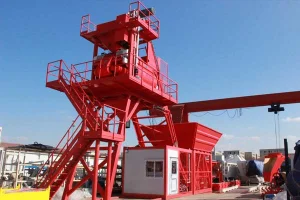
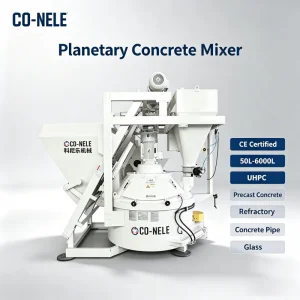
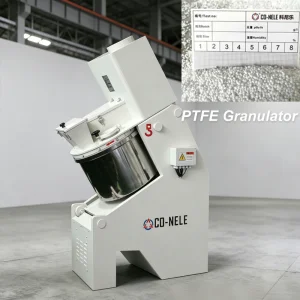
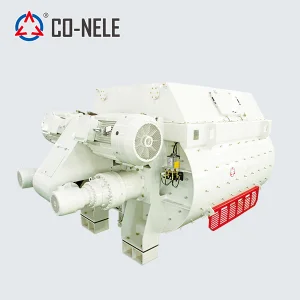
A comprehensive deep dive into forced-action counter-current mechanics, shear distribution, and why stationary batch plants deliver superior homogeneity over mobile alternatives.
In modern high-performance concrete production—ranging from standard C30/C40 commercial ready-mix to complex Ultra-High-Performance Concrete (UHPC) and glass-fiber-reinforced concrete (GFRC)—the mechanical mechanism of batch mixing determines ultimate material density, hydration velocity, and structural compressive performance. A stationary concrete mixer for sale manufactured in China represents decades of refined kinematic optimization, moving beyond traditional free-fall gravity drums toward precision compulsory mixing.
Unlike mobile or drum mixers that rely on gravity to cascade aggregates over internal flights, stationary mixers utilize horizontal twin-shafts or vertical-shaft planetary counter-current mixing arms. This mechanical design imparts maximum kinetic energy directly into the mix volume. The fundamental differential equation governing mixing intensity relies on shear velocity gradient ($G$), expressed as:
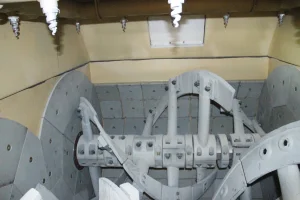
Shear Rate Equation: $G = \frac{d v}{d y} = \frac{\omega \cdot R}{h}$ — Where $\omega$ is planetary rotation speed, $R$ is mixing star radius, and $h$ is the clearance gap between high-chrome blades and the floor liner plate. China's top mixing machinery factories precision-machine gearboxes to maintain $h$ down to fractions of a millimeter, ensuring complete micro-homogeneity without dead zones.
When dry aggregates, cementitious binders (Portland cement, fly ash, silica fume), chemical admixtures (superplasticizers), and micro-water dosages enter the mixing vessel, counter-current blades force fluid particles into violent micro-interstitial collisions. Micro-clumps of unhydrated cement are mechanically sheared open within 15 to 30 seconds, accelerating chemical nucleation and yielding a uniform binder paste matrix.
Selecting the optimal stationary concrete mixing machine requires evaluating two core mechanical architectures:
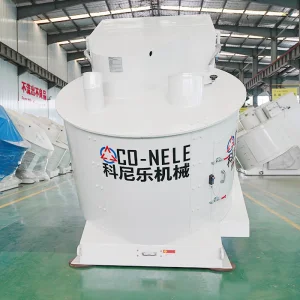
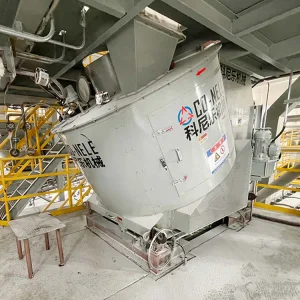
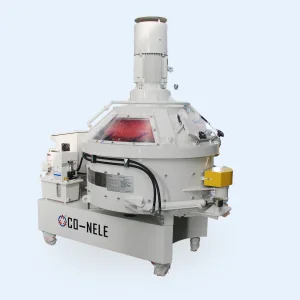
Designed for ultra-rigorous recipes including precast concrete elements, paving blocks, pipes, and UHPC. The mixing arms revolve around a central axis while simultaneously rotating at high speed around their own orbital axes. This dual-kinematic motion guarantees that every square millimeter of the floor and side wall is swept within 4 to 6 planetary cycles, achieving a Coefficient of Variation (CV) below 5%.
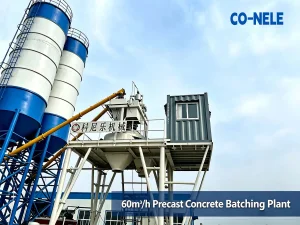
Optimized for high-throughput commercial ready-mix concrete batching plants (capacities ranging from 60 m³/h up to 240 m³/h). Dual counter-rotating synchronized horizontal shafts feature overlapping helical paddles that create a three-dimensional axial and radial turbulence zone. This configuration achieves batch cycles in 30 to 45 seconds with low power consumption per cubic meter.
| Engineering Attribute | Planetary Counter-Current Mixer | Twin-Shaft Compulsory Mixer | Traditional Gravity Drum Mixer |
|---|---|---|---|
| Primary Application | Precast, UHPC, Refractories, Dry-Cast | High-Volume Ready-Mix, Infrastructure | Low-Grade Mass Concrete, Slurry |
| Mixing Homogeneity (CV) | < 3% to 5% (Ultra-High) | < 5% to 7% (High) | > 12% to 18% (Low-Moderate) |
| Batch Cycle Time | 45 – 90 Seconds | 30 – 45 Seconds | 120 – 180 Seconds |
| Handling Stiff/Dry Mixes (Zero Slump) | Exceptional Performance | Moderate to High | Poor (Sticks to Drum Walls) |
| Wear Parts Material Grade | Ni-Hard / High-Chrome Alloys (>60 HRC) | Chromium Carbide Wear Plates | Standard Carbon Steel (Q235/Q355) |
How state-of-the-art Chinese manufacturing plants integrate robotic welding, custom planetary gearboxes, and strict QA protocols to deliver unmatched equipment reliability.
Unlike assemblers who buy generic commercial gearboxes, leading Chinese stationary concrete mixer factories engineer proprietary hardened planetary gear reducers in-house. Featuring carburized alloy gears (20CrMnTi) ground to ISO Grade 5 precision, these gearboxes withstand shock loads over 300% of rated torque during emergency cold restarts.
Mixer drums and structural frame weldments are processed by 6-axis robotic welding cells, ensuring deep weld penetration without human fatigue variance. Post-weld thermal stress-relieving annealing furnaces eliminate internal material stresses, preventing structural cracking under continuous multi-shift vibration.
Wear liners and mixing blades utilize proprietary high-chromium alloy cast iron with hardness exceeding 60 to 64 HRC. Field operations report liner lifespans exceeding 150,000 batch cycles for standard aggregate concrete and up to 60,000 cycles for highly abrasive ceramic or quartz-rich mixes.
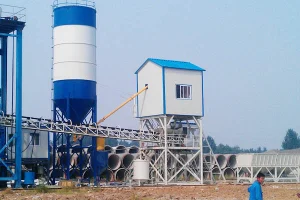
Purchasing a stationary concrete mixer machine from a China factory direct provides global operators with a decisive Total Cost of Ownership (TCO) advantage. China’s integrated industrial ecosystem provides direct, localized access to high-grade raw steel, advanced CNC machining centers, specialized heat-treatment facilities, and global port access (such as Qingdao Port) within a tight geographical radius.
This industrial density reduces component procurement lead times from months to days. Furthermore, Chinese manufacturers maintain strict quality assurance frameworks audited under ISO 9001:2015, CE Machinery Directive 2006/42/EC, and ATEX standards for explosion-proof environments (essential for specialized dry-mortar powder mixing plants).
Tailored mixing plant configurations driving mega-infrastructure, precast fabrication, offshore engineering, and advanced powder metallurgy.
Challenge: Production of interlocking pavers, curb stones, hollow-core slabs, and architectural wall panels requires zero-slump concrete with strict color uniformity and zero surface honeycomb voids.
Solution: Implementation of a stationary vertical planetary concrete mixer integrated with dual discharge gates, microwave moisture probes (SCADA linked), and precise pigment dosing. Results in dynamic batching accuracy within ±0.5% and surface rejection rates below 0.1%.
Challenge: Dispersion of steel fibers (13mm–20mm length, 1–3% volume fraction) and nano-silica powders without fiber clumping (balling effect) or heat buildup during extended mixing cycles.
Solution: High-torque, variable-frequency planetary mixers fitted with high-shear scraper blades and water-chilled pan jackets. Enables uniform steel fiber matrix dispersion, yielding compressive strengths over 160 MPa for offshore wind turbine foundations and long-span bridge joints.
Challenge: High-throughput continuous supply of RCC (Roller Compacted Concrete) containing large aggregate sizes (up to 80mm–120mm) under harsh field conditions.
Solution: Stationary twin-shaft compulsory mixers (CHS series, 3.0 m³ to 6.0 m³ batch size) featuring heavy-duty forged shaft ends, automated grease injection seals, and reinforced arm designs to handle large aggregate impact forces without structural deflection.
Challenge: Homogeneous dispersion of fine bonding matrices, liquid binders, and metallic additives in high-temperature refractory linings for steel mills and glass furnaces.
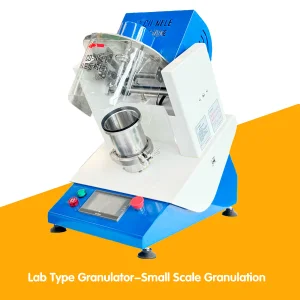
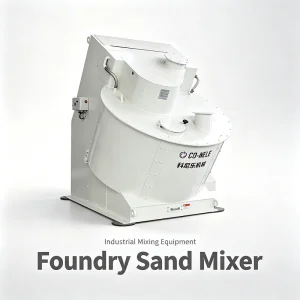
Solution: Intensive mixers and granulators utilizing inclined mixing pans with high-speed rotor tools running counter to pan rotation. Achieves rapid pelletization and micro-blending in ceramics, battery chemicals, and foundry sand recycling.
A rigorous economic evaluation framework for procurement heads, project engineers, and plant operators evaluating stationary concrete mixer investments.
When enterprise construction contractors and commercial ready-mix operators issue tenders for stationary concrete batching equipment, initial Capital Expenditure (CAPEX) represents only 20% to 30% of total lifecycle cost. Operational Expenditure (OPEX)—including electrical power consumption, wear part replacement frequency, unplanned maintenance downtime, and raw material waste due to inaccurate batch weighing—dominates long-term profitability.
China stationary mixers utilize optimized planetary gear gearheads and high-efficiency IE3/IE4 standard motors. By maximizing mechanical energy transfer directly into fluid shear, power consumption is reduced by 15% to 22% per cubic meter compared to legacy pan mixers.
Bolt-on modular liner plates enable fast replacement without cutting or field welding. Standardized replacement blades mean maintenance technicians can swap an entire mixing arm set within 2 to 4 hours during scheduled shift breaks.
Micro-homogeneity ensures that cement grains are fully dispersed and hydrated. Facilities replacing traditional drum/pan mixers with planetary stationary units often reduce cement consumption by 5% to 8% while maintaining identical 28-day characteristic compressive strength targets.
TCO Calculation Formula: $TCO = C_{CAPEX} + \sum_{t=1}^{N} \frac{O_{Energy} + M_{Wear} + D_{Downtime} - W_{Cement\_Savings}}{(1 + r)^t}$ — China factory-direct procurement drastically lowers $C_{CAPEX}$ while robust engineering minimizes $M_{Wear}$ and $D_{Downtime}$, delivering maximum net present value (NPV) over a 10-to-15 year equipment lifespan.
Pioneering advancements in AI-driven moisture control, real-time torque rheology sensing, and eco-friendly low-carbon mixing processes.
Next-generation stationary mixers integrate real-time drive-motor torque spectrum analysis. By monitoring instantaneous current draw fluctuations at millisecond intervals, the PLC calculates dynamic plastic viscosity ($\mu$) and yield stress ($\tau_0$) during mixing, automatically adjusting water and superplasticizer dosing on-the-fly.
Embedded thermal imaging sensors on planetary gearboxes and vibration accelerometers on main bearings stream data to cloud diagnostics. Factory engineers can monitor machine health globally, predicting bearing fatigue or liner wear weeks before catastrophic mechanical failure occurs.
As the construction industry transitions toward alkali-activated materials (AAM), geopolymers, and calcined clay cements, mixing mechanics must handle rapid flash-setting tendencies. China's research centers are developing specialized anti-stick polymer coatings and ultrasonic cavitational mixing blades tailored for zero-clinker concrete formulas.
Ensuring seamless site integration, international electrical compliance, and resident engineer deployment across 80+ export markets.
Export stationary concrete mixing machinery from China is customized to meet regional regulatory and electrical grid standards. Power systems support multi-voltage and multi-frequency configurations (220V, 380V, 415V, 440V, 480V at 50Hz or 60Hz).
Every stationary batch mixer shipment is backed by complete engineering documentation, including 3D BIM foundation drawings, electrical ladder diagrams, and operating manuals in English, Spanish, Russian, French, or Arabic.
In-depth technical and commercial answers provided by senior concrete batching engineers.
Choose a vertical planetary counter-current mixer when your application requires micro-homogeneity below a 5% Coefficient of Variation, stiff or zero-slump concrete, fiber integration, or specialized color pigments—such as in precast elements, paving blocks, UHPC, and refractories. Twin-shaft mixers are ideal for high-volume ready-mix commercial concrete (above 2 m³ per batch) where rapid 30-to-45 second cycles and high volumetric throughput are the primary requirements.
Under standard operating conditions with standard aggregate mixes, high-chromium wear liners (>60 HRC) achieve 90,000 to 150,000 batch cycles. For highly abrasive applications such as quartz silica sand, refractory castables, or ceramic slurries, lifespan ranges between 40,000 and 60,000 batches. All liners and blades are modular, bolt-on, and rapidly replaceable in the field.
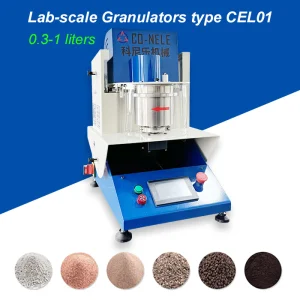
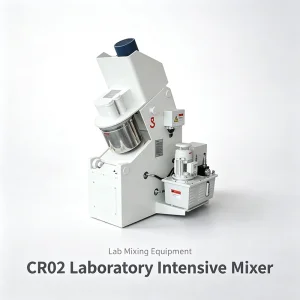
Yes. Our Qingdao R&D testing center operates lab-scale intensive mixers and granulators from 5 L up to 75 L capacity. Overseas clients can send 10 kg to 50 kg sample batches of aggregate, binder, or powder. Our process engineers perform rheology, sphericity, density, and hydration tests, providing a detailed technical report and scale-up calculations for full production machinery.
Every stationary mixer and batching plant is built to order based on your site's local power utility (e.g., 380V/50Hz, 415V/50Hz, 480V/60Hz). Control panels feature industrial Siemens or Schneider PLCs with multi-lingual HMI touchscreens (English, Spanish, French, Russian), supporting cloud data logging, recipe management, and automated batch printing.
Standard standalone stationary concrete mixers (such as MP planetary or CHS twin-shaft models) ship within 15 to 20 business days from order confirmation. Customized turnkey batching plants or specialized granulating lines require 30 to 40 days. Shipments are packaged in standard container break-bulk or flat-rack configurations direct from Qingdao Port.
Review additional high-performance industrial mixers, laboratory testing units, and specialized material granulators.