CO-NELEMixing & Granulation
Explore our flagship industrial mixing machinery engineered for concrete, dry mortar, refractory, and ceramic industries.
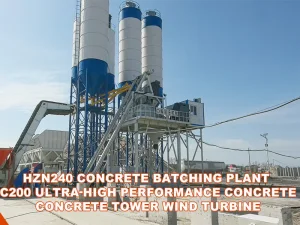
In the global infrastructure landscape, stationary concrete batching plants represent the benchmark for high-capacity, continuous, and micro-homogeneous concrete output. Unlike temporary or mobile concrete mixing plants, stationary installations are engineered for severe-duty cycles, large-scale commercial ready-mix concrete (RMC) production, precast concrete components, and high-tech formulations such as Ultra-High-Performance Concrete (UHPC) and Glass Fiber Reinforced Concrete (GFRC).
The core structural advantage of a China-manufactured stationary batching plant lies in its rigid engineering foundation, heavy-duty mixing chassis, integrated powder silos, and advanced automated batching systems. By optimizing batching precision, moisture dynamics, and shear force distribution, modern stationary plants ensure a Coefficient of Variation (CV) below 3% in mix homogeneity—a metric required for mega-infrastructure projects such as high-speed railways, hydroelectric dams, and offshore wind turbine foundations.
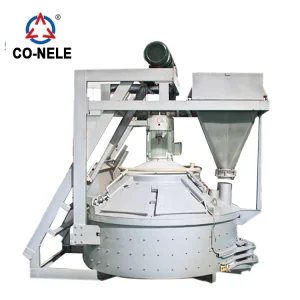
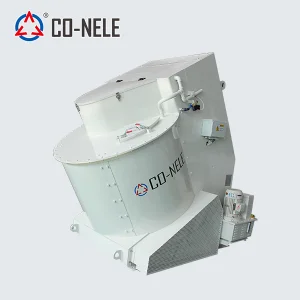
A stationary batching plant is not merely an assembly of aggregate bins and conveyor belts. High-tier engineering demands synchronized particle kinematics. Forced-action planetary counter-current mixing creates multi-directional mechanical shearing forces that break up fine powder agglomerates (microsilica, fly ash, cementitious binders) within 30 to 45 seconds, maximizing hydration efficiency and compressive strength performance.
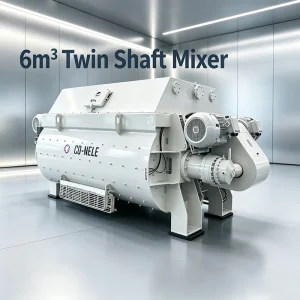
Choosing the correct mixing engine within a stationary batching plant directly impacts operational expenditure (OPEX) and concrete mechanical performance. The table below outlines the core technical distinctions between vertical-shaft planetary mixers and horizontal twin-shaft mixers integrated into stationary batching plants:
| Performance Metric | Vertical Planetary Counter-Current Mixer | Horizontal Twin Shaft Mixer |
|---|---|---|
| Primary Application | Precast Elements, UHPC, Permeable Bricks, Refractories | High-Volume Commercial Ready-Mix, Mass Concrete Dams |
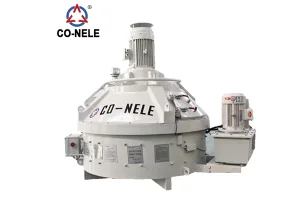
| Mixing Kinematics | Planetary revolution + star rotor rotation (Zero dead zone) | Dual counter-rotating shafts with overlapping helical paddles |
| Mixing Homogeneity (CV) | < 3% (Ultra-High Micro-Homogeneity) | < 5% (Standard High Homogeneity) |
| Discharge Efficiency | Complete bottom-gate discharge, zero material residual | Rapid dual hydraulic gate discharge for high throughput |
| Wear Part Longevity | 90,000 – 150,000 batches (High-Chrome Castings) | 60,000 – 100,000 batches (Ni-Hard / Chrome Steel) |
As global construction firms seek to optimize Capital Expenditure (CAPEX) without sacrificing mechanical longevity, China has established itself as the undisputed leader in heavy industrial equipment manufacturing. Qingdao, Shandong Province, serves as the primary hub for advanced industrial mixing technology, housing fully integrated production ecosystems from gearbox casting to automated electrical PLC cabinet assembly.
Unlike assemblers who buy commercial off-the-shelf gearboxes, top China factories design and build heavy-duty planetary gearboxes specifically tuned to withstand torsional concrete shock loads.
Global compatibility is guaranteed through integration of world-class electrical and pneumatic brands: Siemens PLC controllers, Schneider low-voltage electrics, WAM dust filters, and AirTAC pneumatics.
Utilizing high-chrome wear liners (26% Cr content) and Hardox steel plates ensures liner life exceeding 120,000 cycles under continuous abrasive sand and coarse aggregate scraping.
A high-performance stationary concrete batching plant operates as a continuous, synchronized industrial system comprising five vital subsystems:
For international buyers across North America, Europe, the Middle East, and Southeast Asia, operational safety and localized electrical compliance are critical procurement factors. A reputable China stationary batching plant manufacturer delivers complete engineering compliance packages tailored to regional legal requirements:
Full compliance with European Machinery Directive 2006/42/EC, EN 12151, and low-voltage directive electrical safety standards.
Customized motor windings supporting 220V, 380V, 415V, 440V, and 480V at 50Hz or 60Hz grid specifications without external transformers.
Detailed CAD foundation drawings, schematic wiring diagrams, operation manuals, and spare-part catalogs supplied in English, Spanish, or French.
Standard containerized modular design enabling fast flat-rack or 40HQ ocean shipping with resident engineer field commissioning.
Stationary batching plants built by leading Chinese manufacturers are deployed across diverse demanding operational environments:
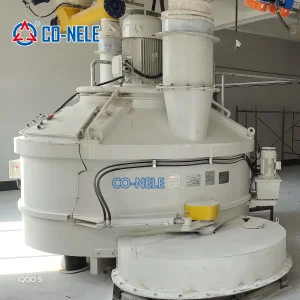
Modern renewable energy projects require ultra-dense, steel-fiber-reinforced concrete capable of withstanding extreme dynamic loads. Stationary batching plants equipped with CMP series planetary mixers provide micro-fine silica fume dispersion and uniform fiber distribution without balling, achieving compressive strengths exceeding 150 MPa.
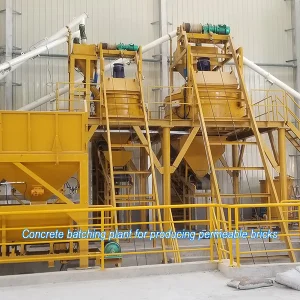
Urban rainwater management systems demand high-porosity permeable concrete bricks. Utilizing dedicated batching plants (such as the CBP150 series), the system controls low-water-binder ratio recipes with extreme repeatability, producing eco-friendly paving blocks with exceptional flexural strength and drainage capabilities.
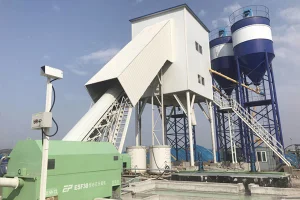
Heavy stationary batching plants (HZN90, HZS120, HZS180) are the powerhouse behind skyscraper foundation mats, bridge piers, and highway corridors. Capable of continuous output from 90 m³/h up to 180 m³/h, these plants ensure seamless transit mixer dispatch logistics with automated aggregate moisture compensation.
The transition toward digital construction sites has pushed stationary batching plant design into the era of Industry 4.0. Modern plant architectures integrate IoT sensors, real-time microwave moisture probes inside mixing pans, and AI-driven predictive maintenance monitoring systems.
By constantly analyzing motor torque signatures, oil temperature curves, and load cell vibration spectra, the intelligent plant control system alerts operators to mechanical wear before downtime occurs, optimizing total asset efficiency and operational longevity.
Technical answers to common engineering, procurement, and installation queries.
A stationary concrete batching plant is designed for permanent or long-term site installation where high capacity (60 m³/h to 180+ m³/h), long service life, and maximum mixing precision are paramount. It features heavy structural steel frames, deep aggregate storage hoppers, and extensive dust control systems. A mobile batching plant prioritizes rapid relocation on a wheeled chassis for short-term road or bridge repair projects, typically sacrificing aggregate storage volume and modular expansion capability.
Plant selection should be calculated backwards from peak site pour requirements and truck dispatch cycles. As a rule of thumb, actual field output is roughly 65-75% of theoretical rated capacity due to aggregate loading intervals and transit mixer positioning. For example, an HZS90 plant with a theoretical 90 m³/h rating comfortably delivers 60-68 m³/h of continuous ready-mix concrete. For precast operations, mixer batch volume matching the block machine cycle time is critical.
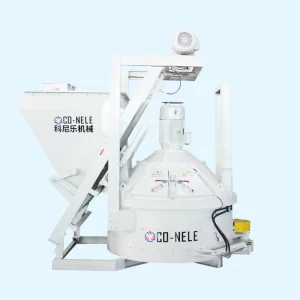
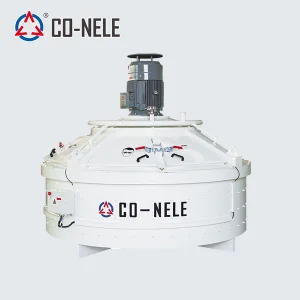
Planetary counter-current mixers feature vertical star arms that rotate while revolving around the central axis. This complex kinematic motion ensures that 100% of the pan floor is swept during every revolution, eliminating dead zones. It delivers superior dispersion of color pigments, fine additives, and synthetic/steel fibers required in precast, paving block, and UHPC manufacturing, achieving a homogeneous mix much faster than horizontal twin shaft mixers.
Our mixing blades and inner pan liners are cast from ultra-high chromium alloy iron (Cr26 content) with hardness ratings exceeding 60 HRC. Under standard concrete aggregate processing, liner sets routinely exceed 120,000 batches. For highly abrasive mixes like refractories or quartz silica sands, wear life ranges between 40,000 and 60,000 batches. All wear segments are segmented, bolt-on, and easily replaceable during routine maintenance.
Every stationary batching plant export package includes comprehensive CAD foundation layout drawings, electrical schematic diagrams, step-by-step assembly manuals, and video commissioning guides. We offer resident engineering dispatch for on-site mechanical erection, PLC calibration, and staff operational training. Furthermore, full spare parts inventory is maintained in our Qingdao warehouse with express worldwide dispatch.
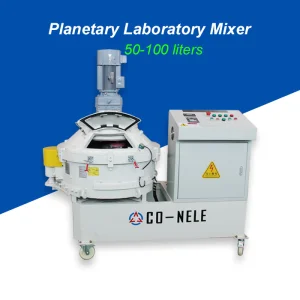
Discover specialized ceramic, glass, laboratory, and UHPC mixing equipment manufactured to rigorous ISO 9001 standards.