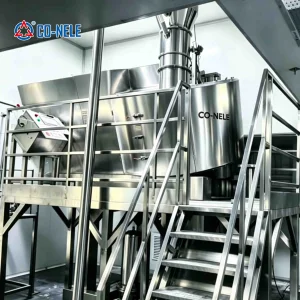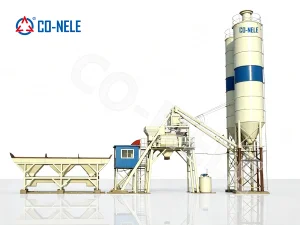
CO-NELEMixing & Granulation
Direct factory manufacturing delivering micro-homogeneity, high-shear dispersion, and extreme wear-resistance for globally demanding thermal processing industries.
Refractory manufacturing is no longer a simple mixing process of aggregates and water; it has evolved into a sophisticated discipline of particle packing theory, colloid chemistry, and thixotropic shear control.
As global high-temperature industries push furnace operating parameters to extreme thresholds, the physical performance of unshaped refractories (monolithics), Low-Cement Castables (LCC), Ultra-Low Cement Castables (ULCC), and Zero-Cement Castables (ZCC) hinges directly on mixing homogeneity. Standard horizontal pan mixers or legacy drum mixers fall severely short when dealing with modern refractory formulations that incorporate micro-silica powders, ultra-fine nano-alumina, metallic fibers, and chemical deflocculants.
Achieving optimal packing density based on the Andreassen particle distribution model ($q = 0.21$ to $0.37$) requires a refractory mixer capable of imparting massive shear energy into the batch within seconds. Without high-shear planetary motion or intensive rotor dispersion, micro-silica agglomerates remain intact, creating localized voids, inconsistent water demand, and catastrophic thermal spalling during furnace operation.
Sub-micron particles tend to form stubborn agglomerates due to van der Waals forces. CO-NELE counter-current refractory mixers break these force bonds through forced-action rotational shear, guaranteeing 100% matrix coating and uniform liquid film distribution.
By optimizing rheological thixotropy, our mixing systems allow refractory recipes to operate at critical water-to-cement ratios (W/C as low as 4.2%). Reducing excess water directly eliminates capillary pore formation, boosting cold crushing strength (CCS) and modulus of rupture (MOR).
Incorporating stainless steel fibers or organic polypropylene anti-spalling fibers requires precise mechanical trajectories. Our specialized blade geometry distributes fibers evenly throughout the dense aggregate matrix without clustering or mechanical shearing.
From decarbonized green steel production in Europe to rapid infrastructural expansion across Southeast Asia and the Americas, refractory reliability dictates global manufacturing uptime.
Modern high-temperature industries operate under continuous thermal and chemical stress. A single blast furnace lining failure or cement rotary kiln shutdown can cost plant operators millions of dollars per day in lost yield. Consequently, global refractory producers and engineering groups (EPCs) are discarding outdated mixing technology in favor of fully automated, precision-controlled refractory mixing equipment engineered in China by industry leaders like CO-NELE.
| Target Industry | Refractory Application | Technical Mixing Challenge | CO-NELE Engineering Solution |
|---|---|---|---|
| Iron & Steel Metallurgy | Blast furnace troughs, Ladle linings, Tundish castables, RH degasser units | High density Al2O3-SiC-C formulations with hydrophobic graphite powders | Intensive counter-current shear breaking surface tension for fast liquid wetting |
| Cement & Lime Kilns | Preheater cyclones, Kiln hood, Burning zone, Cooler nose ring monolithics | Extreme abrasive wear from coarse corundum and calcined bauxite aggregates | Replaceable high-chrome Ni-Hard armor liners (65 HRC) & rubber blade scraper systems |
| Non-Ferrous Smelting | Copper anode furnaces, Aluminum electrolysis cells, Zinc roasting furnaces | Sensitivity to metallic contamination & requirement for ultra-precise dosing | Stainless steel or ceramic-lined mixing pans with integrated vacuum debubbling |
| Glass & Petrochemical | Glass melting tank crowns, FCC cracking unit abrasion-resistant linings | Ultra-fine silica & phosphate binder reaction kinetics during mixing cycle | VFD-driven dynamic rotor speeds with multi-stage automated fluid injection |
The fundamental flaw of traditional single-shaft or twin-shaft concrete mixers when applied to refractories is the existence of mechanical "dead zones" and uncontrolled particle segregation.
China's manufacturing prowess in industrial mixing is anchored by sophisticated gearbox design and kinematic trajectory optimization. As a specialized refractory mixer manufacturer, CO-NELE integrates dual kinematic mechanical systems tailored specifically to batch viscosity and material shear sensitivity:
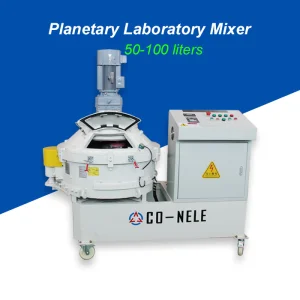
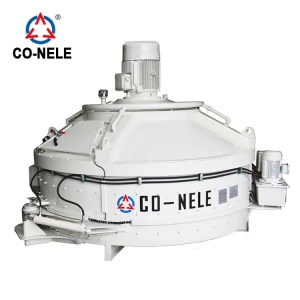
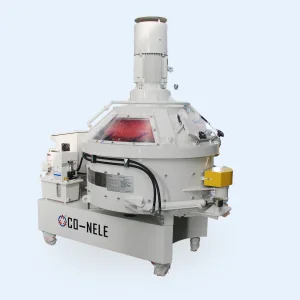
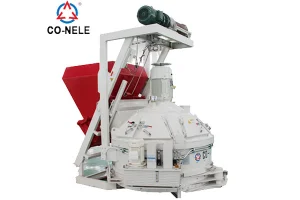
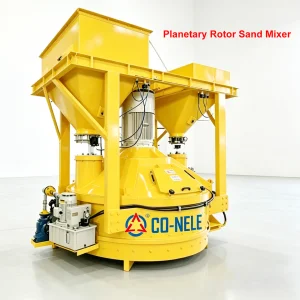
The mixing star arms rotate on a central axis while simultaneously orbiting around the mixing pan. This overlapping, mathematical vector trajectory guarantees that 100% of the pan floor and sidewalls are swept every few seconds, eliminating unmixed dry pockets completely.
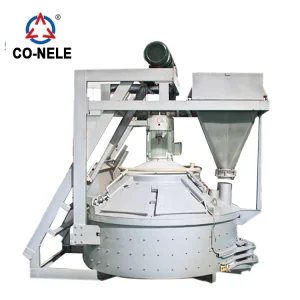
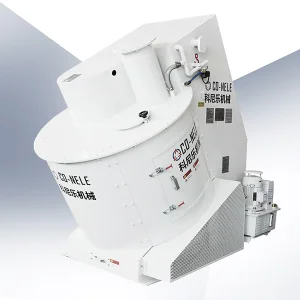
Designed for ultra-demanding monolithic formulations, the inclined mixing pan rotates at a controlled speed while an independently driven, variable-speed high-speed rotor tool operates in the opposite direction. This creates extreme velocity gradients and high shear impact energy.
Refractory materials like synthetic corundum, silicon carbide, and fused zirconia exhibit extreme Mohs hardness. Our mixing pans are armored with bolt-on Chromium Carbide Overlaid (CCO) plates, Tungsten Carbide blade tips, or sintered Ceramic tiles for 5x service life.
Refractory mixing equipment must adapt to widely varying job-site configurations, raw material sources, and environmental conditions across global operational theaters.
Location: Ruhr Valley, Germany & Pittsburgh, USA
Deployed as compact, quick-discharge mobile refractory batching units. Utilized during emergency blast furnace lining repairs where rapid setting, low-moisture gunning mixes must be prepared continuously at 15 m³/h with zero batch variability.
Location: Zhengzhou, China & Rajasthan, India
Integrated into fully automated brick pressing lines. Intensive rotor mixers process dense magnesia-carbon and aluminum-magnesium-carbon dry mixes, ensuring micro-fine graphite coating onto coarse aggregates prior to hydraulic pressing.
Location: Middle East & Southeast Asia
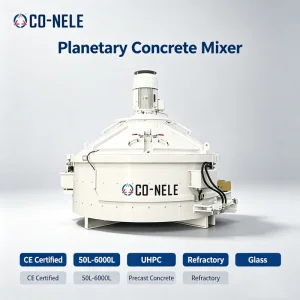
Dual-purpose planetary mixing stations engineered to switch seamlessly between Ultra-High Performance Concrete (UHPC) architectural panels and high-alumina refractory duct linings for petrochemical refining towers.
Procuring industrial machinery from China requires total alignment with destination country electrical codes, occupational safety directives, and fast-response technical support.
CO-NELE operates as a mature OEM/ODM export manufacturer. We recognize that hardware quality must be backed by seamless international compliance frameworks. Every machine leaving our Qingdao factory undergoes rigorous pre-shipment testing under simulated field loads.
Fully compliant with European Union CE Directives (Machinery Directive 2006/42/EC, Low Voltage 2014/35/EU). Explosion-proof ATEX-rated motors and control cabinets are available for volatile chemical environments.
Customized electrical control systems supporting global industrial power grids: 220V, 380V, 415V, 440V, 480V, and 690V at 50 Hz or 60 Hz. Built using premium Schneider Electric, Siemens PLC, and ABB drive components.
Modular design optimized for standard high-cube shipping containers. Fast-track dispatch of replacement mixing blades, scraper arms, and drive gearboxes from regional warehouse hubs in Europe, S. America, and SE Asia.
The next decade of refractory manufacturing will be defined by smart sensing, real-time batch adjusting, and zero-carbon refractory binding chemistry.
CO-NELE's R&D division in Qingdao is actively pioneering the next generation of intelligent refractory mixing systems. By embedding Industry 4.0 IoT telemetry directly into the mixing drive train, our future-ready machines transition from passive mechanical vessels to active quality assurance hubs.
Real-time planar microwave sensors embedded into the pan floor sample moisture at 25 times per second, dynamically communicating with PLC fluid dosing pumps to hit target slump consistency automatically.
By monitoring motor current frequency and gearbox resistance torque in real time, the mixer detects exactly when the dry mix transitions to a plasticized state, ending the cycle at maximum homogeneity to prevent over-mixing.
As green steel initiatives adopt hydrogen-based direct reduced iron (DRI), refractory formulations are moving toward organic bio-binders and alkali-activated geopolymers requiring precise thermal-jacketed mixing chambers.
In-depth technical answers curated by CO-NELE senior process engineers to resolve complex user intent, specification queries, and operational parameters.
Explore our extended machinery lineup tailored for specialized applications, precast elements, dry mortar production, and intense powder granulation.