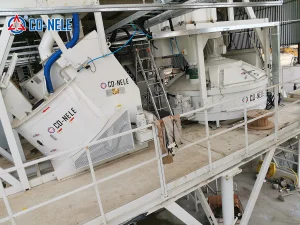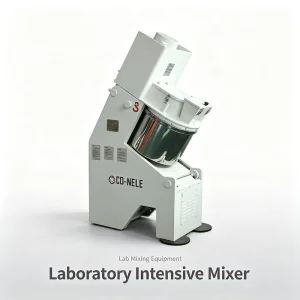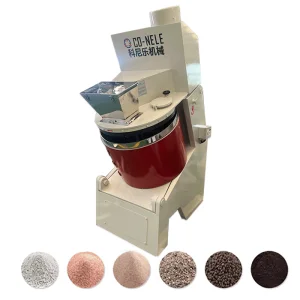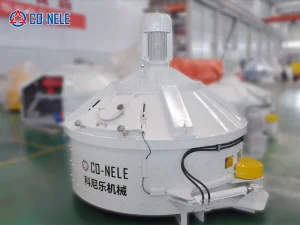
CO-NELEMixing & Granulation
Explore our core engineering lineup manufactured in Qingdao, China for global high-performance material processing.
Analyzing thermal stress, rheological demands, and structural homogeneity in high-temperature applications.
In modern high-temperature industrial manufacturing—spanning steelmaking blast furnaces, non-ferrous smelters, glass melting tanks, and petrochemical FCC units—the operational longevity of thermal linings directly dictates plant profitability. Refractory materials have evolved from simple fireclay bricks to sophisticated Low-Cement Castables (LCC), Ultra-Low-Cement Castables (ULCC), No-Cement Castables (NCC), and dry-vibratable mixtures. These advanced formulations incorporate sub-micron silica fume, reactive micro-alumina powders, metallic stainless steel fibers, and synthetic lightweight aggregates.
However, processing these ultra-fine powders presents extreme mechanical challenges. Traditional gravity-based, tilt-drum, or basic ribbon mixers fail to generate the shear energy required to deagglomerate micro-silica, resulting in "balling," uneven water dispersion, and localized thermal expansion vulnerabilities. A single unmixed pocket of micro-powder in a refractory lining leads to premature spalling, furnace break-throughs, and million-dollar emergency shutdowns.
SEO Technical Insight & Information Gain: Selecting a refractory cement mixer is not merely a volumetric capacity decision; it is a fluid dynamics problem. Achieving a Coefficient of Variation (CV) below 3% in dense, abrasive refractory castables demands counter-current planetary kinematics capable of inputting targeted mechanical shear without crushing fragile aggregates.
Why Vertical-Shaft Planetary Counter-Current Technology Outperforms Twin-Shaft and Horizontal Ribbon Designs.
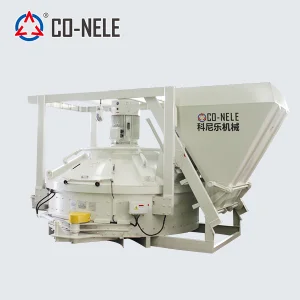
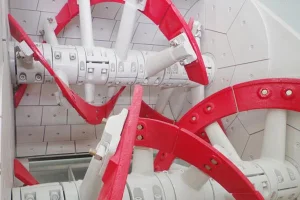
The mixing blades rotate on their own axes while simultaneously revolving around the central axis of the mixing pan. This complex mathematical trajectory covers 100% of the pan floor within 45 seconds, eliminating dead zones and aggregate segregation completely.
Refractory aggregates such as corundum, silicon carbide (SiC), and bauxite possess extreme Mohs hardness. CO-NELE equipment utilizes bolt-on, interchangeable wear liners cast from high-chromium alloy (HRC ≥ 65), delivering up to 150,000 operational cycles.
Unlike competitors relying on outsourced commercial speed reducers, CO-NELE designs and casts custom heavy-duty planetary gearboxes in Qingdao. Built to withstand sudden high-torque resistance caused by sticky low-water refractory batches.
Integrated high-pressure spray bars ensure uniform liquid atomization across the entire moving bed. This rapid wetting mechanism reduces total batch cycle times by 35% while keeping matrix water consumption at the theoretical minimum.
Future-ready PLC integration featuring real-time motor load telemetry, acoustic emissions sensing, dynamic moisture tracking, and automated predictive maintenance alerts to prevent unannounced mixer failure.
Complete hermetic sealing with negative-pressure dust extraction ports protects workshop environments from hazardous respirable crystalline silica (RCS) powders during high-speed dry mixing phases.
Field-proven performance across demanding metallurgical, petrochemical, and ceramic manufacturing environments.
Furnace lining durability directly dictates iron production efficiency. CO-NELE planetary mixers prepare ultra-consistent mixes for:
High-velocity catalytic erosion and extreme thermal cycling require unyielding synthetic refractory matrices:
Thermal insulation and liquid metal corrosion resistance depend on precise batch bulk density:
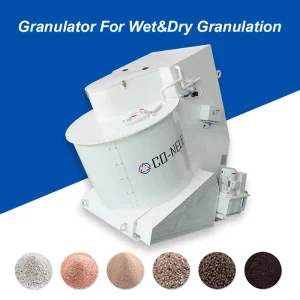
High-shear intensive mixing and granulation in cleanroom or specialized dry environments:
Vertical integration, Qingdao port logistics, and unmatched cost-to-performance efficiency.
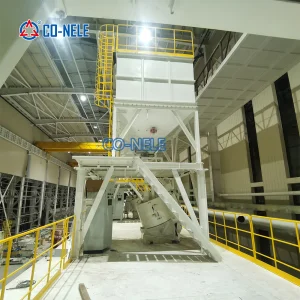
As international industrial buyers evaluate global machinery procurement, Qingdao CO-NELE Machinery Co., Ltd. stands out by offering substantial engineering depth rather than simple export trading. Operating from three specialized production bases spanning over 30,000 square meters in Shandong Province, CO-NELE controls every phase of the manufacturing lifecycle.
From flame cutting heavy structural steel frames to CNC gear grinding of proprietary planetary reducers, internal manufacturing eliminates supplier delays and guarantees 100% quality compliance.
Situated in China's heavy equipment engineering heartland, CO-NELE leverages localized access to high-grade steel, world-class heat treatment facilities, and advanced motor-drive manufacturing.
Every refractory cement mixer undergoes a mandatory 48-hour continuous dry-and-wet load test on our dedicated testing rigs before container loading, verifying vibration levels, noise, and torque output.
This localized supply chain efficiency allows CO-NELE to deliver European-caliber planetary mixing machinery at a 30% to 45% lower total cost of ownership (TCO), supported by fast component dispatch via Qingdao Port—one of the world's largest deep-water shipping terminals.
Seamless international deployment backed by certified safety engineering and resident technical experts.
Fully customizable drive electronics configured for local power grids worldwide: 220V, 380V, 415V, 440V, 480V, or 600V at 50Hz or 60Hz. Standardized with Siemens PLC and Schneider electrical controls.
Engineered in full compliance with European Machinery Directive 2006/42/EC and ISO 9001 Quality Management standards, incorporating dual-channel safety interlocks and emergency stop safety loops.
Over 95% of wearable components—including mixing arms, high-chrome tiles, discharge seal rings, and scraper blades—are kept in perpetual stock in Qingdao for immediate air-freight dispatch.
In-depth answers from CO-NELE application engineers to help you evaluate refractory mixing equipment.
Review our specialized granulators, batching plants, and intensive mixers configured for global projects.