CO-NELEMixing & Granulation
Direct factory supply of planetary concrete mixers, intensive granulators, and batching plant systems engineered for dry-cast, wet-mix, UHPC, and industrial ceramic applications.
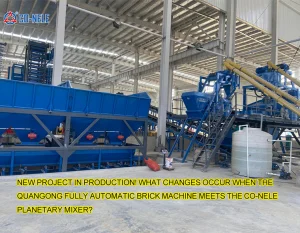
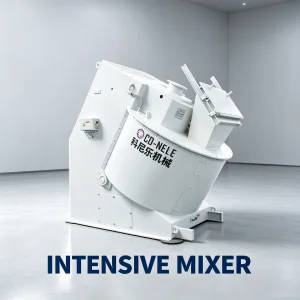
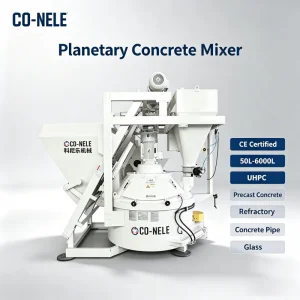
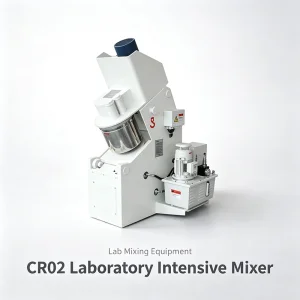
Analyzing the technological transition from gravity mixing to high-intensity forced-action counter-current systems in modern infrastructure.
The global ready mixed concrete (RMC) and industrial mixing landscape is undergoing a structural transition driven by stringent carbon neutrality mandates, escalating aggregate complexity, and the rapid adoption of Ultra-High Performance Concrete (UHPC) and Glass Fiber Reinforced Concrete (GFRC). Modern civil infrastructure projects—such as offshore wind turbine foundations, high-speed rail viaducts, deep-sea tunnels, and architectural precast façades—no longer tolerate the micro-segregation or erratic slump variance typical of legacy free-fall or basic drum mixers.
Engineering intent across international markets focuses heavily on micro-homogeneity and shear energy control. As binder formulations replace traditional Portland cement with Supplementary Cementitious Materials (SCMs) like silica fume, ground granulated blast-furnace slag (GGBFS), and fly ash, mixing dynamics must overcome inter-particle cohesion and disperse ultrafine particles uniformly within seconds.
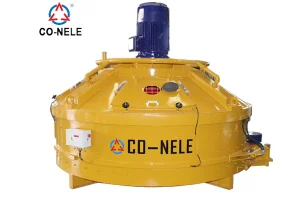
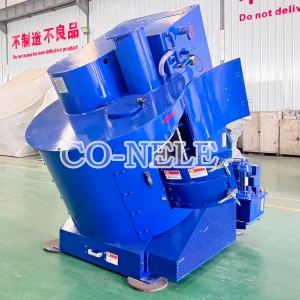
Pan-type planetary counter-current mixers replace vertical shaft drum designs. Parallel rotation and revolution eliminate dead zones, driving the Coefficient of Variation ($CV$) below 5% for dry and semi-dry cast mixtures.
Addition of steel or synthetic micro-fibers into UHPC recipes requires mechanical shear forces capable of breaking agglomerates without fracturing delicate fiber lengths during short 60–90 second mixing cycles.
Modern plant operators demand drive systems optimized for torque curve delivery. Hydro-mechanical couplings and planetary gear reducers reduce peak electric draw during heavy dry-charge startups.
Recent empirical studies show that concrete strength grade (such as C60 to C120) is dictated not only by water-cement ratio ($w/c$) but by hydraulic shear distribution within the mixing vessel. Counter-current planetary motion ensures every particle passes through high-shear zones twice per revolution, increasing 28-day compressive strength consistency by up to 18% compared to standard twin-shaft horizontal configurations.
What international EPC contractors, ready-mix conglomerates, and precast producers look for when evaluating machinery suppliers from China.
Procurement directors and plant operations leaders evaluate commercial concrete mixing machinery through a holistic Total Cost of Ownership (TCO) framework. Purchasing decisions extend far beyond initial capital expenditure (CAPEX); operational expenditure (OPEX), spare parts lifecycle logistics, gear reducer reliability, and international compliance form the baseline evaluation criteria.
| Procurement Metric | Traditional Equipment Standard | CO-NELE Engineering Standard | Operational Impact for Buyers |
|---|---|---|---|
| Mixing Homogeneity ($CV$) | $CV \le 8\% - 10\%$ | $CV \le 3\% - 5\%$ | Eliminates batch rejects; guarantees structural density in UHPC and dry-cast blocks. |
| Liner & Blade Lifespan | 40,000 – 60,000 Batches | 90,000 – 150,000 Batches | High-chrome alloy liners ($HRC \ge 62$) halve maintenance downtime and replacement costs. |
| Drive System Design | Commercial Off-the-Shelf Reducers | In-House Built Planetary Reducers | Absorbs heavy shock loads during dry mixing without teeth fracture or oil leakage. |
| Automation Integration | Basic Manual/Relay Logic | Siemens PLC + IoT Cloud Diagnostics | Real-time moisture compensation, printable batch tracking, and predictive maintenance alerts. |
Furthermore, international buyers are increasingly searching for modularity. Plants operating in remote infrastructure corridors require containerized delivery layouts, fast-erection foundationless structures, and global electrical compatibility (supporting 220V–480V, 50/60Hz configurations with CE, UL, or CSA electrical cabinet compliance).
Inside Qingdao CO-NELE Machinery Co., Ltd: Two decades of dedicated mixing engineering, proprietary gearbox technology, and vertically integrated production.
Operating from Qingdao, Shandong Province—the heartland of China's heavy industrial equipment manufacturing sector—Qingdao CO-NELE Machinery Co., Ltd. (Est. 2004) represents the pinnacle of Chinese mixing machinery engineering. Rather than operating as an aggregator or trading assembly shop, CO-NELE maintains total vertical integration across three major manufacturing bases spanning over 30,000 m².
The single most critical failure point in high-torque concrete or refractory mixing equipment is the gear reducer. Standard commercial gearboxes often fail under severe shock loads caused by coarse aggregate jamming or dry mortar startup torque. CO-NELE has addressed this vulnerability by designing and manufacturing its proprietary vertical-shaft planetary reducers in-house.
Utilizing high-precision CNC gear grinding, vacuum heat treatment, and stringent ultrasonic weld flaw detection, CO-NELE gearboxes feature dual-output torque distribution. This design absorbs unbalanced radial forces, ensuring uninterrupted 24/7 industrial duty cycles in demanding precast and refractory brick factories worldwide.
Selecting the optimal mixing mechanism based on rheology, particle size distribution, and throughput intent.
Kinematic Principle: Mixing arms revolve around a central axis while simultaneously rotating at high speeds in opposite directions.
Best Application: UHPC, GFRC, precast concrete elements, colored paving blocks, kerbstones, dry-cast mortars, and refractory materials.
Key Advantage: Complete pan coverage; zero dead space; superior pigment and fiber dispersion.
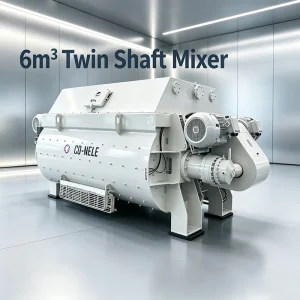
Kinematic Principle: Dual horizontal counter-rotating shafts equipped with overlapping paddle arms create a turbulent fluidizing zone.
Best Application: High-throughput commercial ready-mix concrete ($>60\text{ m}^3/\text{h}$), dam foundations, road base stabilization.
Key Advantage: Extremely fast cycle times (30–45 seconds); rapid hydraulic discharge gates; high volume efficiency.
Kinematic Principle: Inclined rotating pan combined with high-speed rotor tools running at adjustable friction rates.
Best Application: Ceramic powders, proppants, battery cathode materials, diamond tools, iron ore pelletizing, fertilizers.
Key Advantage: Combines mixing, wetting, and high-sphericity pelletizing ($\ge 90\%$) within a single process vessel.
Proven operational performance across demanding infrastructure projects and industrial processing plants worldwide.
Offshore wind turbine jacket foundations demand specialized self-leveling UHPC mixes with zero bleed water and high early compressive strength ($>100\text{ MPa}$ within 48 hours). CO-NELE mobile UHPC mixing stations equipped with CMP planetary mixers are deployed directly on offshore barges, providing precise water-binder ratio dosing under harsh sea states.
During the construction of the Tongling Yangtze River Bridge, steel fiber reinforced UHPC was specified for bridge deck expansion joints. CO-NELE customized planetary mixing plants ensured 100% fiber de-clumping and uniform matrix wetting, successfully completing continuous casting cycles without cold joints.
In modern automated brick and block plants, surface finish and color uniformity define product price premiums. Standard twin-shaft mixers often leave color streaks in dry-cast face mix. Deploying CO-NELE planetary mixers (CMP1000/CMP1500) ensures uniform pigment distribution across thousands of daily cycles, eliminating batch-to-batch color variance.
Beyond traditional concrete, CO-NELE intensive mixers are widely utilized in Luoyang refractory brick facilities and ceramic pelletizing plants in India. High-speed rotor impellers break down agglomerated alumina and zirconia powders, achieving controlled micro-pellet size distribution ($0.5\text{ mm}$ to $8\text{ mm}$) with lower binder consumption than conventional spray drying.
Expert engineering answers to common technical queries regarding machine selection, maintenance, material trial testing, and international shipping.
Choose a vertical-shaft planetary counter-current mixer when your concrete formulation is dry, semi-dry, fiber-reinforced, heavily pigmented, or requires ultra-high performance (e.g., UHPC, GFRC, refractory castables, paving blocks, and precast elements demanding a $CV < 5\%$). A twin shaft concrete mixer is the more economical option for high-throughput commercial ready-mix concrete ($>2\text{ m}^3$ output per batch) where rapid 30–45 second discharge speed is prioritized over micro-homogeneity.
Standard CO-NELE wear liners and mixing blades are cast from high-chrome alloy steel ($HRC \ge 62$). Under normal aggregate mixing conditions, wear parts typically achieve 90,000 to 150,000 operational batches. For highly abrasive applications such as quartz-rich UHPC or refractory ceramics, wear life ranges between 40,000 and 60,000 batches. All wear components are bolt-on and field-replaceable, with spare parts stocked for all models produced since 2004.
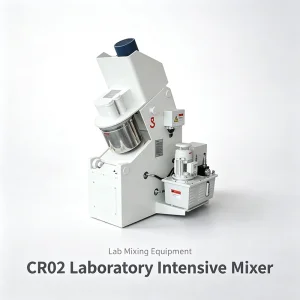
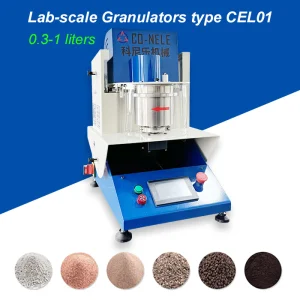
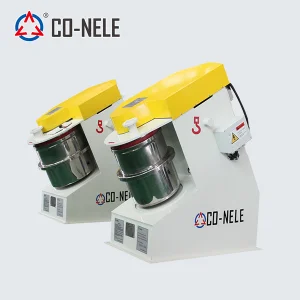
Yes. CO-NELE maintains a fully equipped R&D testing facility in Qingdao with lab-scale planetary and intensive mixers ranging from 5L to 75L capacity. Clients can ship 10kg to 50kg samples of aggregate, powder, or binder. Our process engineers will execute mixing tests and return a comprehensive report covering granule sphericity, bulk density, moisture curves, mixing cycle optimization, and scale-up recommendations for full production models.
All machinery is built to order based on the buyer's local electrical grid (220V, 380V, 415V, 440V, 480V at 50Hz or 60Hz). Electrical control cabinets feature Schneider or Siemens switchgear and can be built to comply with CE mark, UL, or CSA standards. Deliveries include complete foundation CAD drawings, wiring diagrams, English O&M manuals, and 12-month warranty coverage on drive components.
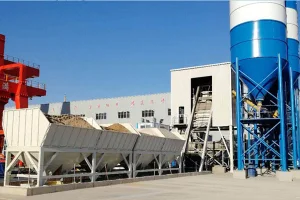
Plant sizing should be calculated from real operational truck dispatch cycles rather than theoretical nominal output. Nominal plant capacity assumes continuous discharging without waiting cycles. Real output is generally 60% to 75% of theoretical capacity. For example, if your project requires an actual continuous demand of $35\text{ m}^3/\text{h}$, an HZS60 plant equipped with a $1\text{ m}^3$ mixer (planetary or twin-shaft) provides the optimal balance of capacity and operational efficiency.
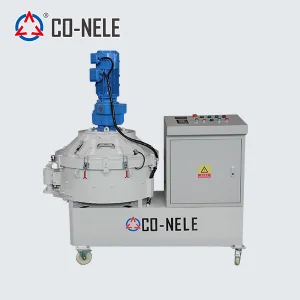
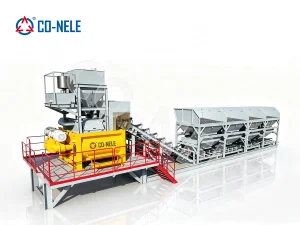
Explore our specialized lab granulators, planetary block mixers, foundationless batch plants, and diamond powder equipment.