
CO-NELEMixing & Granulation
Engineered to meet the exact stiffness, shear, and micro-homogeneity demands of structural cement pipe production lines.
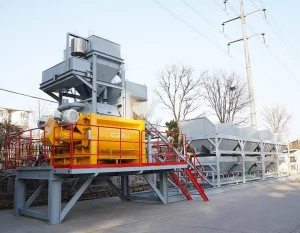
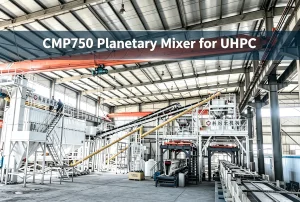
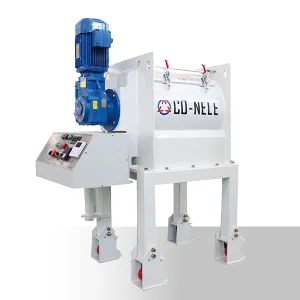
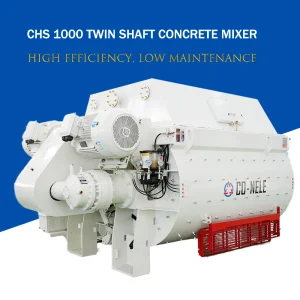
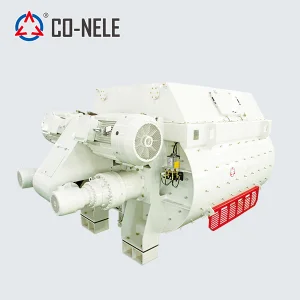
Why vertical-shaft planetary counter-current mixing kinetics outperform conventional horizontal twin-shaft systems in high-density concrete pipe manufacturing.
Structural concrete pipes produced via spun casting (centrifugal formation), radial compaction (roller head), or vertical vibration demolding demand zero-slump or semi-dry concrete matrices. Operating with water-cement ($w/c$) ratios as low as 0.28 to 0.34, these mixtures present extreme yield stress and high plastic viscosity. Standard mixing systems frequently suffer from mortar balling, unhydrated cement pockets, and uneven aggregate distribution.
When dry-cast concrete lacks absolute micro-homogeneity, centrifugal forces during spinning cause radial phase segregation—flinging heavy coarse aggregates outward while pushing weak paste internally. This yields structural weak points, wall porosity, micro-cracking, and failed hydrostatic pressure tests (ASTM C76 / EN 1916).
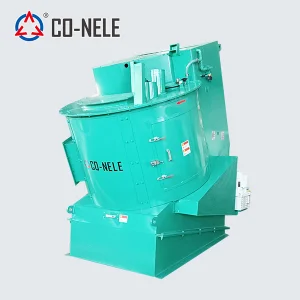
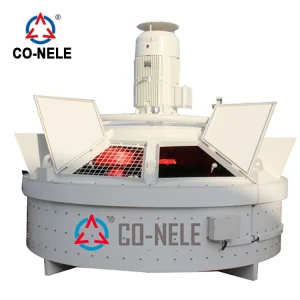
China planetary concrete mixers utilize complex counter-current kinematics. The mixing star arms rotate on a central vertical axis while simultaneously revolving around the vessel's center point in an offset planetary orbit. This dual-rotation movement creates continuous high-shear kinetic energy overlapping every square millimeter of the mixing pan bottom and sidewalls within a single revolution.
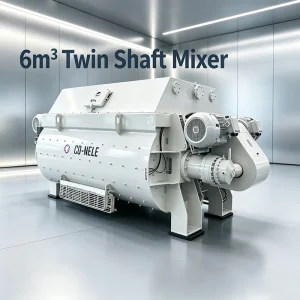
Unlike horizontal twin-shaft mixers where aggregate material can pool in shaft seal transition zones or ride above high-velocity paddles, planetary motion forces 100% of the batch through forced-action shear paths. The resulting mechanical collision breaks down agglomerated micro-silica, pigment, and cementitious gels, achieving a Coefficient of Variation ($CV$) under 3% in less than 60 seconds.
Designed for 24/7 industrial pipe production with extreme torque resistance, hardened wear liners, and automated moisture dynamic feedback.
The core heart of the machine is a custom-engineered single-stage planetary reducer. Engineered with high-torque gear tooth geometry, hardened alloy gears (20CrMnTi carburized), and oil-submerged lubrication, it handles sudden impact loads caused by dry aggregate shearing without gear fatigue or mechanical backlash.
Cement pipe production mixes utilize highly abrasive quartz sand, crushed granite, and slag. Pan bottoms are lined with replaceable high-chromium alloy tiles ($HRC \ge 62$), while mixing arms and scrapers utilize rhomboid Ni-Hard or carbide tips to guarantee service lives exceeding 150,000 batches.
Equipped with optical and microwave moisture sensors embedded directly into the pan floor floor-tiles. The system measures water content 20 times per second, dynamically adjusting water injection valves via PLC to maintain target water-cement ratios within a tight $\pm 0.1\%$ tolerance band.
| Performance Indicator | Planetary Counter-Current Mixer | Standard Twin-Shaft Mixer | Conventional Pan Mixer |
|---|---|---|---|
| Micro-Homogeneity (CV) | < 3.0% (Superior) | 5.0% - 8.0% (Moderate) | > 10.0% (Poor) |
| Zero-Slump Mix Suitability | Exceptional ($w/c \ge 0.26$) | Moderate (Prone to shaft wrapping) | Poor (High dead zones) |
| Discharge Speed & Cleanliness | Fast Pneumatic/Hydraulic Door (>99.5%) | Fast (Dual Gate) | Slow Residual Deposit |
| Fiber Dispersion (Steel / PP) | 100% Ball-Free Dispersion | Moderate Clumping Risk | High Clumping Risk |
| Wear Life (High-Abrasive Pipe Concrete) | 120,000 - 160,000 Batches | 60,000 - 90,000 Batches | 30,000 - 50,000 Batches |
Tailored concrete mixing solutions matching specialized pipe formation technologies globally.
During the spinning process, molds rotate at speeds producing over 30G of centrifugal acceleration. If cement paste fails to encapsulate every sand grain homogeneously, water and fine particles migrate inward while aggregates move outward, causing structural wall stratification. CO-NELE planetary mixers generate extreme shear forces that build intense interfacial bond strength between aggregate boundaries, preventing radial phase separation during spinning.
Radial compaction machines demand ultra-consistent zero-slump concrete fed via conveyor at precise rates. Variations in moisture content or cement paste distribution cause pipe collapse during immediate vertical demolding. Our planetary mixer's rapid discharge cycle and integrated microwave moisture compensation ensure every batch maintains identical green strength for instant mold stripping.
Trenchless micro-tunneling jacking pipes experience immense axial compression loads. Incorporating steel or synthetic structural fibers into the pipe matrix dramatically boosts shear and tensile capacity. Planetary counter-current mixing action separates interlocking fiber bundles efficiently, ensuring 100% 3D fiber spatial orientation without balling.
Large-scale precast concrete box culverts and sewer manhole units require smooth exterior surfaces free from bugholes (air voids). The planetary mixer’s forced shearing releases entrapped micro-air pockets during mixing, producing high-density consolidated surfaces that resist sulfate and chemical corrosion in underground municipal networks.
How advanced robotic manufacturing, vertical engineering integration, and massive production capacity deliver unmatched total cost of ownership (TCO) advantages.
Unlike standard equipment assemblers who outsource planetary gearboxes and structural frames, our Qingdao production bases feature 5-axis CNC machining centers, automated gantry gear grinders, and robotic laser welding stations, ensuring tight tolerance control on all transmission housings.
Every planetary gearbox undergoes 8 hours of continuous no-load and full-load dynamic oil temperature testing, acoustic vibration diagnostics, and torque-breakdown testing prior to shipment, guaranteeing zero oil leakage and quiet operation below 75 dB(A).
Leveraging China's fully integrated industrial supply chain, we deliver heavy-duty concrete mixing plants at 30% to 40% lower capital expenditure than European counterparts while incorporating tier-1 global components like Siemens PLCs, Schneider electronics, and SEW drives.
Elevating concrete mixing equipment with IoT intelligence, dynamic rheology monitoring, and sustainable carbon reduction.
By continuously analyzing motor current harmonics and torque feedback curves during the mixing cycle, our smart control system calculates the slump and yield stress of the concrete in real time, auto-adjusting mixing durations for non-homogeneous raw material batches.
Next-gen floor tiles feature embedded conductive sensors that alert plant managers when wear thickness reaches 80%, enabling scheduled maintenance shutdowns before liner failure damages the structural mixing pan.
Optimized high-speed mixing kinematics allow concrete pipe manufacturers to replace up to 40% of Ordinary Portland Cement (OPC) with fly ash, ground granulated blast-furnace slag (GGBS), or calcined clay, drastically cutting carbon emissions without sacrificing initial demolding strength.
A strategic framework evaluating initial CAPEX against long-term maintenance, energy consumption, and line availability.
Purchasing a mixer is not merely a capital equipment expense; it dictates operational expenditures over a 10-to-15-year lifecycle. Standard low-cost pan mixers often seem economical initially, but frequent liner replacements, long mixing cycle times, gear unit failures, and high motor wattage quickly erase initial savings.
CO-NELE maintains standard interchangeable wear components and gear reducer assemblies across all product series produced since 2004. Overseas clients gain immediate access to global spare part hubs, ensuring express shipment of replacement mixing blades, liner plates, shaft seals, and discharge solenoid valves within 24 to 48 hours.
Every export shipment includes a 2-year maintenance spare parts package, fully documented English technical manuals, complete wiring schematics, and step-by-step video installation guides.
Certified engineering standards backed by localized field commissioning across 80+ countries.
All machinery control systems comply with European CE directives (Machinery Directive 2006/42/EC and Low Voltage Directive 2014/35/EU). Control cabinets can be custom-built with UL/CSA certification for North American installations, featuring dual-channel safety circuits and emergency stop relays.
Export units are fully configured to match destination grid requirements, including 220V, 380V, 415V, 440V, 480V at 50Hz or 60Hz. Motor windings feature IP55 dust/waterproof ratings with Class H tropicalized insulation to withstand hot and humid pipe factory environments.
Equipped with secure cloud gateway modules, our service engineers can perform remote PLC diagnostics, software updates, and calibration assistance anywhere worldwide. Dedicated field engineers provide on-site foundation layout approval, mechanical installation supervision, and operator training.
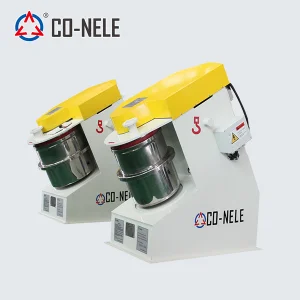
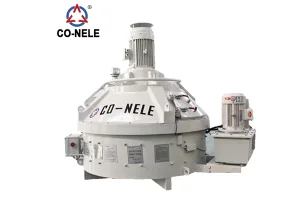
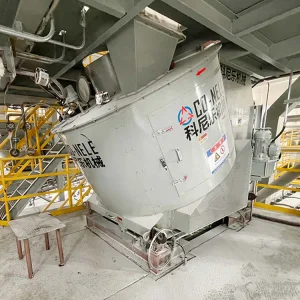
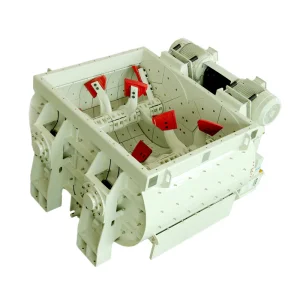
Discover specialized planetary, intensive, refractory, and batching plant configurations tailored to your specific plant volume.
Expert answers covering mixing physics, concrete pipe manufacturing standards, maintenance schedules, and equipment selection.
Concrete pipes made via spun casting or radial compaction utilize zero-slump, low water-cement ratio ($w/c \le 0.32$) mixtures. Twin-shaft mixers excel at wet ready-mix concrete above 2 m³, but struggle to shear semi-dry concrete efficiently, often resulting in dry aggregate lumps or paste wrapping around the shafts. Planetary counter-current mixers eliminate dead zones through forced-action 3D orbital blade kinematics, delivering homogenously mixed mortar paste essential for crack-free pipe walls and high hydrostatic resistance.
During high-speed centrifugal spinning, concrete experiences heavy radial g-forces. If the cement matrix is not perfectly homogenized down to the micro-scale, heavy coarse aggregate separates from the fine mortar matrix, creating weak structural outer zones and aggregate-depleted inner surfaces. CO-NELE planetary mixers thoroughly coat every aggregate particle with hydrated cement gel, maximizing interfacial shear adhesion and preventing phase separation during spinning.
Under normal operating conditions with highly abrasive quartz sand and hard crushed stone, CO-NELE high-chromium alloy liner tiles ($HRC \ge 62$) typically endure 120,000 to 160,000 mixing cycles. Wear blades with tungsten carbide edge overlays deliver between 40,000 and 70,000 batches depending on aggregate sharpness. All wear tiles are modular, standard-sized, and easily unbolted from inside the pan floor for rapid replacement during maintenance.
Yes. Fiber-reinforced concrete (FRC) used in micro-tunneling jacking pipes requires uniform 3D fiber spatial distribution. The high-shear planetary motion and multi-arm scrapper configuration rapidly disperse interlocking fiber clumps within the dry mixing phase (15 seconds dry mix) prior to water injection, guaranteeing zero fiber balling and consistent tensile strength across every section of the pipe.
Immediate vertical demolding in radial compaction pipe machines requires precise moisture content; a moisture variance of just 0.3% can cause the green pipe wall to slump or collapse upon mold removal. Microwave sensors mounted in the mixer pan floor measure real-time moisture 20 times per second during mixing. The smart PLC automatically adjusts fine-dosing water valves, ensuring target moisture stability from batch to batch.
Every machine exported by QINGDAO CO-NELE MACHINERY CO., LTD. complies with European CE safety standards (Machinery Directive 2006/42/EC). Deliveries include complete English operation and maintenance manuals, exploded spare part catalogs, 3D foundation civil drawings, electrical schematics (with optional UL compliance for North America), ISO9001 factory test certificates, and a 12-month warranty covering drive components.
Contact our senior mixing engineers for a complete technical proposal, CAD plant layout, and custom mixer sizing report tailored to your aggregate sample properties.