CO-NELEMixing & Granulation
Precision-engineered mixing equipment designed for micro-homogeneity, rapid cycle times, and maximum abrasion resistance across demanding industrial applications.
In modern industrial manufacturing, mixing is no longer merely a process of mechanical blending; it is a foundational material science discipline that directly dictates structural integrity, electrochemical efficiency, and thermal resistance in advanced end products. As industrial raw materials transition toward sub-micron powders, nano-scale additives, and ultra-tough synthetic fibers, traditional mixing paradigms—such as gravity drum mixers, single/twin-shaft horizontal mixers, and passive ribbon blenders—increasingly encounter fundamental physical limitations. These limitations manifest as localized material agglomeration, dead zones, excessive heat generation, and prolonged batch cycle times that degrade operational profitability.
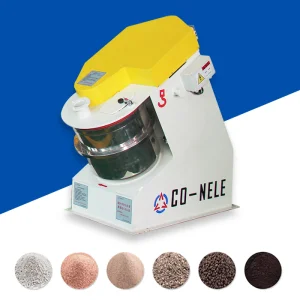
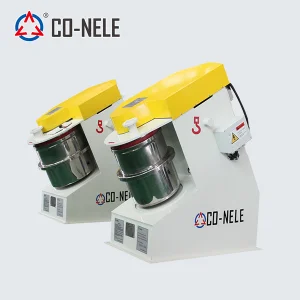
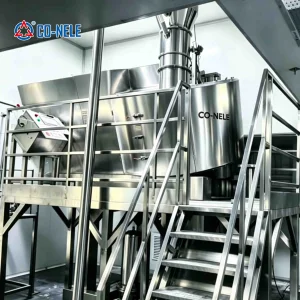
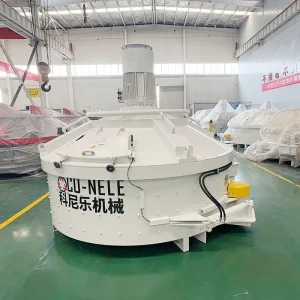
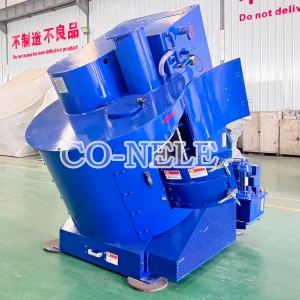
The Eirich-type intensive mixer principle, characterized by a inclined or vertical rotating mixing pan combined with a high-speed eccentric rotor running in opposite or identical directions, revolutionized powder processing and wet mass preparation. Historically developed in Western Europe, this counter-current technology separated the primary functions of material transport and energy input. Today, China’s intensive mixer manufacturing ecosystem has evolved from basic technology absorption to high-precision engineering innovation, establishing robust manufacturing bases that deliver world-class intensive mixing machines, pelletizing granulators, and continuous industrial reactors.
Core Engineering Insight: China-manufactured Eirich-type intensive mixers deliver equivalent micro-homogeneity metrics (Coefficient of Variation CV < 3%) at 40% to 60% lower Total Cost of Ownership (TCO), combined with Industry 4.0 smart PLC integration and localized wear-resistance alloy customisation.
This technical whitepaper provides process engineers, plant operation managers, and procurement directors with an exhaustive analysis of China's intensive mixer industry. It examines the mechanical kinematics of counter-current pan mixing, evaluates global market demand dynamics, details China's Smart Factory 4.0 production standards, and presents real-world industrial case studies ranging from dry battery electrode fibrosis to Ultra-High Performance Concrete (UHPC) formulation.
Unpacking the physical fluid dynamic and velocity differential principles that separate intensive pan mixers from conventional industrial mixing machines.
Traditional horizontal mixers rely on a single drive shaft to move material and impart shear simultaneously, causing uneven shear rates. Intensive mixers decouple these mechanisms: the rotating pan transports 100% of the material into the mixing zone, while the independent high-speed rotor imparts target kinematic energy.
The speed ratio between the rotating container wall and the central rotor tool can be adjusted dynamically from 2 m/s to over 40 m/s. This allows the same machine to perform gentle dispersion, high-shear granulating, rapid wetting, or intensive de-agglomeration within the same process cycle.
A multi-functional bottom-and-wall scraper continuously diverts material from the vessel boundary into the high-shear sweep path of the rotor. This guarantees that 100% of batch volume undergoes active dispersion every single turn of the pan, eliminating unmixed edge zones.
In high-intensity mixers operating on the counter-current principle, material movement is governed by the rotational Froude number ($Fr$), expressed as:
$Fr = \frac{\omega^2 \cdot r}{g}$
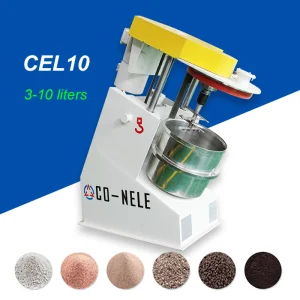
Where $\omega$ is angular velocity, $r$ is pan radius, and $g$ is gravitational acceleration.When configured for pelletizing and granulation (such as in the CEL05 and CQM10 series), the machine operates at controlled lower rotor velocities while applying micro-fine liquid dosing. Capillary force draws particles together, forming dense, spherical green granules with tight grain size distribution ($d_{50}$ variance < 5%). When set to intensive dispersion (e.g., for lithium battery slurries or carbon black), rotor speeds are elevated to maximize mechanical shear stress, breaking agglomerates down to primary particle scale in sub-minute batch times.
How modern Chinese industrial manufacturing hubs leverage vertical integration, robotic machining, and advanced metallurgy to redefine global mixing equipment procurement.
International procurement heads across North America, Europe, the Middle East, and Southeast Asia face compounding supply chain pressures: skyrocketing equipment replacement costs, 30-to-40 week factory lead times from traditional European OEMs, and expensive long-term replacement spare parts.
Chinese intensive mixer factories, anchored in advanced manufacturing zones such as Qingdao, Shandong, have restructured the competitive landscape. By standardizing high-torque planetary drives, modular wear liners, and open-architecture Siemens/Schneider PLC controls, Chinese OEMs provide global buyers with key structural advantages:
The strength of a China Eirich-type mixer lies in heavy mechanical engineering and material longevity. Leading Chinese manufacturing plants employ complete end-to-end quality assurance systems:
Examining real-world production environments where Chinese intensive mixers and planetary batching systems drive process optimization.
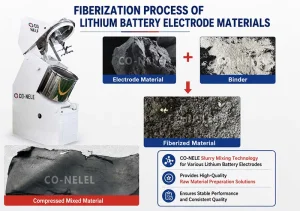
Challenge: Dry electrode manufacturing requires uniform fibrillation of PTFE binders within active cathode/anode powders without thermal degradation.
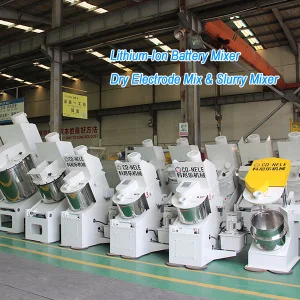
Solution: Specialized China intensive battery mixers provide exact shear temperature control, achieving continuous PTFE fiberization and homogenous slurry mixing for next-gen solid-state cell lines.
Challenge: Ultra-High Performance Concrete (>150 MPa) requires flawless dispersion of steel micro-fibers, silica fume, and low w/c ratio chemical admixtures.
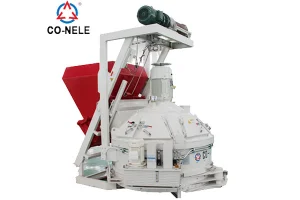
Solution: High-intensive planetary and counter-current mixers prevent steel fiber balling, achieving complete binder hydration and air void elimination in 60-90 seconds per batch.
Challenge: Unshaped refractory castables and ceramic press powders suffer from density segregation when mixed in low-energy pan or ribbon blenders.
Solution: Counter-current intensive mixers coat liquids evenly over fine aggregates, yielding consistent bulk density, high cold crushing strength, and reduced binder consumption.
A side-by-side technical evaluation of intensive counter-current mixing vs. traditional mixer architectures.
| Performance Criteria | Eirich-Type Intensive Mixer | Vertical Planetary Mixer | Twin-Shaft Compulsory Mixer |
|---|---|---|---|
| Mixing Kinematics | Counter-current pan + high-speed multi-stage rotor | Planetary counter-current star arms | Horizontal counter-rotating twin shafts |
| Homogeneity (CV%) | < 1.5% to 3% (Micro-scale) | < 3% to 5% (Macro-scale) | < 5% to 8% (Standard) |
| Standard Batch Time | 30 – 90 seconds | 60 – 120 seconds | 45 – 90 seconds |
| Energy Dispersion Control | Fully variable via independent rotor motor drive | Fixed speed ratio to planetary head | Fixed speed range across shafts |
| Pelletizing / Granulating | Direct wet granulating capability in same vessel | Not applicable (mixing only) | Not applicable (mixing only) |
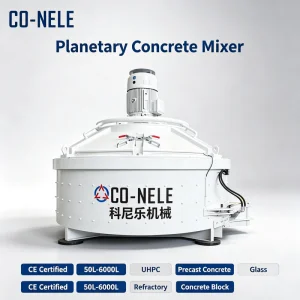
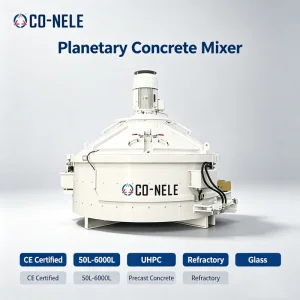
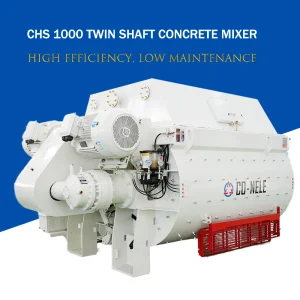
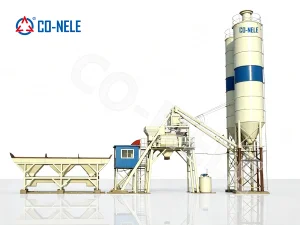
| Primary Industrial Focus | Refractories, Ceramics, Battery Slurry, Granulation, UHPC | Precast Concrete, Block Bricks, GFRC, Glass Batching | Ready-Mix Commercial Concrete, Dam / Road Base Infrastructure |
Expert insights addressing key technical, operational, and purchasing considerations for China intensive mixers.
Explore our complete machinery portfolio, featuring planetary mixers, twin-shaft concrete batching plants, refractory mixers, and specialized granulating systems.
Consult directly with our senior mechanical and process engineering team. Request custom laboratory raw material trial runs, detailed CAD plant layouts, and comprehensive machinery quotes tailored to your project requirements.