
CO-NELEMixing & Granulation
High-precision compulsory twin shaft mixers, planetary batching systems, and specialized granulation platforms engineered for demanding structural concrete and chemical applications.
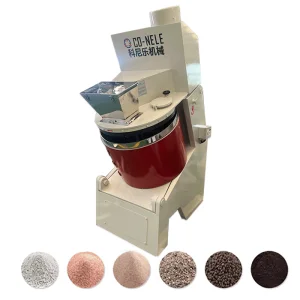
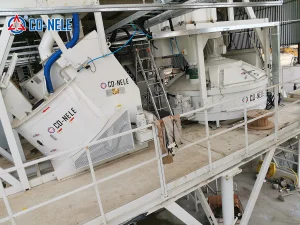
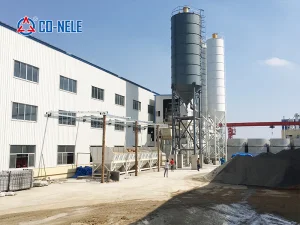
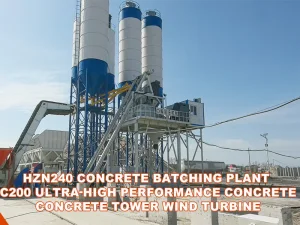
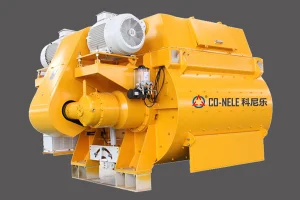
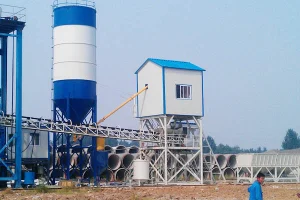
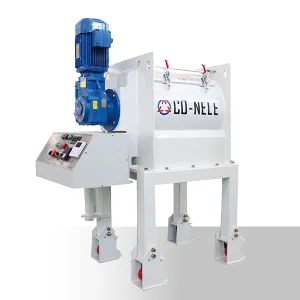
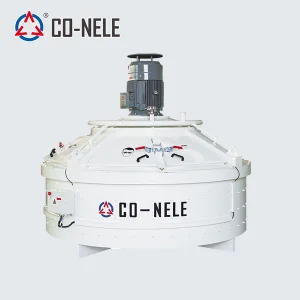
Rigorous mechanical testing, real-time torque sensing, and advanced wear metallurgy redefine operational productivity for global infrastructure projects.
In modern industrial engineering, the mixing stage represents the decisive bottleneck for structural integrity, chemical homogeneity, and material durability. Legacy single-shaft horizontal mixers and gravity-fed tilting drum mixers are increasingly incapable of satisfying the rigorous rheological demands of high-performance concrete (HPC), Ultra-High Performance Concrete (UHPC), self-consolidating concrete (SCC), dry-powder mortars, and high-binder asphalt matrices. As construction specifications shift toward zero-defect tolerances, global megastructure projects demand forced-action compulsory mixing systems capable of achieving micro-level homogeneity within rapid cycle constraints.
China's dual shaft mixer manufacturing sector has undergone a profound transformation. Transitioning from basic mechanical fabrication to advanced precision engineering, leading manufacturers like Qingdao CO-NELE Machinery Co., Ltd. integrate computational fluid dynamics (CFD), finite element analysis (FEA), and fully automated robotic manufacturing lines. This evolution positions Chinese dual shaft concrete mixers as the global benchmark for high-throughput, low-maintenance batching equipment across more than 80 countries.
The global demand for industrial compulsory mixers is propelled by three distinct structural shifts:
Exploring the fluid mechanics, torque distribution, and wear-resistant metallurgy that separate high-end Chinese industrial mixers from legacy batching units.
Unlike single-shaft mixers that move material primarily in a circumferential direction, a dual shaft mixer employs synchronized synchronized counter-rotating horizontal shafts fitted with multi-angled paddle blades. The paddle geometry forces material into a continuous three-dimensional spiral circulation pattern.
At the center zone where the opposing mixing radius circles intersect, an intensely turbulent counter-current fluidization zone is formed. Aggregates, cementitious powders, water, and liquid admixtures collide with high kinetic velocity. This counter-current action eliminates stagnant dead zones at the tank ends, achieving a Coefficient of Variation ($CV \le 5\%$) in mixing uniformity in as little as 30 seconds.
The historical vulnerability of horizontal mixers has been shaft-end slurry leakage, which leads to bearing contamination and premature gearbox failure. Advanced Chinese dual shaft concrete mixers solve this through multi-stage sealing technology:
Abrasive wear caused by high-velocity granite, basalt, or quartz aggregate impacts is mitigated through advanced metallurgical casting:
Mixing blades and wall liners are produced from high-chromium cast iron alloys (ranging from Cr15 to Cr26 Ni-Hard matrixes), offering surface hardness ratings exceeding HBW ≥ 600 (HRC 58-62). Liner plates feature rhombic or interlocking trapezoidal geometric shapes that facilitate easy bolt-on replacement while preventing fine mortar migration behind the liners.
| Mixer Architecture | Mixing Action Type | Homogeneity ($CV$) | Batch Cycle Time | Wear Plate Longevity | Primary Application Suitability |
|---|---|---|---|---|---|
| Dual Shaft Compulsory (CTS / CHS) | 3D Double Spiral Counter-Current Shearing | ≤ 5% (Superior) | 30 – 45 Seconds | 120,000 – 150,000 Batches | High-Volume Ready-Mix, Mass Concrete, Dams, Precast Infrastructure |
| Planetary Counter-Current (CMP) | Vertical Orbital Rotation + Star Arms | ≤ 3% (Ultra-High) | 60 – 90 Seconds | 90,000 – 120,000 Batches | UHPC, GFRC, Color Blocks, Refractories, Pipe Precast |
| Single Shaft Horizontal | Circumferential Radial Shearing | ≤ 10% (Moderate) | 60 – 90 Seconds | 60,000 – 80,000 Batches | Standard Commercial Concrete, Low-Grade Mortars |
| Reversing Drum / Gravity Tilt | Free-Fall Gravity Cascade | ≤ 15% (Basic) | 120 – 180 Seconds | 40,000 – 60,000 Batches | Small On-Site General Civil Works, Non-Structural Pours |
Why international buyers increasingly partner with Chinese mixer OEMs for enterprise-grade durability, precision gear transmission systems, and unmatched delivery efficiency.
The mechanical heart of any compulsory dual shaft mixer is its heavy-duty speed reducer. Premier manufacturers such as CO-NELE design and assemble planetary gearboxes and heavy synchronizing drive units internally rather than outsourcing off-the-shelf commercial gear assemblies.
Gear teeth undergo deep carburizing heat treatment and high-precision CNC gear grinding, achieving AGMA Class 12 / ISO Grade 6 precision standards. This ensures thermal stability under shock-load start-ups with settled dense mixes, yielding a mechanical drive efficiency exceeding 98.5%.
Shandong Province serves as an international cluster for industrial machinery engineering. China's integrated supply chain allows mixing equipment manufacturers to source raw high-grade Q355B structural steel, wear-resistant chromium castings, hydraulic components, and Siemens industrial PLCs within tight geographic proximity.
This structural proximity reduces manufacturing lead times by 40% compared to European or North American machinery factories, allowing turnkey delivery of custom batching machinery within 20 to 35 days.
Precision robotic seam welding eliminates human error in structural frame assembly, preventing micro-fractures caused by continuous torsional vibration. Mixing tubs undergo stress-relieving thermal annealing after welding to neutralize internal material stress.
Before shipment, every dual shaft machine undergoes a 4-hour full-load dynamic test bench trial, monitoring bearing temperature curves, noise levels (< 80 dB), oil pressure stability, and shaft alignment under variable speed inputs.
Evaluating initial capital expenditure against lifecycle operating costs, energy efficiency per cubic meter, and component availability.
International EPC contractors and batching plant operators often make the mistake of evaluating mixers purely on initial capital expenditure (CAPEX). A comprehensive TCO model incorporates operational expenditure (OPEX) across a 10-year service lifecycle:
TCO = CAPEX + (kWh/m³ × Electricity Cost) + (Wear Spare Parts Cost / Batch Volume) + Unscheduled Downtime Losses
Dual shaft concrete mixers manufactured by CO-NELE optimize each variable in this formula. By achieving rapid homogeneous mixing in 30 seconds, energy consumption per cubic meter is reduced by 15-22% compared to conventional tilt-drum or pan mixers. Furthermore, high-chrome wear blades exhibit wear rates under 0.05 grams per tonne of aggregate, lowering long-term maintenance costs drastically.
When selecting a Chinese dual shaft mixer manufacturer, global procurement teams evaluate critical structural parameters:
From offshore wind farm foundation grouting to high-capacity commercial ready-mix plants, dual shaft machinery adapts to extreme material formulations.
In high-capacity commercial ready-mix plants (such as HZS120, HZS180, and HZS240 plant layouts), twin shaft mixers serve as the central mixing core. Handling batch capacities from 2.0 m³ up to 6.0 m³ per drop, these machines maintain continuous output cycles for transit mixer truck fleets. Dual discharge gates allow rapid dumping into concrete transit trucks without segregation.
Ultra-High Performance Concrete (UHPC) requires breaking down microscopic silica fume clusters while disbursing high volumes of steel micro-fibers without clumping ("balling"). Specially configured heavy-duty twin shaft and planetary mixers utilize high-torque speed reducers and variable-frequency drives (VFD) to deliver intense shear stress during initial hydration.
For precast concrete pipes, wind turbine tower foundations, culverts, and prestressed bridge girders, concrete must be cast with extremely low water-cement ratios ($w/c \le 0.28$). Dual shaft compulsory mixers produce stiff, zero-slump pastes with precise air-entrainment levels, enabling instant mold stripping and superior surface finish.
Beyond traditional wet concrete, twin shaft batching technology is modified for dry powder tile adhesives, self-leveling floor compounds, and asphalt batch plants. Dual shaft paddle arrangements prevent micro-ingredient segregation and handle polymer powder additions under dust-tight environmental seals.
Integrating IoT sensor arrays, machine-learning moisture calibration, and green binder compatibility.
Next-generation Chinese dual shaft mixers incorporate wireless vibration sensors, temperature probes on main shaft bearings, and oil-viscosity monitors inside gearboxes. Edge-computing modules analyze harmonic vibration patterns in real time, alerting maintenance managers to seal wear or gear backlash before catastrophic mechanical failure occurs.
Real-time microwave moisture probes installed inside the mixing tub measure the dielectric constant of aggregate sand continuously during the dry mixing phase. The plant PLC automatically adjusts water dosing within milliseconds, guaranteeing slump consistency regardless of raw aggregate surface moisture variations.
As the global construction sector transitions to zero-cement geopolymers (activated alkali fly ash/slag binders), mixers must withstand aggressive alkaline environments. Modern mixers utilize specialized anti-corrosive stainless-clad mixing tubs and chemical-resistant fluoroelastomer seals to ensure longevity.
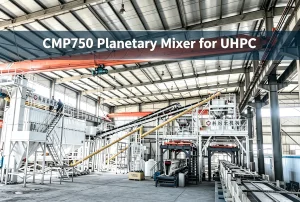
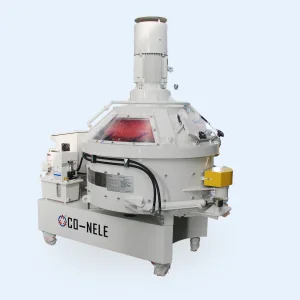
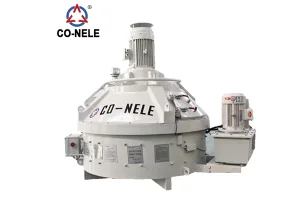
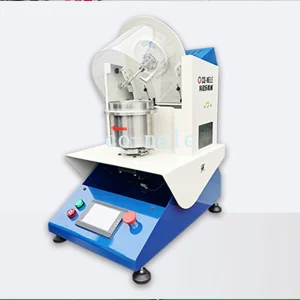
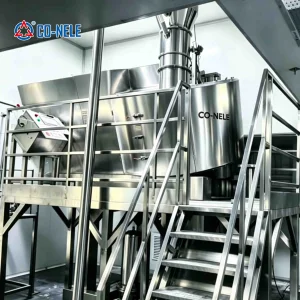
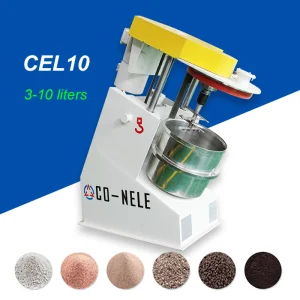
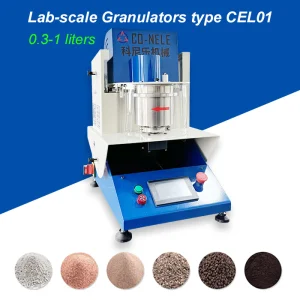
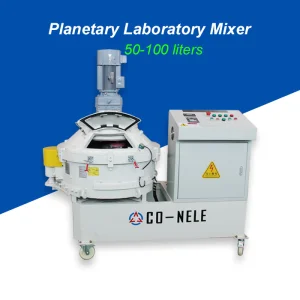
Complete batching, laboratory scale-up, and continuous granulating machinery engineered by CO-NELE to support comprehensive material engineering programs.
Clear technical guidance provided directly by CO-NELE application engineers for global machinery buyers.
A twin shaft mixer features two horizontal counter-rotating shafts that create a 3D compulsory turbulence zone, making it ideal for continuous, high-volume production of wet concrete and standard ready-mix above 1.5 m³ per batch. In contrast, a vertical-shaft planetary counter-current mixer uses orbiting star arms to deliver intensive micro-homogeneity ($CV \le 3\%$) for dry-cast, UHPC, glass-fiber reinforced concrete (GFRC), and specialized refractory formulations.
Our dual shaft mixers utilize a multi-stage seal combining precision metal floating seal rings, rubber labyrinth seals, and an automatic multi-line high-pressure electric grease pump. The pump injects continuous grease into the seal chamber during operation, maintaining a positive outward pressure barrier. Furthermore, main bearings are structurally isolated from the tub walls.
Under standard aggregate mixing conditions (hardness HBW ≤ 600), CO-NELE high-chromium alloy liners ($Cr15 - Cr26$) achieve a service life of 120,000 to 150,000 batch drops (approx. 250,000 to 400,000 m³ of concrete). For highly abrasive mixes containing crushed quartz or basalt, wear life ranges between 60,000 and 90,000 batches. All wear plates are modular and field-replaceable via standard bolt fittings.
Yes. All machinery motors, control cabinets, and hydraulic power units are engineered to match local site power parameters worldwide (e.g., 220V/380V/415V/440V/480V at 50Hz or 60Hz). Electrical control panels feature Siemens PLCs, Schneider contactors, and optional UL/CSA or CE compliant enclosures based on destination market regulations.
Standard dual shaft concrete mixers (CTS 1000 to CTS 4000 series) are manufactured within 20 to 30 working days. Compact and modular batching units are sized specifically to fit standard 40ft High Cube (HQ) shipping containers or Flat Rack containers, reducing international sea freight charges and preventing sea-spray oxidation during transit.