CO-NELEMixing & Granulation
Understanding the fluid dynamics, counter-rotating shear kinematics, and structural mechanics that make China double shaft mixers the international standard for high-throughput concrete production.
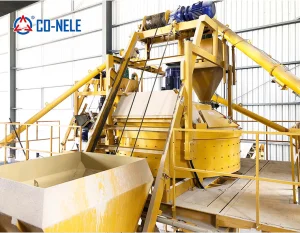
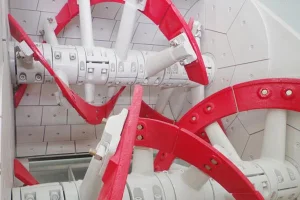
Unlike free-fall drum mixers, a double shaft mixer utilizes dual horizontal synchronized shafts fitted with staggered paddles. The paddles rotate inward at opposing directions, creating a turbulent three-dimensional fluidization zone where particles collide in mid-air, cutting mixing time by up to 50%.
The primary point of mechanical failure in twin-shaft mixers is cement slurry ingress into main bearings. Advanced Chinese manufacturing employs floating ring seals, automated multi-line grease injection pumps, and high-pressure fluid barriers that maintain a 1.2 MPa counter-pressure to safeguard shaft longevity.
Standard liners degrade rapidly under abrasive aggregate friction. Premium Chinese factories utilize Ni-Hard and High-Chromium cast iron alloys (Brinell Hardness ≥ HB600) for mixing arms, wall liners, and corner guards, achieving operational life cycles exceeding 120,000 batches.
The convergence of advanced metallurgical engineering, complete supply chain integration, and total cost of ownership (TCO) optimization.
China's heavy machinery production hubs, particularly in Qingdao and Shandong Province, host mature industrial clusters. From raw structural steel casting to precision gear grinding and PLC cabinet assembly, every component of a double shaft mixer is produced within a 50 km radius. This clustering reduces supply chain lead times from months to days and drives rigorous quality control across every stage of fabrication.
Furthermore, leading factories participate directly in setting Chinese National Standards (GB/T) for concrete machinery, ensuring structural safety margins exceed traditional OEM standards.
Procuring industrial mixing machinery from China yields an immediate capital expenditure savings of 35% to 50% compared to European brands without compromising structural integrity or mechanical reliability. Key advantages include:
Information Gain Benchmark: Selecting the right mixing technology based on recipe dynamics, aggregate sizing, and output demands.
| Performance Indicator | Double Shaft Concrete Mixer (CHS) | Planetary Counter-Current Mixer | Single Shaft / Pan Mixer |
|---|---|---|---|
| Primary Application | Ready-Mix, Mass Concrete, Infrastructure | UHPC, Precast, Refractory, Glass, Blocks | Small-scale construction, Mortar, Bricks |
| Mixing Cycle Time | 30 - 45 Seconds (Ultra-Fast) | 60 - 90 Seconds | 90 - 120 Seconds |
| Discharge Speed | Hydraulic Dual Gate (Instantaneous) | Single/Dual Sector Gate | Manual / Mechanical Gate |
| Max Aggregate Size | Up to 150 mm (Heavy Gravel) | Up to 40 mm (Medium Aggregate) | Up to 20 mm (Fine Aggregate) |
| Mixing Homogeneity (CV) | ≤ 3% - 5% (High Efficiency) | < 1% - 3% (Micro-Homogeneity) | > 5% - 8% (Moderate) |
| Maintenance Complexity | Low (External Seal Lubrication) | Moderate (Complex Gearbox) | Low |
How artificial intelligence, green concrete formulations, and predictive maintenance are changing industrial batching plants globally.
Modern Chinese double shaft mixers now feature embedded IoT telemetry. Shaft vibration analysis, bearing thermal monitoring, and real-time lubricant pressure tracking send alerts directly to plant managers' mobile dashboards, preventing catastrophic mechanical failures before they occur.
As global carbon targets push the industry toward low-carbon cements, alkali-activated materials, calcined clay, and high-volume fly ash recipes, double shaft mixers are re-engineered with variable frequency drives (VFD) to adjust mixing intensity dynamically per formulation stage.
Integrating high-pressure water wash manifolds and multi-point liquid admixture misting nozzles directly inside the twin shaft mixing drum ensures fast chemical dispersion, minimizing slump loss and maximizing early concrete compressive strength development.
From high-speed railway sleepers to massive dam foundations, see how Chinese double shaft mixers adapt to rigorous job site demands worldwide.
In high-capacity ready-mix concrete plants, cycle speed is revenue. A 3.0 m³ output double shaft mixer delivers homogenous concrete every 45 seconds, supporting continuous truck mixer loading schedules in sprawling urban infrastructure expansion projects across Southeast Asia, the Middle East, and Latin America.
Precast structural components (tunnel lining segments, bridge girders, culverts) require consistent zero-slump or low-slump concrete without air voids. The forced shear action of double horizontal shafts guarantees uniform distribution of coarse aggregates and fine sand matrix without segregation.
Hydraulic engineering projects require vast volumes of dry-hard RCC concrete containing large rock aggregate sizes (up to 120 mm - 150 mm). Reinforced double shaft mixers with heavy-duty forged steel arms and thick alloy liners handle aggregate impact without shaft flex or paddle breakage.
Direct technical answers from factory engineering teams regarding sizing, wear part maintenance, power requirements, and international compliance.
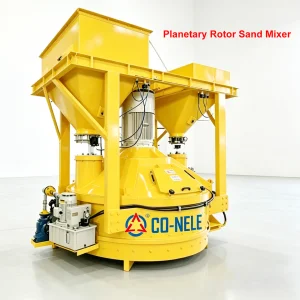
A double shaft mixer features two horizontal parallel shafts with overlapping paddles that create horizontal and axial turbulent currents. It is optimized for high-volume wet and ready-mix concrete (above 1.0 m³ per batch) with extremely fast cycle times (30–45s). A planetary mixer features vertical shafts rotating on a planetary track, making it better suited for dry-cast concrete, UHPC, color precast, and ceramic powders requiring micro-homogeneity but with longer mixing cycles (60–90s).
Leading Chinese manufacturers use a 5-layer sealing technology: inner steel floating seal rings, high-pressure grease lubrication barrier, rubber seal rings, labyrinth seal channels, and external isolated bearing housings. An automatic electric lubrication pump maintains a continuous 1.2 MPa grease pressure to keep cement slurry out of main shaft bearings permanently.
Under standard aggregate conditions (quartz sand, limestone gravel under 40mm), high-chromium alloy liner plates (Cr26 / HB600+) last between 90,000 and 150,000 batches. For highly abrasive aggregates (crushed granite, basalt), wear life ranges between 60,000 and 90,000 batches. All wear plates are modular and bolt-on for rapid onsite replacement.
Chinese OEM export equipment is custom-built to match regional power grids: 220V/380V/415V/440V/480V at 50Hz or 60Hz. Electrical cabinets feature international components (Siemens PLC, Schneider breakers, ABB VFDs) and comply with CE, UL, and CSA safety specifications upon buyer request.
Standard manufacturing lead time is 15 to 25 business days. Compact and modular foundationless plants fit entirely into standard 40HQ shipping containers (e.g., an HZS60 plant packs into two 40HQ containers), drastically reducing ocean freight costs and site installation timeline.
Yes. Heavy-duty double shaft mixers (CHS series) are specifically optioned with high-torque gearboxes and specialized paddle geometry to prevent steel or synthetic fiber clumping in fiber-reinforced concrete (FRC) and ensure complete binder coating in dry Roller Compacted Concrete (RCC).
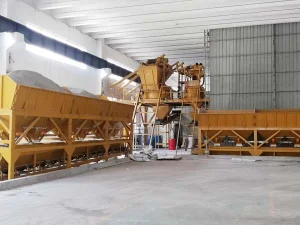
China Precast Concrete Wall Panels | Planetary Concrete Mixer | PC Batching Plant Price Manufacturer, Factory
View Details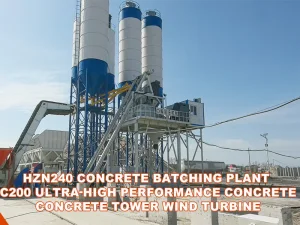
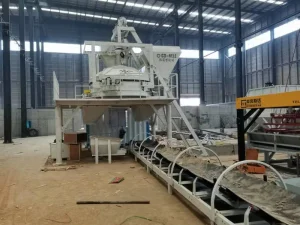
China UHPC Batching Plant for Precast Concrete Wind Turbine Towers Manufacturer, Factory
View Details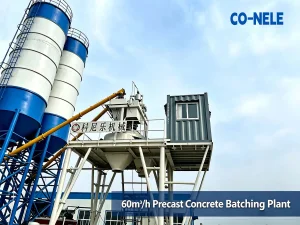
China HZS60 60m³/h Precast Concrete Batching Plant | 1000 Planetary Mixer Manufacturer, Factory
View Details