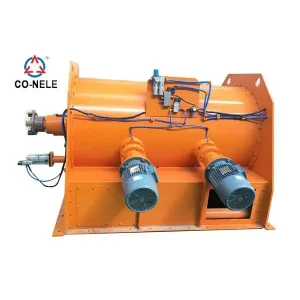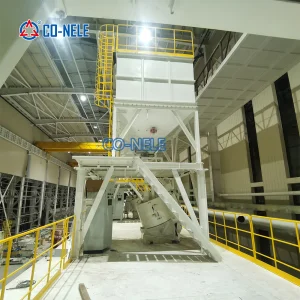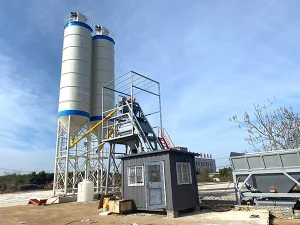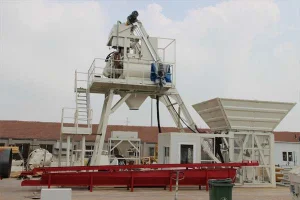
CO-NELEMixing & Granulation
Explore CO-NELE’s flagship planetary, twin-shaft, intensive, and granulating mixer lines engineered for zero-defect output across global infrastructure and industrial powder sectors.
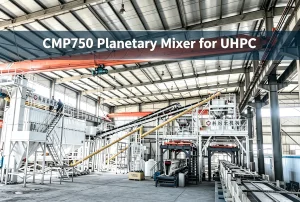
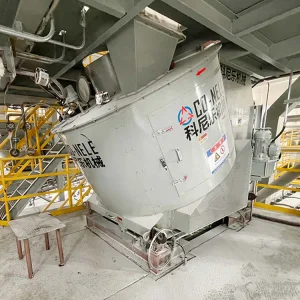
A comprehensive examination of shear dynamics, thermodynamic boundary conditions, and micro-homogeneity benchmarks across modern manufacturing domains.
In modern industrial processing, the transition from basic mechanical blending to advanced micro-homogenous dispersion represents the decisive factor between standard material output and ultra-high-performance deliverables. As infrastructure demands shift toward Ultra-High Performance Concrete (UHPC), Glass Fiber Reinforced Concrete (GFRC), synthetic refractories, advanced ceramic precursors, and high-density battery material matrixes, traditional gravity tilting drum mixers and horizontal twin-shaft units frequently reach operational limits. High variance in moisture distribution, binder agglomeration, aggregate segregation, and excessive cycle times severely penalize batching yield and structural longevity.
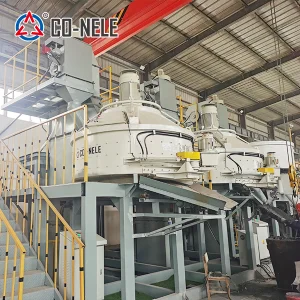
Qingdao CO-NELE Machinery Co., Ltd. (established in 2004) has spent over two decades systematically addressing these mechanical bottlenecks through continuous research, custom gearbox engineering, and advanced kinematic design. Operating out of three dedicated production bases spanning over 30,000 m² in Qingdao, Shandong Province, CO-NELE has established itself as China’s paramount manufacturer of vertical-shaft planetary mixers, inclined intensive mixer-granulators, and automated concrete batching plants.
Key Engineering Milestone: CO-NELE holds over 80 national patents and has spearheaded the formulation of Chinese National Standards for industrial mixing machinery, exporting high-precision systems to over 80 countries spanning Europe, the Americas, the Middle East, and Southeast Asia.
Analyzing the physical motion vectors, energy transmission efficiency, and wear mechanics that distinguish vertical planetary mixers from standard twin-shaft machinery.
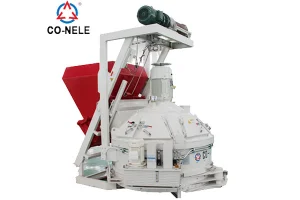
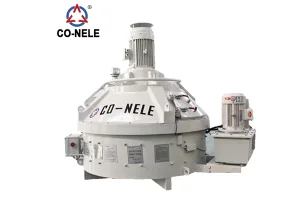
Unlike standard pan mixers with static rotational axes, CO-NELE’s planetary mixers execute a complex dual-motion trajectory. The mixing star arms rotate rapidly on their own axes while simultaneously revolving around the central pan axis in a synchronized counter-current direction.
This overlapping motion profile eliminates flow dead zones, guarantees that 100% of the mixing pan surface is swept within seconds, and forces heavy aggregate particles, fine micro-silica, water, and liquid admixtures into intense chaotic collisions. The result is a Coefficient of Variation (CV) below 5%, achieved in cycle times 30% faster than conventional vertical mixing units.
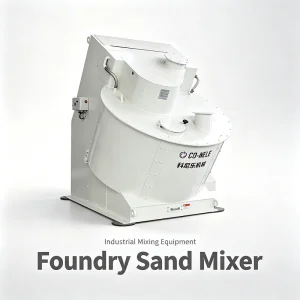
For fine powders, refractory castables, alumina ceramic precursors, and metallurgy mixes, simple agitation is insufficient. CO-NELE’s intensive mixer granulators utilize an inclined rotating mixing pan coupled with an independently driven, high-speed eccentric rotor.
The inclined pan moves material upwards continuously, allowing gravitational force to pull mass back down into the high-speed rotor shear zone. This creates intense velocity gradients, allowing simultaneous micro-mixing, binder dispersion, liquid coating, and controlled round-bead pelletization (0.5 mm to 8 mm) in a single sealed process vessel without requiring spray drying energy loads.
| Technical Parameter | CO-NELE Planetary Counter-Current | High-Speed Intensive Granulator | Twin Shaft Compulsory (CHS) | Single Shaft / Ribbon Mixer |
|---|---|---|---|---|
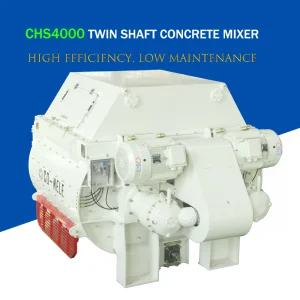
| Primary Application Target | UHPC, GFRC, Precast, Dry Block, Refractory | Ceramics, Battery Powder, Pellets, Fine Ores | Ready-Mix Concrete, Commercial Mass Pour | Dry Powder Mortar, Basic Aggregates |
| Mixing Homogeneity (CV) | < 5% (Micro-Homogeneous) | < 2% (Ultra-Fine Dispersion) | < 10% (Commercial Standard) | < 15% (Macro-Blended) |
| Batch Cycle Duration | 60 – 90 Seconds | 90 – 180 Seconds (Inc. Granulation) | 30 – 45 Seconds | 120 – 240 Seconds |
| Kinematic Mechanism | Dual-Axis Planetary Star Revolution | Inclined Pan + High-Speed Rotor Shear | Parallel Twin-Axis Counter Rotation | Single Horizontal Shaft Agitation |
| Wear Resistance Spec | Cr26 High-Chrome Alloy (HRC 60-65) | Tungsten Carbide / Ceramic Coating | Ni-Hard / High-Chrome Cast Liners | Standard Hard-Faced Mild Steel |
| Fibre Dispersion Capability | Outstanding (Zero Steel Fiber Balling) | N/A (Focused on Powders/Granules) | Moderate (Prone to Clumping) | Poor (High Fiber Entanglement Risk) |
How CO-NELE mixing systems are custom-engineered to meet rigorous operating requirements across diverse climate zones and specialized product formulations.
In bridge jointing, structural rehabilitation, and offshore wind turbine foundations, UHPC requires compressive strengths exceeding 150 MPa. Achieving this requires dispersing extremely fine silica fume (0.1 µm) without creating agglomerate pockets while thoroughly coating dense steel micro-fibres.
CO-NELE CMP series planetary mixers utilize reinforced high-torque drivetrains, hydraulic dampening couplings, and anti-balling star arm geometries that guarantee 100% steel fibre alignment and void-free structural consistency. deployed on major bridge projects like the Tongling Yangtze River Bridge and offshore installations worldwide.
Refractory lining bricks and monolithic castables used in steelmaking blast furnaces, glass kilns, and cement calcining plants encounter extreme thermal and abrasive stress. Mixing dry aggregates with liquid binders requires high mechanical force without causing aggregate degradation.
CO-NELE refractory mixers feature wear liners made of ultra-hard Chromium 26 alloy (HRC > 62) and carbide-tipped scraper blades. The counter-current planetary shear homogenizes dense refractory castables, synthetic mullite, and corundum mixes rapidly without excessive heat generation inside the mixing tub.
In powder metallurgy, alumina ceramics, bentonite clay processing, and lithium battery cathode production, material flowability determines pressing efficiency. Traditional pan granulators struggle with wide grain-size distribution and high dust emissions.
CO-NELE intensive granulators operate under fully enclosed, dust-tight negative pressure. By precisely adjusting the peripheral speed of the high-energy rotor (up to 30 m/s) against pan rotation, operators produce micro-granules with 90%+ sphericity, controlled bulk density, and zero binder waste.
How vertical manufacturing integration, proprietary gearbox production, and strict quality assurance empower CO-NELE mixers to outperform global competitors.
A critical limitation of generic commercial mixer assemblers is their reliance on third-party commercial off-the-shelf (COTS) speed reducers and outsourced steel structures. Heavy industrial mixing exposes planetary gearboxes to intense torsional shock loads, rapid direction shifts, and abrasive airborne particulate contamination. Third-party gearboxes designed for standard industrial conveyors often fail prematurely under severe mixing loads due to tooth root fatigue and thermal breakdown.
CO-NELE has eliminated this point of failure through total vertical manufacturing integration across its three Qingdao production bases:
The transition from manual moisture compensation and fixed timing to dynamic closed-loop sensor networks and predictive wear maintenance.
Integrating high-frequency microwave sensors beneath the ceramic pan liners allows CO-NELE systems to measure aggregate moisture changes 20 times per second, automatically adjusting water dosing valves in real time to maintain targeted water-cement ratios within ±0.1% accuracy.
By monitoring VFD motor current draw, torque ripple, and fluid shear resistance continuously, the control unit measures rheological changes inside the tub, automatically determining exact mix completion without stopping the machine for slump tests.
Embedded vibration transducers and oil temp sensors transmit real-time health telemetry to cloud diagnostic servers. Plant managers receive early warnings regarding bearing wear or gear fatigue before failures lead to unplanned downtime.
Ensuring seamless structural integration, local power grid compatibility, and reliable engineering support for international procurement teams.
Every CO-NELE export unit is built custom to match regional site utilities—including 220V, 380V, 415V, 440V, and 480V at either 50 Hz or 60 Hz. Electrical control cabinets utilize premium Schneider, Siemens PLC, and ABB frequency drives, enclosed to IP65/IP66 dust and water ingress standards with CE, UL, and CSA electrical compliance packages available on demand.
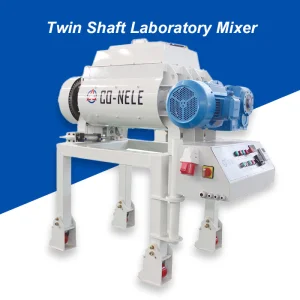
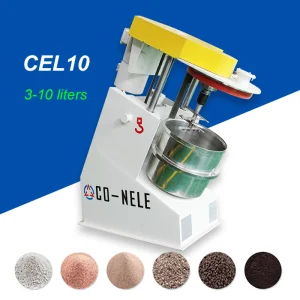
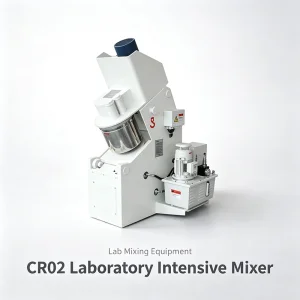
Before issuing a commercial proposal for complex powders or custom recipes, CO-NELE operates an industrial test laboratory in Qingdao. Overseas clients can send 10-50 kg raw material samples. Process engineers perform test batches on lab-scale units (5L to 75L), analyzing density curves, binder requirements, and granule sphericity to guarantee exact performance metrics before line installation.
Discover specialized laboratory granulators, mobile batching plants, twin-shaft ready-mix units, and dry mortar mixing plants designed by CO-NELE.
In-depth technical answers addressing operational mechanics, machine selection, wear replacement, and custom international specifications.