
CO-NELEMixing & Granulation
Precision-engineered machinery designed for maximum rheological efficiency, wear resistance, and high output continuous concrete production.
A definitive guide to selecting, integration, and deploying high-performance planetary mixers, twin-shaft compulsory units, and modular batching plants for global engineering projects.
The global construction material industry has undergone a radical paradigm shift over the past decade. Modern infrastructure projects—ranging from high-speed railway viaducts, deep-sea offshore wind turbine foundations, and ultra-tall architectural structures—demand concrete mixtures with exceptionally high mechanical performance, ultra-low water-binder ratios, and absolute micro-homogeneity. As a premier China concrete plants manufacturer and factory hub, domestic mixing equipment engineering has evolved far beyond simple mechanical assembly into an advanced discipline of industrial powder processing, rheological fluid dynamics, and digital automated dosing control.
To achieve strict compliance with international standards such as ASTM C94, EN 206-1, and DIN 1045, modern batching equipment must resolve complex material distribution physics. High-performance concrete formulas—including Ultra-High Performance Concrete (UHPC), Glass Fiber Reinforced Concrete (GFRC), and complex Refractory Castables—require intense dynamic mechanical energy inputs to break up micro-agglomerations of silica fume, fly ash, and nano-additives without causing fiber damage or thermal degradation.
How localized industrial clusters, advanced metallurgy, and complete in-house gearbox manufacturing create unparalleled competitive value for global buyers.
Unlike standard integrators who outsource core drive assemblies, leading Chinese manufacturers maintain dedicated gear-machining plants. Heavy-duty planetary reducers feature forged alloy gears, heat-treated to HRC 58-62, providing massive torque multiplication and resistant shock-load dampening for dry mix startups.
Capitalizing on China's premier metallurgical supply chain, wear plates and mixing paddles are cast from Ni-Hard and High-Chromium Alloy (Cr26+). This metallurgical purity yields extreme abrasion resistance, reaching operational lifespans of up to 150,000 batches even under severe quartz aggregate friction.
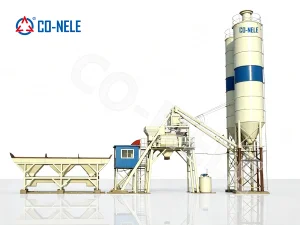
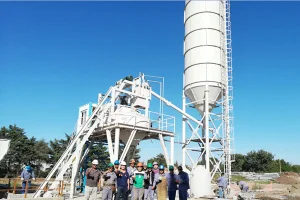
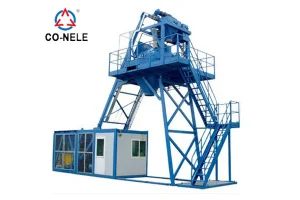
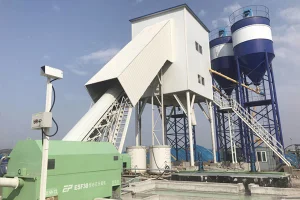
Factory-engineered batching plants are built around containerized modular steel frameworks. Complete stationary and mobile plants (such as the HZN and MBP series) ship pre-wired and pre-piped inside standard 40ft High Cube containers, minimizing overseas freight costs and reducing on-site erection schedules by up to 65%.
Selecting the optimal mixing engine based on rheological properties, aggregate size distributions, and binder chemical reactions.
Matching the correct mixing architecture to your exact product dynamic is critical for avoiding binder segregation, unmixed dry pockets, or excessive wear. Below is an engineering evaluation comparing the three primary industrial mixer categories produced in our Qingdao factory base.
| Equipment Architecture | Kinematic Principle | Optimal Target Material | Mixing Efficiency / Homogeneity | Primary Industrial Field |
|---|---|---|---|---|
| Planetary Counter-Current Mixer | Vertical central axis with rotating mixing stars traveling along planetary paths. Zero dead-zone coverage. | UHPC, GFRC, Dry-Cast Concrete, Colored Pavers, Refractory Materials | Ultra-High (CV < 5%) within 45-60 seconds cycle time | Architectural Precast, Heavy Infrastructure, Refractories |
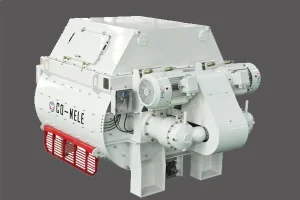
| Twin-Shaft Compulsory Mixer | Dual horizontal synchronized shafts counter-rotating to generate intense 3D turbulent cross-mixing zones. | Ready-Mix Commercial Concrete, Mass Dam Pouring, Conventional Construction | High (CV < 8%) within 30-45 seconds cycle time | Commercial Ready-Mix Plants, Highway Infrastructure |
| Intensive Mixer Granulator | Inclined dynamic mixing pan combined with high-speed counter-rotating rotor tools. | Fine Powders, Bentonite, Iron Ore, Battery Cathode Compounds, Fertilizers | Granulation Sphericity > 90%, controlled bulk density | Powder Metallurgy, Ceramics, Chemical Pelletizing |
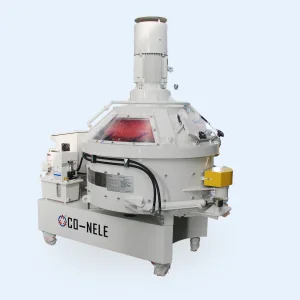
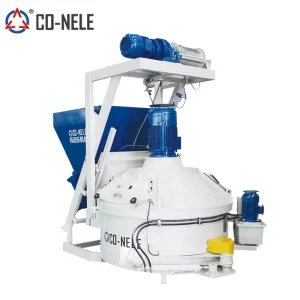
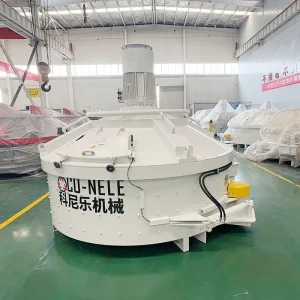
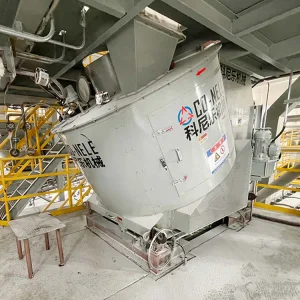
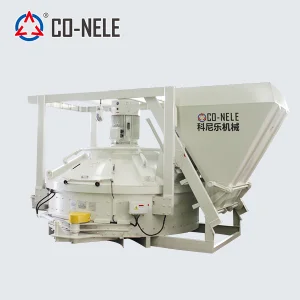
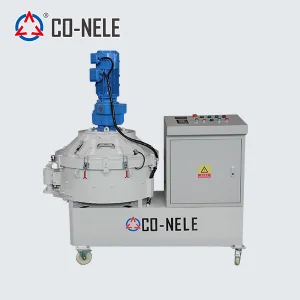
In a vertical planetary counter-current mixer (such as the CMP and MP series), the mixing arms spin on their own axis while simultaneously orbiting around the central pan axis. This complex geometric pattern ensures that every square millimeter of the pan floor is swept multiple times per revolution. For zero-slump dry mixes and fiber-reinforced formulations, planetary action completely eliminates the material segregation common in standard pan mixers.
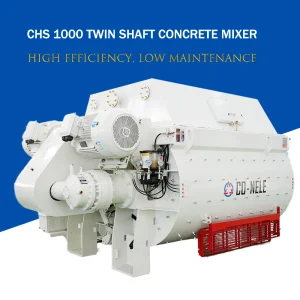
Twin-shaft compulsory mixers (such as the CHS series) utilize overlapping helical mixing arms configured to push material horizontally and vertically simultaneously. The center interaction zone experiences extreme shear forces, rapidly dissolving cement clinker agglomerations and encapsulating coarse aggregates. This makes twin-shaft mixers the most economical solution for high-volume commercial ready-mix concrete production where batch speed ($m^3/h$) is paramount.
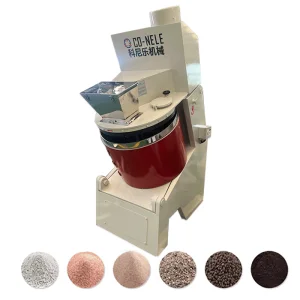
When dealing with powder processing, traditional dry mixing fails to provide fluid flowability. Intensive granulators utilize an inclined rotating pan combined with high-speed rotor tools running at tip speeds up to 30 m/s. Material is pushed upward by pan rotation and impacted by the rotor, instantly initiating liquid-bridge nucleation to form uniform spherical granules without requiring expensive spray dryers.
Mitigating risk for international EPC contractors, plant operators, and industrial buyers through rigid quality compliance and field-proven engineering services.
All export-bound concrete plants and standalone mixing machinery are manufactured in strict compliance with CE Directives (Machinery Directive 2006/42/EC and Low Voltage Directive 2014/35/EU), UL standards, and ISO 9001 quality system certifications. Control cabinets feature dual-channel safety relays and IP65 dust-tight enclosures.
Factory power systems are custom-built to match regional power grids globally: 220V/380V/415V/440V/480V at 50Hz or 60Hz. Drive motors are sourced from world-class brands (Siemens, ABB, SEW) or domestic top-tier rated manufacturers, ensuring worldwide warranty cover and instant spare parts replacement.
Concrete plants feature fully automated Siemens S7-1200/1500 PLC control architectures with multi-language HMI touch panels. Built-in cloud IoT gateways enable remote diagnostics, automated moisture compensation, software updates, and instant troubleshooting by our Qingdao software engineering center.
From architectural precast concrete components to demanding offshore grouting, engineered mixing solutions tailored to precise material properties.
Industrial concrete mixing is not a "one-size-fits-all" machine category. Different downstream production lines demand distinct physical concrete characteristics. As a leading manufacturer, our engineering team custom-configures complete production lines based on specific field applications:
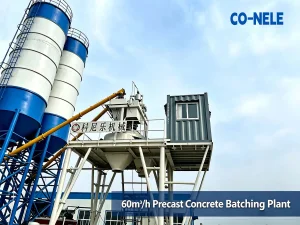
Paving stones, concrete blocks, prestressed bridge girders, kerbstones, and precast wall panels demand uniform surface aesthetics and exact color distribution. Coupled with CMP planetary counter-current mixers, plants like the HZS60 Precast Plant guarantee zero pigment streakiness and consistent density per element.
Ultra-High Performance Concrete (compressive strength > 150 MPa) contains high steel fiber volume fractions. Specialized CMP UHPC Mixers feature heavy-duty high-shear rotors that disperse steel fibers cleanly without balling, critical for wind-farm grouting, bridge joint seals, and blast-resistant structures.
Steel mill ladles, glass furnaces, and cement kilns rely on specialized refractory brick formulas containing coarse corundum and micro-silica powders. Refractory planetary mixers feature tungsten-carbide coated wear liners designed to withstand extreme thermal abrasion and harsh dry mixing duty cycles.
Navigating the global transition toward decarbonized construction materials, low-cement mix formulations, and AI-driven rheological tracking.
The construction sector accounts for approximately 8% of global carbon dioxide emissions, primarily driven by Portland cement clinker production. As international carbon tax frameworks and ESG procurement rules tighten, concrete production equipment must adapt to process alternative low-carbon binders, high-volume Supplementary Cementitious Materials (SCMs) like blast furnace slag and calcined clay, and recycled coarse aggregates.
Our Qingdao R&D center is actively pioneering smart concrete plant designs integrated with real-time microwave moisture sensors, AI dynamic batching adjustments, and closed-loop dust extraction technology:
By measuring real-time motor torque variations and hydraulic load sensor signals during mixing cycles, our next-generation control systems calculate batch rheology in real-time, automatically metering micro-doses of superplasticizers to maintain precise target slump without operator intervention.
Modern batching plants are supplied with integrated sand-gravel separators and filter-press slurry water reclamation circuits. Recovered aggregate and gray water are automatically re-calculated into recipe weight calculations, achieving zero concrete wash-out waste on site.
Eliminating fluid couplings and traditional belt pulley friction losses, custom direct-coupled planetary gearboxes reduce mechanical energy transmission loss by up to 14%, significantly reducing electricity consumption per cubic meter of concrete produced.
In-depth technical answers from our senior mixing process engineers regarding selection, operation, maintenance, and logistics.
A vertical-shaft planetary counter-current mixer utilizes mixing arms that rotate on their own axis while simultaneously orbiting around the pan center. This guarantees zero dead zone mixing and micro-homogeneity ($CV < 5\%$), making it mandatory for dry-cast products, color blocks, UHPC, and refractory castables. A twin shaft mixer uses horizontal synchronized shafts suitable for high-throughput ($50m^3/h$ to $180m^3/h$) standard ready-mix concrete where rapid cycle speed is preferred over micro-level fiber dispersion.
Our Qingdao laboratory operates dedicated test rigs equipped with lab-scale intensive mixers and planetary granulators (from 5L to 75L capacity). Overseas clients can send 10–50 kg of raw powders, aggregates, or refractory minerals. Our process engineers execute test runs to measure mixing time, bulk density, granule sphericity, and compressive strength, returning a formal technical test report and scaling calculation prior to contract sign-off.
With our standard High-Chrome Alloy (Cr26+) liners and tungsten-carbide hardfaced mixing blades, standard concrete operations yield a lifespan between 90,000 and 150,000 batch cycles. Under extreme friction applications (such as corundum refractories or quartz-dense UHPC), liner lifespan typically averages 40,000 to 60,000 cycles. All wear liners feature modular bolt-on mounting, allowing rapid field replacement in hours.
Our foundationless batching plants (such as the MBP and compact HZS series) are built on heavy-duty structural steel base frames fitted with steel loading ramps. They do not require deep reinforced concrete foundation pits. Installation only requires a leveled, hardened concrete ground slab ($200\text{--}250\text{ mm}$ thickness), allowing contractors to assemble the plant within 3 days and easily relocate the machinery upon project completion.
We provide full English technical documentation, 3D foundation drawings, and electrical schematics. For commissioning, we offer two modes: 1) Resident installation engineer dispatch to the project site for hands-on assembly and crew training; 2) AR-assisted live video remote commissioning. Wear components and critical spares are maintained in centralized stock in Qingdao with express air-freight dispatch window of 24–48 hours.
Explore specialized industrial machinery engineered for laboratory research, refractory mixing, bentonite granulators, and precast batching lines.