CO-NELEMixing & Granulation
Engineered for high-viscosity mixes, rapid site deployment, and heavy-duty infrastructure requirements in the Valley of Mexico.
An in-depth technical examination of high-altitude pneumatics, volcanic aggregate wear dynamics, and structural ductility compliance under Mexican building codes.
Operating concrete batching equipment within Mexico City (Zona Metropolitana del Valle de México - ZMVM) presents unique mechanical and chemical challenges rarely encountered in coastal or lowland industrial zones. Elevated at 2,240 meters (7,350 feet) above sea level, the region experiences reduced atmospheric pressure (~77.5 kPa compared to 101.3 kPa at sea level). This barometric shift directly impacts air compressor displacement, pneumatic valve timing, and motor cooling efficiency in concrete batching plants. Equipment designed strictly for standard atmospheric conditions suffers up to a 15-20% loss in pneumatic discharge efficiency and thermal derating of electric drives unless specifically engineered with compensated high-altitude drive systems and oversized heat exchangers.
Furthermore, the soil profile of Mexico City is notoriously complex. Divided into Zone I (Foothills), Zone II (Transition), and Zone III (Lacustrine Clay of ancient Lake Texcoco), construction in Zone III demands ultra-consistent, high-ductility, high-strength concrete mixes (C40 to C80 Ultra-High Performance Concrete - UHPC). Following updates to the Normas Técnicas Complementarias (NTC-2023) del Reglamento de Construcciones para el Distrito Federal, seismic resilience requirements dictate precise control over water-cement ratios (w/c variation < 1.5%) and microscopic air-entrainment distribution to prevent catastrophic shear failures during seismic events originating along the Pacific subduction zone.
Local aggregates sourced from the Trans-Mexican Volcanic Belt—such as Tezontle (highly porous basaltic scoria) and Tepetate—exhibit high free-silica content and irregular particle geometry. Standard twin-shaft mixers suffer rapid wear rates when processing these abrasive materials. CO-NELE batching machinery utilizes Ni-Hard 4 and Cr26 high-chrome cast iron liners coupled with vertical-shaft counter-current planetary kinematics to distribute abrasive stress uniformly, extending liner operational life beyond 120,000 batches.
For precast elements, structural wall panels, and high-density concrete pipes used in CDMX urban renewal projects, mixing homogeneity cannot be compromised. Conventional horizontal twin-shaft mixers utilize gravity-assisted chaotic falling vectors, which can lead to dead zones when handling low-slump (< 30mm) or dry-cast mixes containing volcanic fines.
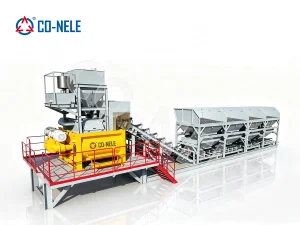
In contrast, Planetary Counter-Current Mixers drive mixing arms in a mathematically optimized orbital trajectory. The star-arm blades rotate on their own axis while simultaneously revolving around the central pan axis. This forced-action mechanical shear ensures that 100% of the pan floor is swept every 4 rotations, achieving a Coefficient of Variation (CV) of less than 3% in mixing uniformity within 45 to 60 seconds of cycle time.
The global ready-mix concrete market is rapidly transitioning toward decarbonization, circular economy integration, and real-time Industry 4.0 monitoring. In Mexico City, environmental regulations enforced by SEDEMA (Secretaría del Medio Ambiente) under standard NADF-007-RNAD-2013 strictly regulate particulate emissions (PM10 and PM2.5) and industrial wastewater runoff from batching operations.
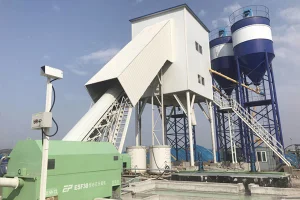
CO-NELE’s modern batching plants integrate pulse-jet reverse-dust filtration units on cement silos achieving < 10 mg/Nm³ stack emissions, alongside closed-loop gray-water recycling systems. The batching control software—built on Siemens PLC hardware with multi-language user interfaces (Spanish/English)—tracks cement consumption per batch against nominal strength, generating automated environmental audit reports required by Mexican municipal inspectors.
Specially calibrated air compressors, enlarged solenoid valve orifices, and thermal-compensated motors to ensure flawless operation at 2,240m elevation in Mexico City.
Micro-dosing accuracy for chemical admixtures (±0.8%) and water weighing (±1%), delivering consistent ductile concrete required for earthquake-resistant infrastructure.
Replaceable bolt-on wear liners composed of high-chrome cast alloys (Cr26) specifically designed to withstand abrasive Mexican volcanic aggregates (Tezontle/Basalt).
Quantitative benchmarks demonstrating mechanical reliability, mixing precision, and long-term durability.
Matching specific machine configurations to high-impact infrastructure, industrial building, and precast manufacturing across the ZMVM region.
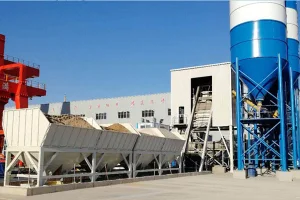
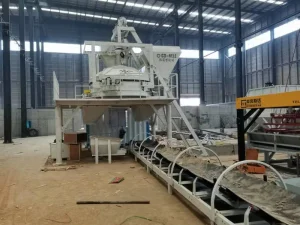
Stationary plants equipped with 180m³/h twin-shaft mixers or high-output planetary units supplying continuous bridge girder precast elements and tunnel segmental linings (dovelas).
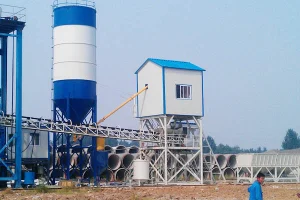
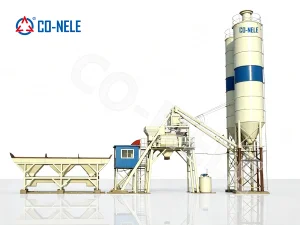
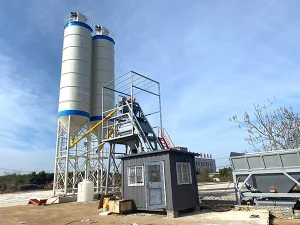
Foundationless and mobile plants engineered for tight footprints in densely populated boroughs like Cuauhtémoc, Miguel Hidalgo, and Iztapalapa without major excavation.
Planetary mixers dedicated to Glass Fiber Reinforced Concrete (GFRC) and decorative façade panels, offering zero fiber segregation and dynamic speed adjustments via inverter control.
Explore our complete range of specialized equipment designed for ready-mix suppliers, precast factories, and infrastructure contractors serving Mexico.
Technical guidance and operational advice for concrete producers and contractors across the Valley of Mexico.
Consult with our senior application engineers to receive custom plant drawings, high-altitude performance calculations, and factory-direct commercial proposals.
Send Inquiry Now