
CO-NELEMixing & Granulation
Engineered to deliver high micro-homogeneity, rapid cycle times, and full compliance with European UNE-EN 206 standards.
The global construction equipment sector is undergoing a structural transition driven by three converging pressures: the strict decarbonization of cementitious binders, the rapid rise of digital twin batching automation, and uncompromising demands for concrete strength consistency. As urban density increases worldwide, the demand for specialized, high-performance concrete formulations—such as Ultra-High-Performance Concrete (UHPC), Glass Fiber Reinforced Concrete (GFRC), and Low-Carbon Calcined Clay Formulations (LC3)—has shifted batching technology from traditional gravimetric dosing toward integrated compulsory mixing systems.
In modern industrial civil engineering, standard tilting or non-compulsory drum mixers are no longer capable of meeting the tight standard deviation tolerances demanded by modern structural codes. Micro-homogeneity, defined by a Coefficient of Variation (CV) below 3%, is now the baseline benchmark for structural safety. Achieving this degree of precision requires planetary counter-current mixing action and double-shaft forced mixing, supported by real-time microwave moisture compensation and intelligent automated additive dosing systems.
The Metropolitan Area of Barcelona (AMB) and the broader Catalonia region present unique structural, environmental, and spatial challenges for concrete producers and infrastructure contractors. Major capital initiatives—including the expansion of the Port of Barcelona, the continuous structural engineering of the Sagrada Família, the subterranean excavation of the Metro Line 9 (L9/L10) tunnel network, and urban re-densification projects across 22@ Poblenou—require specialized mixing plants optimized for compact footprints, near-zero dust emissions, and strict acoustic dampening.
Operating a concrete batching plant in Barcelona requires strict adherence to local environmental frameworks, including Catalonia’s Climate Change Act 16/2017 and the Spanish Structural Code (Código Estructural, Real Decreto 470/2021). Key regulatory and operational factors include:
Plants operating within the ZBE area must utilize zero-emission batching enclosures, pulse-jet filter bag silos (< 10 mg/Nm³ particulate), and electric or compact relocatable modular designs to reduce urban transit footprints.
Barcelona's coastal port logistics require concrete with high sulfate resistance and dense pore geometry to prevent chloride penetration. Batching plants must accurately introduce silica fume, fly ash, and corrosion inhibitors under automated PLC controls.
Self-compacting concrete (SCC) and architectural precast elements produced in the Besòs and Llobregat industrial corridors require pigment dispersion without color streaking, requiring planetary counter-current mixing technology.
Selecting the optimal mixing engine is critical when designing a batching plant for Barcelona's diverse construction demands. CO-NELE engineers both Vertical-Shaft Planetary Counter-Current Mixers and Horizontal Twin-Shaft Compulsory Mixers, each serving distinct concrete rheologies:
Mechanism: Mixing star arms rotate on a central vertical axis while simultaneously revolving around the pan perimeter. Blades sweep every square millimeter of the pan floor and sidewalls every 4 seconds.
Mechanism: Dual synchronized horizontal shafts with counter-rotating paddles create intense three-dimensional turbulence in the overlapping central mixing zone.
Custom-designed equipment profiles built to solve specific regional challenges across Catalan construction sites.
Application: Sulfate-resistant, high-density C40/50 marine concrete blocks and anti-scour underwater grouting.
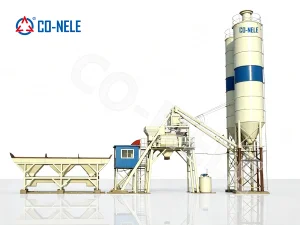
Solution: HZS90 Stationary Batching Plant integrated with twin-shaft compaction mixing, closed water recycling systems, and automated micro-silica dosing.
Application: High-precision precast tunnel lining segments (Tubos de Dovelas) requiring extreme impermeability and dimensional tolerances.
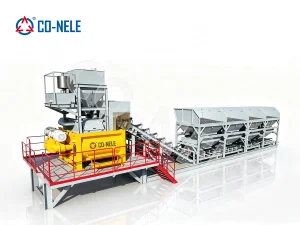
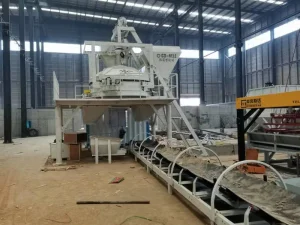
Solution: Precast Plant equipped with CMP1500 Planetary Counter-Current Mixer, microwave moisture probes, and automated shuttle bucket distribution.
Application: Compact urban ready-mix and architectural UHPC structural facades in restricted footprint lots across Eixample and Ciutat Vella.
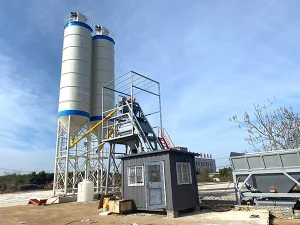
Solution: Compact / Foundationless Modular Batching Station, featuring plug-and-play steel frame pads, zero-pit foundation requirements, and quiet air compressors.
Deploying concrete batching machinery into the European Union demands full compliance with rigorous machine safety, electrical, and environmental directives. CO-NELE equipment delivered to Barcelona is engineered to meet all European standards out of the factory:
Architecting the future of batching operations for zero carbon footprint and predictive equipment maintenance.
Real-time microwave absorption sensors mounted in both the aggregate bins and planetary mixing pan continuously measure moisture 20 times per second, dynamically adjusting water dosing mid-batch to guarantee slump consistency.
Equipped with micro-powder aeration and high-precision screw feeders specifically configured to handle cohesive calcined clays, alkali-activated slag powders, and geopolymers without bridging or rat-holing in silos.
Open OPC-UA communication architecture connects plant batching software directly with construction management systems (BIM, SAP, Command Alkon), giving managers live visibility over material consumption and carbon accounting per batch.
From portable compact units to massive 180 m³/h commercial batching hubs, discover our full lineup engineered for Catalan construction companies.
Comprehensive engineering and commercial responses to guide contractors, engineers, and plant operators.
A vertical-shaft planetary counter-current mixer is essential when manufacturing dry-cast precast elements, pigmented concrete pavers, UHPC (>150 MPa), or self-compacting concrete (SCC). The complex kinematics ensure zero dead zones and rapid pigment/fiber dispersion with a Coefficient of Variation under 3%. For mass commercial ready-mix concrete pours exceeding 100 m³/h, twin-shaft compulsory mixers offer a faster 30-45 second batch cycle, making them the standard for high-throughput transit mixing.
Our batching systems incorporate automated Siemens PLC controls integrated with high-precision digital load cells certified to OIML standards. This guarantees aggregate weighing accuracy within ±2% and binder/water/admixture dosing accuracy within ±1%. Furthermore, our batching software automatically generates printable and digitally archived batch logs required for CE and Spanish Código Estructural quality control audits.
For temporary urban construction sites or leased industrial land in the Barcelona metropolitan area, we supply Foundationless Modular Concrete Batching Plants. These plants feature integrated steel foundation frames that sit directly on compacted ground or simple flat concrete pads, eliminating civil excavation, pit construction, and long permitting delays. They can be fully assembled in 4 to 7 days and easily dismantled for relocation.
Our planetary and twin-shaft mixers are lined with high-chrome alloy wear tiles with a hardness rating exceeding 60 HRC. Mixing blades feature tungsten-carbide hardfacing options designed to handle abrasive granite, quartz, or recycled concrete aggregate (RCA). Liner plates are modular and bolt-on, allowing for rapid replacement in under one shift without requiring specialized welding.
Standard modular plants and standalone planetary mixers ship within 30 to 45 business days. Equipment is delivered with comprehensive CE documentation, electrical schematics, and English/Spanish operating manuals. Critical wearing parts, electrical spares, and pneumatic actuators are stocked in European service hubs for 24- to 48-hour delivery, backed by remote PLC video commissioning support.
Contact our process engineering team today to receive a complete technical proposal, CAD site layout drawing, aggregate trial assessment, and competitive pricing for your project in Catalonia.