CO-NELEMixing & Granulation
Advanced mixing systems designed for high-density, fiber-reinforced, and specialty material processing in compliance with European industrial requirements.
Spain’s construction and industrial manufacturing sectors are undergoing a profound technological transformation, propelled by the European Union’s NextGenerationEU recovery framework and the Spanish government’s Plan de Recuperación, Transformación y Resiliencia. Across industrial hubs from Catalonia and the Basque Country to the Madrid metropolitan area and Andalusia, there is a rapidly accelerating shift toward high-value precast concrete, Ultra-High Performance Concrete (UHPC), Glass Fiber Reinforced Concrete (GFRC), and specialized refractory manufacturing.
Unlike standard ready-mix applications where traditional twin-shaft or tilting-drum mixers suffice, Spain’s evolving structural requirements demand microscopic homogeneity, zero segregation of fine particles, and precise dispersion of mineral additives (such as silica fume, nano-silica, and fly ash). Furthermore, Spanish environmental regulations governing carbon intensity (driven by UNE-EN 206 aggregate and binder standards) are forcing producers to lower cement clinker content while maintaining high early-age compressive strength. Achieving this complex chemical and mechanical balance requires forced-action planetary counter-current mixing technology.
Standard twin-shaft compulsory mixers often create localized zones of uneven shear when processing low-water-binder ratio mixes (w/b < 0.25) or heavy steel/synthetic fiber reinforcement. Vertical-shaft planetary counter-current mixers eliminate dead space completely by forcing mixing stars to orbit the pan center while simultaneously rotating at high velocity around their own axes.
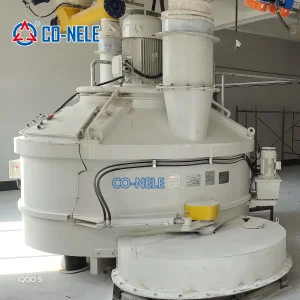
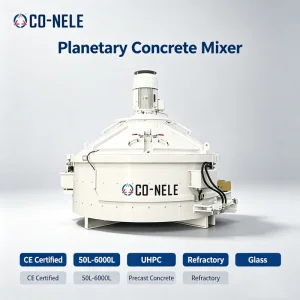
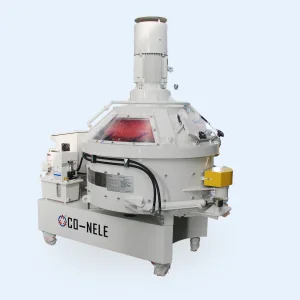
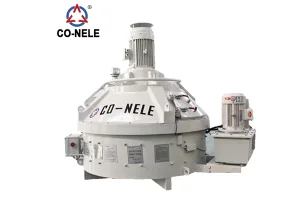
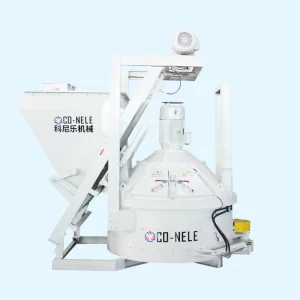
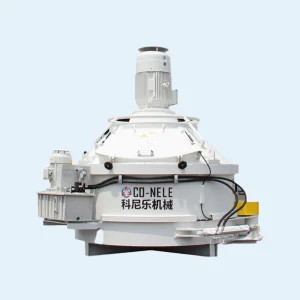
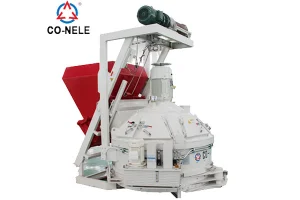
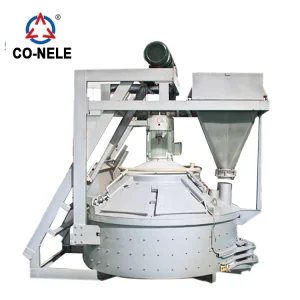
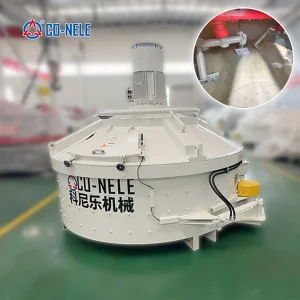
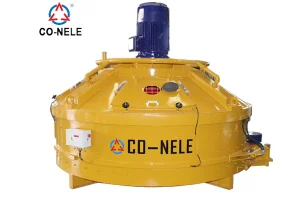
The mechanical architecture of a planetary concrete mixer relies on synchronized gear kinematics. The central drive transfers torque to outer mixing stars through a heavy-duty, in-house designed planetary gearbox. As the mixing arms revolve around the vertical axis of the pan, the attached mixing blades rotate in the counter direction.
This dual-rotational movement creates complex, intersecting helical trajectories. Every square millimeter of the mixing pan floor and side wall is swept within seconds, achieving a high degree of kinetic energy dissipation throughout the batch volume:
Historically, Spanish precast manufacturers relied heavily on legacy Central European mixer OEMs, which frequently involved steep initial capital expenditures and costly long-lead spare parts. China’s premier mixer manufacturers—exemplified by CO-NELE’s two decades of mixing engineering—offer a competitive alternative that bridges top-tier performance with exceptional Total Cost of Ownership (TCO).
By combining vertically integrated manufacturing (in-house casting, CNC gear grinding, dynamic balancing, and load-bench testing in Qingdao) with top-grade international components (Siemens PLCs, Schneider electronics, Brevini/Bonfiglioli drive options, and Hardox/High-Chrome wear plates), Chinese planetary mixers offer Spanish producers European-tier mixing quality at a significantly lower capital entry threshold.
High-stress railway sleepers engineered for Spain’s Adif high-speed network require ultra-dense concrete (C50/60 to C80/90) with minimal air entrainment. Planetary mixers deliver rapid discharge and precise moisture control to ensure zero internal voids.
Modern urban regeneration projects across Madrid, Barcelona, and Valencia demand thin-element UHPC cladding panels. Integrated planetary mixers equipped with high-shear fly-cutters ensure uniform pigment distribution and flawless surface aesthetics.
Massive solar tracker ballast blocks and wind farm concrete tower segments deployed in southern Spain require high volume output without compromising batch-to-batch strength uniformity under harsh environmental exposure.
Industrial furnaces, steel mill refractory linings in northern Spain, and ceramic glass batching facilities in Castellón rely on customized planetary batch mixers capable of handling extremely abrasive aggregates and high-temperature formulations.
Exporting heavy industrial machinery to Spain requires total alignment with European Union directives and Spanish national codes. Our equipment framework includes comprehensive compliance protocols:
As the global concrete industry moves toward decarbonization, planetary mixers are evolving beyond simple mechanical agitation into intelligent process hubs. Future-ready features integrated into our latest mixer lines include:
Real-Time Optical Rheology Sensing: In-pan microwave and optical moisture/viscosity sensors measure batch moisture dynamically at 100 readings per second, automatically adjusting water and admixture dosing to maintain target slump without manual sampling.
Energy-Optimized Frequency Drives: Variable frequency drives (VFD) allow dynamic speed modification during the batch cycle—high-speed shearing during powder homogenization, followed by low-speed mixing during fiber addition—reducing energy consumption per batch by up to 18%.
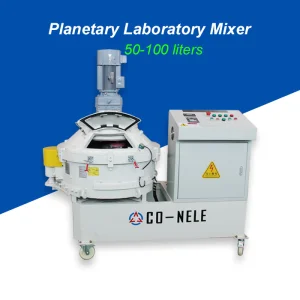
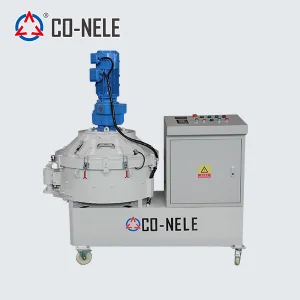
From compact laboratory units to high-capacity batching plant powerhouses, explore our full spectrum of planetary mixing machinery.
In-depth responses curated by process engineering specialists for buyers in Spain and the wider EU region.
While twin-shaft mixers excel in high-volume ready-mix concrete production (>2.5 m³ per batch) where speed is paramount, vertical-shaft planetary counter-current mixers are indispensable for dry-cast products, colored paving blocks, UHPC, GFRC, and structural elements requiring strict uniformity. The counter-current planetary motion guarantees zero dead zones, maintaining a Coefficient of Variation (CV) under 3%, preventing aggregate segregation, and delivering consistent surface finishes required by European architectural standards.
Yes. All export machinery configured for Spain is built strictly in accordance with the European Union Machinery Directive 2006/42/EC and Low Voltage Directive 2014/35/EU. Electrical systems are configured for 400V, 3-Phase, 50Hz operation with IP65-rated control cabinets, dual-circuit safety interlocks on maintenance hatches, emergency stop circuits, and complete CE documentation package translated into Spanish.
When processing standard aggregate mixes, our high-chrome alloy wear plates (hardness 500-600 HB) typically achieve a operational lifespan of 100,000 to 150,000 batches. For highly abrasive applications, such as quartz-rich UHPC or refractory castables, wear life ranges between 40,000 and 60,000 batches. All wear plates are bolt-on and modular, allowing quick single-panel replacement without dismantling the mixing arm assembly.
We provide comprehensive installation guidance through video commissioning protocols or by dispatching resident commissioning engineers directly to your plant location in Spain. All critical spare parts (blade tips, scraper arms, seal kits, sensors) are maintained in inventory and can be dispatched via express air freight within 24-48 hours. Remote PLC diagnostics are also supported via integrated Ethernet access.
Yes. For UHPC mixing, we supply the CMPS series equipped with optional high-speed side fly-cutter rotors. The planetary arms provide uniform macro-mixing, while the auxiliary fly-cutter spins at high RPM to instantly disperse micro-steel or synthetic fibers, preventing agglomeration and ensuring equal tensile strength throughout the cast structure.
Contact our senior process engineers today for raw material sample testing, custom plant layouts, and competitive direct-factory quotations tailored to your regional operations.