
CO-NELEMixing & Granulation
Engineered for extreme structural density, cold-weather reliability, and low-carbon cement replacement formulations required by the Danish market.
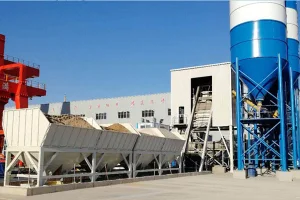
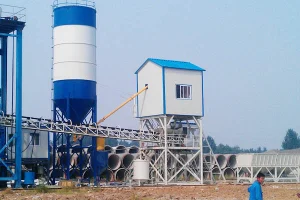
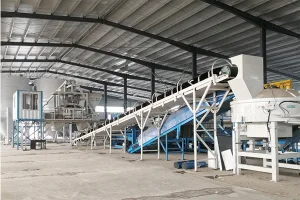
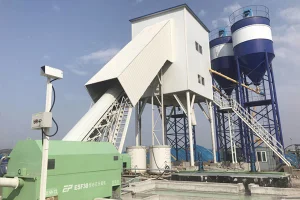
Denmark’s construction sector is governed by some of the most rigorous environmental legislation, structural codes (DS/EN 206), and decarbonization targets in Northern Europe. As Denmark accelerates towards its ambitious goal of a 70% reduction in greenhouse gas emissions by 2030, concrete suppliers, precast manufacturers, and civil contractors face unprecedented pressure to transition towards ultra-low-carbon mixes, highly automated production lines, and extreme material consistency.
For decades, European buyers viewed machinery sourcing through a binary lens: high-cost Western European equipment or lower-grade imports. Today, leading Chinese manufacturers like Qingdao CO-NELE Machinery Co., Ltd. have completely transformed this landscape. By pairing state-of-the-art vertical-shaft planetary counter-current kinematics with European CE-certified automation (Siemens PLC, Schneider electrifying circuits, WAM filtration), CO-NELE delivers industrial concrete batching plants engineered specifically for the strict operating conditions of Denmark.
Understanding Denmark's unique construction ecosystem is vital for selecting the appropriate concrete batching plant configuration. From the energy island initiatives in the North Sea to the Fehmarnbelt Fixed Link megaproject, concrete production in Denmark is evolving rapidly.
Danish building regulations (BR18) and public tenders strictly evaluate the embodied carbon of structural elements. Concrete plants supplying Danish sites must efficiently process multi-binder formulations including calcined clay (e.g., FutureCem), blast furnace slag (GGBS), and high-volume fly ash without sacrificing mixing speed or causing agglomeration.
Operations in regions such as Jutland, Funen, or Zealand require year-round thermal management. Danish concrete batching plants require fully enclosed winterization packages, steam-injection aggregate heating systems, and dual-water temperature control to guarantee fresh concrete discharge temperatures between +15°C and +20°C even during sub-zero Nordic winters.
Denmark leads the global transition in offshore wind energy. Foundation grouting, anti-scour structures, and harbour expansions demand Ultra-High-Performance Concrete (UHPC) and GFRC featuring high steel/synthetic fiber loads. Standard twin-shaft mixers often struggle with micro-silica dispersion, whereas counter-current planetary mixers excel.
Achieving compliance with Danish standard DS/EN 206 requires precise aggregate grading and absolute fluid-phase homogeneity. The table below highlights the performance metrics of CO-NELE planetary mixing technology versus traditional twin-shaft configurations when applied to Danish recipe profiles.
| Performance Metric | CO-NELE Vertical Planetary Mixer (CMP Series) | Standard Twin-Shaft Compulsory Mixer | Danish Market Impact & Advantage |
|---|---|---|---|
| Mixing Kinematics | Counter-current mechanical arms with overlapping planetary motion; zero dead zones. | Dual horizontal shaft rotation pushing material inward in a spiral path. | Essential for self-compacting concrete (SCC) and heavily pigmented precast blocks. |
| Micro-Silica & Calcined Clay Dispersion | Complete agglomerate breakdown within 45 to 60 seconds of dry batching. | Requires extended cycle time (>90s) to achieve uniform dispersion; risk of balling. | Reduces expensive chemical admixture consumption by up to 12% per batch. |
| Fiber Integration (Steel/Synthetic) | High-shear star arms evenly distribute fibers up to 60mm without clumping. | Fibers tend to wrap around horizontal shafts and mixing paddles. | Crucial for Danish offshore wind turbine foundation grout & structural precast elements. |
| Wear Life & Maintenance Costs | Cast high-chrome alloy liners (HB600+) with field-replaceable bolt-on designs. | Frequent blade replacement due to severe abrasion from coarse granite aggregates. | Reduces annual maintenance downtime by up to 35% in high-volume Danish plants. |
| Discharge Cleanliness | Hydraulically driven full-bottom rotation discharge gate; 99.4% clean empty. | Center drop gates frequently collect hardened residue along seals. | Eliminates mix cross-contamination when switching between standard and colored concrete. |
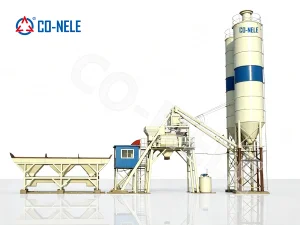
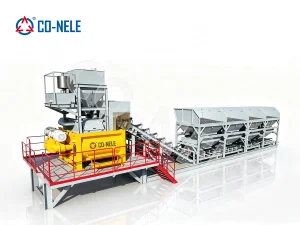
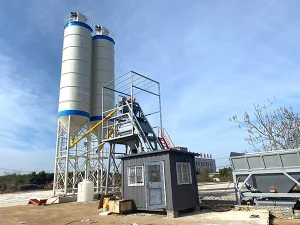
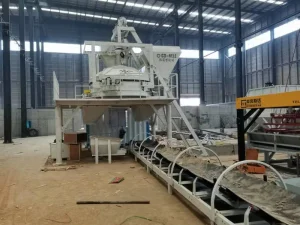
To serve diverse operational scenarios—from urban Copenhagen building sites to regional precast yards in Jutland—CO-NELE provides three primary plant structural architectures.
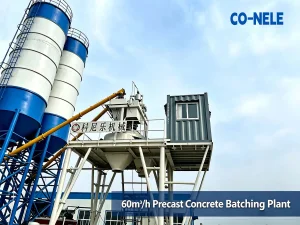
Designed specifically for automated precast component production (hollow-core slabs, architectural wall panels, wind tower segments). Integrated directly with concrete delivery shuttles (flying buckets) and controlled by Siemens S7-1500 PLC automation with real-time moisture compensation via microwave sensors embedded in the mixer pan floor.
Ideal for leased municipal land or temporary civil infrastructure projects. These plants require zero deep foundation pouring—installing directly onto flat concrete pads or compacted ground. Delivered in pre-wired 40ft High Cube container modules to reduce local installation costs in Denmark by up to 60%.
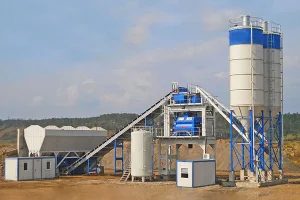
Engineered for large-scale commercial ready-mix suppliers serving metropolitan Copenhagen and Aarhus. Features dual-shaft compulsory mixing, heavy-duty belt conveying, multi-silo cement storage up to 4x200 tons, and intelligent dispatch system integration.
Our process engineering team will review your batching capacity, recipe requirements, and site footprint to deliver a complete 3D layout drawing, ROI calculation, and firm factory quote within 24 hours.
Send Inquiry NowImporting heavy industrial machinery into Denmark requires strict adherence to European Union directives and local safety norms. CO-NELE ensures that every plant dispatched to Northern Europe undergoes rigorous compliance auditing prior to shipment.
All control panels, electrical cabinets, and safety interlocks are manufactured in compliance with EN 60204-1 safety standards and carry official CE certificates. Wiring harnesses use halogen-free materials with clear, English/Danish terminal labeling.
Every plant shipped to Denmark is fitted with a secure VPN remote maintenance module. CO-NELE software engineers in Qingdao can perform live diagnostic checks, PLC firmware updates, and troubleshooting side-by-side with your local Danish operator.
We maintain regional spare parts partnerships across Northern Europe. High-wear items (mixer blades, scrapers, liner plates, butterfly valves, load cells) ship via express courier within 24 to 48 hours to minimize unexpected plant downtime.
The concrete manufacturing plant of the next decade is smart, self-optimizing, and zero-emission. CO-NELE is continuously integrating advanced sensor technologies into our machinery to keep Danish producers at the cutting edge of industrial efficiency.
Utilizing high-frequency microwave sensors installed in aggregate bin walls and mixer bottoms, our PLC software continuously recalculates batching weights at 50 Hz, ensuring water-cement ratios remain stable within ± 0.005 despite weather fluctuations.
By monitoring drive motor torque signatures and acoustic sensor profiles, the plant automatically predicts wear blade degradation and alerts maintenance teams prior to mix quality drop-offs.
Integrated automated mixer wash-out systems divert wash water into filter press units, recycling clean water back into production and pressing concrete sludge into reusable dry aggregate cakes.
Everything you need to know about purchasing, shipping, assembling, and operating CO-NELE concrete plants in Denmark.
Vertical-shaft planetary counter-current mixers (CMP series) force materials through complex counter-current kinematic paths, completely eliminating unmixed material zones. For dry-cast, pigmented, fiber-reinforced, or ultra-high-performance concrete (UHPC) commonly used in Danish precast, planetary mixers deliver mix homogeneity with a Coefficient of Variation (CV) below 5%, whereas twin-shaft mixers are optimized for rapid, high-volume wet ready-mix pouring.
We regularly ship equipment to major Danish ports such as Aarhus Port, Copenhagen Port, and Fredericia, or via German ports (Hamburg/Bremerhaven) with direct flatbed transit into Denmark. All plants are packaged in ocean-worthy containerized modules (Open Top & 40' HC) with corrosion-resistant protective coatings.
Yes. All electrical engineering is tailored to European standard 3-phase 400V 50Hz power supply. Control systems utilize global Siemens S7-1200/1500 PLCs and touchscreens with multi-language software (English/Danish UI available), ensuring local technicians can easily configure or service the controls.
Using our high-chrome alloy cast liners (hardness ≥ HB600), typical service life ranges from 100,000 to 150,000 mixing cycles under normal concrete production, and 50,000 to 70,000 cycles for highly abrasive UHPC or refractory mixes. All wear elements are modular and bolt-on for fast field replacement.
Yes. Our customized dosing silos feature fluidization pads, high-frequency vibrators, and precision screw conveyors designed specifically to handle fine calcined clays, fly ash, and GGBS without rat-holing or bridging in the cement batcher.
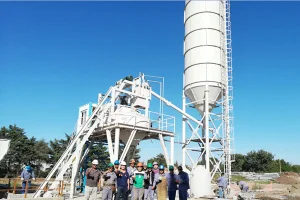
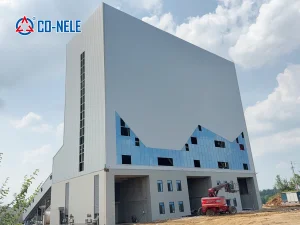
Explore our versatile portfolio of mobile, compact, stationary, and wall-panel batching solutions tailored for Danish industrial applications.
Deliver superior concrete quality across Denmark. Contact our engineering department today for custom mixing plant drawings, CE documentation, and direct factory pricing.
Send Inquiry Now