CO-NELEMixing & Granulation
Understanding the shift from conventional volumetric batching to high-precision, AI-monitored planetary counter-current mixing for sustainable, ultra-high-performance concrete production.
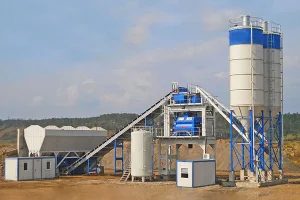
Multi-stage aggregate weighing hoppers utilizing digital strain-gauge load cells deliver dosing accuracy within ±1% for aggregates and ±0.5% for cementitious powders, silica fume, and liquid admixtures.
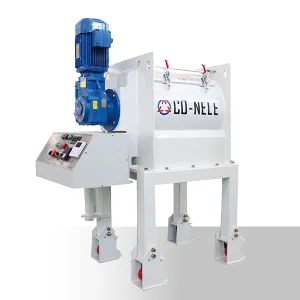
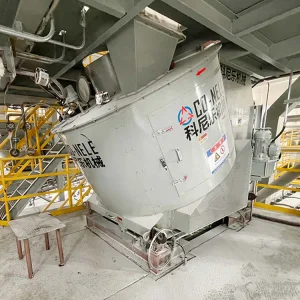
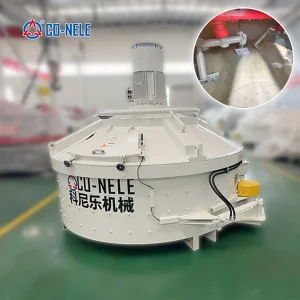
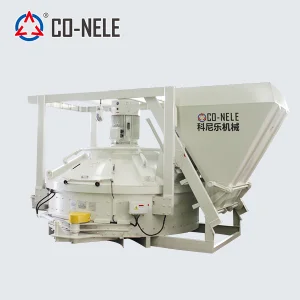
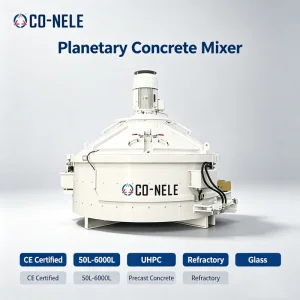
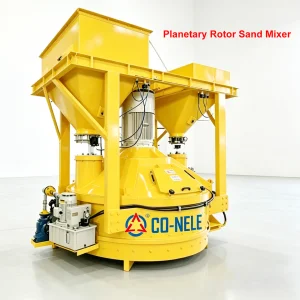
Unlike traditional twin-shaft mixers, counter-current planetary mixing arms rotate on orthogonal axes, ensuring 100% pan surface coverage every 4 revolutions to prevent particle agglomeration in low w/c ratio mixes.
Closed-loop water recycling stations combined with high-efficiency pulse-jet filter baghouses maintain site airborne dust emissions under 10 mg/Nm³, fulfilling international green building certifications.
How China's leading batching plant OEMs are integrating real-time moisture microwave telemetry, dynamic rheology optimization, and autonomous recipe adaptation into commercial batching operations.
Standard aggregate stockpiles suffer from inconsistent surface moisture due to environmental variation. CO-NELE batching plants utilize high-frequency planar microwave sensors mounted inside sand batching hoppers and mixer discharge chutes. By measuring dielectric constants at 2.45 GHz up to 25 times per second, the SCADA control software automatically adjusts water and fine aggregate mass target values in real time before batch discharge, maintaining absolute water-binder ratios (w/b) within a margin of ±0.008.
As the construction sector moves toward Net-Zero Carbon targets, batching plants must accommodate ultra-fine calcined clays, ground granulated blast-furnace slag (GGBFS), and high-volume fly ash. China factories are engineering dual-stage pneumatic fluidization silos featuring anti-clogging aeration pads and variable-frequency screw feeders that prevent powder bridging and guarantee consistent mass flow even for fine powders with Blaine fineness exceeding 600 m²/kg.
Integrating Industrial Internet of Things (IIoT) sensors directly into planetary reducers enables continuous monitoring of oil temperature, vibration spectra, and metallic particle contamination. The digital twin engine models real-time gear tooth stress curves, predicting wear lifetime and signaling mechanical intervention weeks before potential fatigue failures, reducing unplanned operational downtime by up to 92%.
Standard ready mix mixers fail when processing steel-fiber-reinforced UHPC due to extreme yield stress and fiber balling risks. The next-generation Chinese planetary mixing unit features secondary high-speed dispersion rotor blades (fly-cutters) operating at tip speeds up to 18 m/s, rapidly breaking down silica fume agglomerates and uniformly dispersing high-aspect-ratio steel fibers without crushing structural aggregates.
Engineered plants tailored for extreme climates, marine structures, high-speed rail sleepers, and commercial mega-volume ready mix distribution.
Configured with CMP vertical planetary concrete mixers delivering zero-slump dry-cast concrete. Includes fast-discharge hydraulic gate assemblies and flying bucket distribution systems for continuous block-making machine supply.
Specialized batching plants designed for anti-scour grouting, harbor caissons, and bridge piers. Integrated with multi-admixture liquid dosing systems for anti-washout agents, chloride inhibitors, and micro-silica slurries.
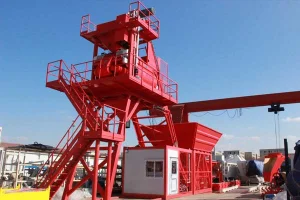
Wheel-mounted MBP series batching plants on heavy-duty chassis allowing rapid deployment without solid concrete foundations. Ideal for remote highway paving, airport runways, and bridge deck overlay installations.
How proprietary gearbox engineering, automated robotic welding, and complete raw material control secure quality dominance for global buyers.
Many European and Asian resellers operate as assembly shops, purchasing key gearboxes, mixing arms, and skip hoists from third-party vendors. In contrast, Qingdao CO-NELE maintains dedicated production facilities housing 5-axis CNC machining centers, automated gear hobbing machines, and internal heat-treatment quenching furnaces.
By designing and manufacturing planetary gearboxes in-house, drive system gear tolerances are locked within DIN Class 6 precision. High-chrome wear liners (Ni-Hard alloy exceeding 63 HRC hardness) are cast in localized foundries, ensuring lifetime wear cycles up to 150,000 batches under high-abrasion aggregate conditions.
Evaluating initial capital expenditure against long-term maintenance costs, energy consumption metrics, and international electrical safety compliance standards.
Batching plants supplied for overseas installation feature Siemens or Schneider PLC architectures certified under CE (Europe), UL/CSA (North America), and EAC (Eurasian Customs Union) specifications. Control cabinets include IP55 climate protection, dual-channel emergency safety relays, and lightning surge suppressors tailored to local grid voltages (220V–480V, 50/60 Hz).
Through variable frequency drive (VFD) controls on skip hoist winches, inclined conveyor belts, and main mixer motors, overall power draw per cubic meter of concrete mixed is reduced from 2.2 kWh/m³ to 1.45 kWh/m³. VFD soft-start mechanisms eliminate peak electrical demand surges on remote diesel generator setups.
From initial site civil foundation CAD drawings to Site Acceptance Testing (SAT) and local operator training, full turnkey installation services are executed by certified field engineers backed by multilingual 24/7 remote SCADA diagnostic channels.
Expert technical clarity on concrete batching plant configuration, wear part lifespans, site selection, and plant sizing.