CO-NELEMixing & Granulation
Core equipment engineering for high-performance concrete, precast elements, and specialty formulations.
Understanding why traditional gravity and twin-shaft mixers fall short in modern precast and UHPC production applications.
In modern precast concrete manufacturing, structural integrity, color uniformity, and surface aesthetics are non-negotiable. As global construction standards shift toward high-performance recipes—such as Ultra-High-Performance Concrete (UHPC), Glass Fiber Reinforced Concrete (GFRC), and self-consolidating mixes—the demands placed on industrial mixing equipment have evolved dramatically. Selecting an advanced China Precast Concrete Mixer Manufacturer & Factory is no longer merely a capital expenditure decision; it is a fundamental process-engineering choice that dictates operational profitability and material performance.
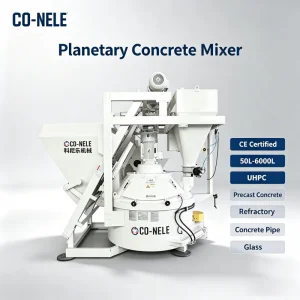
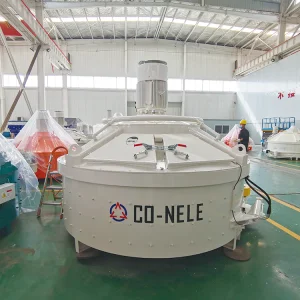
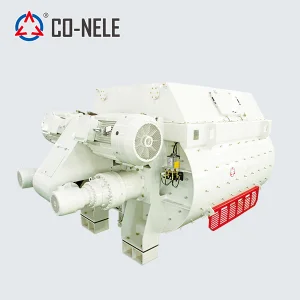
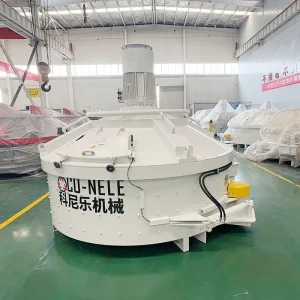
At the core of advanced precast mixing technology lies vertical-shaft planetary counter-current kinematics. Unlike horizontal twin-shaft mixers that rely on intersecting circular trajectories, a counter-current planetary mixer operates on a dual-rotation principal. The mixing star arms rotate rapidly around their own axis while simultaneously revolving around the central axis of the mixing pan. This complex movement ensures that within a single revolution, every millimeter of the mixing chamber is swept without dead zones.
Planetary mixing arms trace overlapping mathematical trajectories, eliminating spatial stagnation. Binders, micro-silica, pigments, and steel fibers are fully dispersed in under 60 seconds of mixing time.
Engineered for low water-binder ratios ($w/b < 0.20$). High-shear action breaks down sub-micron silica fume agglomerates, unleashing latent cementitious reactivity and maximizing compressive strength ($>150\text{ MPa}$).
Liners and mixing blades cast from specialized high-chrome alloy iron ($\text{Cr} \ge 26\%$) offer exceptional abrasion resistance when handling abrasive basalt, granite, or iron powder aggregates.
A rigorous technical comparison between mainstream industrial mixing architectures for precast operations.
| Mixing Technology | Homogeneity Coefficient of Variation ($CV$) | Ideal Recipe Types | Fibre Dispersion Efficiency | Maintenance & Wear Life |
|---|---|---|---|---|
| CO-NELE Planetary Counter-Current | < 3.0% (Superior) | UHPC, GFRC, Colored Precast, Refractories, Dry-Cast Blocks | 100% Homogeneous (No Balling) | High (90,000–150,000 Batches per liner set) |
| Twin-Shaft Compulsory Mixer | < 5.0% (Moderate) | High-Volume Ready-Mix, Mass Concrete, Wet Cast Infrastructure | Moderate (Risk of Fiber Clumping) | Medium (Requires frequent shaft seal maintenance) |
| Vertical Pan Mixer (Single Shaft) | < 8.0% (Fair) | Standard Pavers, Low-Grade Concrete Blocks | Poor (Fibers tend to segregate) | Moderate (Wall wear concentrated in outer ring) |
| Reversing Drum Mixer | > 12.0% (Poor) | General On-Site Civil Works, Low-Strength Fill | Not Suitable | Low mechanical wear, low homogenizing capability |
Why leading global precast producers source heavy-duty concrete machinery from Qingdao, China.
The global industrial mixing landscape has undergone a seismic shift. Historically dominated by European original equipment manufacturers (OEMs), the market now turns to premium Chinese manufacturers like Qingdao CO-NELE Machinery Co., Ltd. for high-spec, highly reliable equipment delivered at competitive total cost of ownership (TCO).
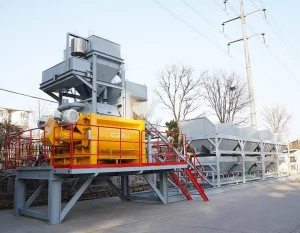
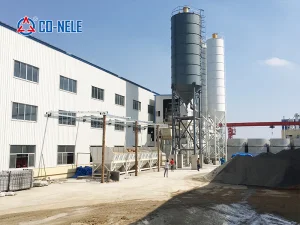
Operating out of three dedicated production bases in Qingdao, CO-NELE leverages an integrated industrial cluster. From heavy plate laser cutting and robotized welding to precision gear grinding and in-house assembly of custom planetary gearboxes, complete quality control is executed under one roof. Unlike assemblers who outsource critical components, CO-NELE engineers design and build dedicated planetary reducers designed specifically to absorb violent torsional shock loads experienced during dry-cast or stiff UHPC mixing cycles.
Engineering compliance for North American, European, Middle Eastern, and Southeast Asian industrial environments.
Achieve strict color repeatability across successive batches for façade panels, decorative columns, and white-cement architectural precast. Planetary counter-current mixing eliminates pigment streaks.
Engineered for zero-slump, dry-cast concrete recipes. Rapid discharge gates and non-stick pan liners maximize cycle speeds for automated pipe casting and box-culvert production lines.
Fully compliant with CE standards, UL/CSA electrical enclosures, Siemens S7-1200/1500 PLC control, and localized motor voltages (220V, 380V, 415V, 440V, 480V at 50Hz/60Hz).
Pioneering green cementitious formulations and smart sensor integration for Industry 4.0 batch plants.
The global construction industry is under intense pressure to decarbonize. The transition from traditional Ordinary Portland Cement (OPC) to low-carbon alternative binders—such as Calcined Clay Limestone Cement (LC3), alkali-activated geopolymers, and heavy fly-ash replacement formulations—presents unique rheological challenges.
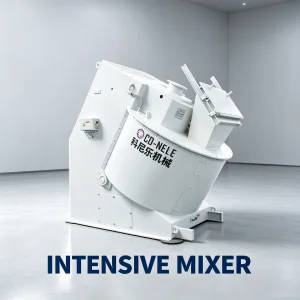
These eco-friendly binders exhibit higher plastic viscosity, thixotropy, and sensitivity to water addition. Standard mixing equipment often fails to break down the sticky agglomerates formed by fine calcined clay particles. CO-NELE’s updated planetary mixing systems incorporate specialized high-shear rotors and dynamic moisture-measuring microwave probes (installed directly in the floor of the mixing pan). This allows real-time adjustment of water dosing, maintaining exact slump tolerances regardless of ambient temperature or aggregate moisture variations.
Detailed responses from our engineering and export team regarding selection, installation, and spare parts.
Choose a vertical-shaft planetary counter-current mixer when your concrete formulation requires high micro-homogeneity, dry-cast consistency, fiber dispersion, or color pigment distribution (such as UHPC, GFRC, refractory castables, block paving, and architectural precast). Twin-shaft mixers are better suited for high-volume, wet ready-mix applications (>2 m³ per batch) where speed and volumetric output are prioritized over micro-dispersion.
Under standard precast batching conditions using hard granite/quartz aggregates, high-chrome wear liners ($\text{Cr} \ge 26\%$) routinely achieve 90,000 to 150,000 batch cycles. For highly abrasive applications, such as ceramic powders or heavy refractory castables, lifespan ranges between 40,000 and 60,000 batches. All wear parts are bolt-on and easily replaceable in the field.
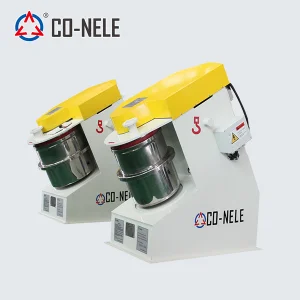
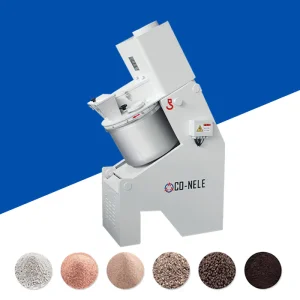
Yes. Our Qingdao test facility houses laboratory-scale planetary and intensive mixers (5L to 75L capacity). Clients can ship 10–20 kg of raw materials (binders, fine aggregates, fibers, additives). Our process engineers perform trial batches, measuring mixing time, fluid density, slump flow, and granule sphericity, providing a comprehensive report prior to machine customization.
Every machine exported by CO-NELE is custom-wired to match the client's localized industrial grid (e.g., 380V/50Hz in South East Asia/Europe, 460V-480V/60Hz in North America, 415V/50Hz in Australia/UK). Electrical cabinets utilize international-brand components (Siemens PLCs, Schneider contactors, ABB VFDs) and comply with CE and UL standards upon request.
Equipment is packaged in heavy-duty export frames suitable for standard container shipping (Open Top or Flat Rack containers for large plants). Deliveries include complete foundation engineering drawings, electrical schematics, 3D plant installation blueprints, and English O&M manuals. Commissioning can be conducted via live remote engineering support or on-site engineer dispatch.
Advanced mixing, granulating, and batching solutions for specialized industrial recipes.