CO-NELEMixing & Granulation
In modern industrial concrete block, paver, and precast manufacturing, batching consistency directly governs product compressive strength, color fidelity, water absorption rates, and edge crispness. Traditional twin-shaft and horizontal pan mixers, while adequate for general ready-mix applications, exhibit clear mechanical limitations when handling stiff zero-slump dry-cast formulations, alkali-activated slag binders, micro-pigments, and Ultra-High Performance Concrete (UHPC) mixtures.
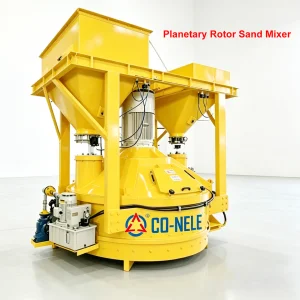
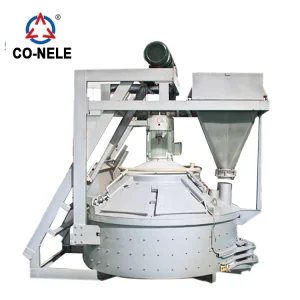
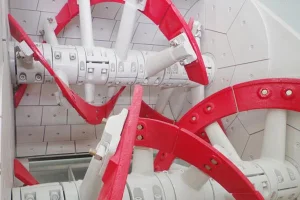
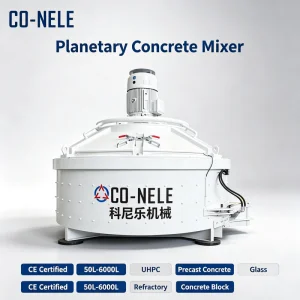
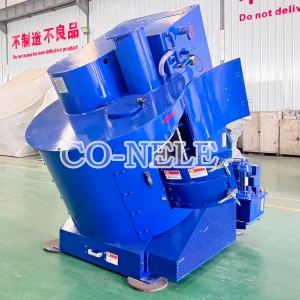
Unlike twin-shaft mixers that rely on intersecting circular arcs—creating dead zones at the shaft seals and pan corners—a vertical-shaft planetary mixer utilizes driven mixing star blades that rotate on their own axis while simultaneously revolving around the central axis of the mixing pan. This complex counter-current trajectory guarantees that within 45 to 60 seconds, every single grain of aggregate, cement particle, and pigment ion passes through high-shear zones without centrifugal segregation.
The global concrete block and paving brick production market is undergoing a structural transition driven by strict decarbonization mandates, rising raw material costs, and the widespread automation of high-speed block molding machines (e.g., Zenith, Hess, Masa, Poyatos, Tiger). Procurement directors across Europe, North America, the Middle East, and Southeast Asia are re-evaluating their batching plants to address four critical industry shifts:
Modern automatic block machines operate at high speeds, pressing blocks every 12 to 18 seconds. If the moisture content or cement-to-aggregate dispersion varies by even 0.5% between batches, block heights fluctuate, resulting in expensive product rejects during automatic stacking and strapping.
Architectural paving blocks feature dual-layer designs: a structural base mix and a dense face mix containing iron oxide pigments and fine sands. Planetary mixers eliminate pigment streaking and clumping, delivering uniform color tones batch after batch.
To reduce embodied carbon, block factories are replacing standard Portland cement with fly ash, ground granulated blast-furnace slag (GGBFS), and silica fume. Mixing these fine, unreactive, or slow-reacting powders requires intensive mechanical shear to activate hydration kinetics.
Block mixes utilize crushed granite, basalt, recycled aggregate, and quartz sand, which cause heavy abrasive wear on mixing blades and liners. Planetary designs allow optimized blade angle adjustments and localized wear-liner replacement, dramatically reducing downtime.
Selecting the optimal mixing equipment requires a rigorous mechanical and economic evaluation. The table below outlines key engineering performance metrics for heavy-duty concrete block and precast manufacturing:
| Performance / Design Parameter | Planetary Counter-Current Mixer (CMP Series) | Twin-Shaft Compulsory Mixer | Ring-Pan / Turbomixer |
|---|---|---|---|
| Mixing Trajectory Kinematics | Dual-Rotation Star-Arm Counter-Current (No Dead Angles) | Dual Parallel Shaft Overlapping Elliptical Arcs | Single Shaft Fixed Radius Circular Orbit |
| Mix Homogeneity (CV Value) | < 3.0% (Ultra-High Micro-Homogeneity) | < 7.0% (Good for standard slump concrete) | < 8.5% (Risk of material stratification) |
| Dry-Cast / Zero-Slump Suitability | Superior (Optimized shear for zero-slump mixes) | Moderate (High load torque spikes on dry mixes) | Poor to Moderate (Prone to segregation) |
| Pigment & Additive Dispersion | 100% Streak-Free Pigment Homogeneity in <60s | Requires Extended Cycle Time (>90s) | Prone to Pigment Agglomeration |
| Shaft Seal Maintenance | Zero Liquid Seal Risk (Gearbox mounted above slurry line) | High Maintenance (Submerged end shaft seals) | Moderate (Central lower seal maintenance) |
| Energy Consumption per m³ | 15% - 22% Lower kWh per Tonne of Formulated Mix | Standard Energy Demand | Higher Friction Energy Losses |
China's industrial machinery sector has evolved from cost-driven manufacturing to a high-precision, vertically integrated engineering power center. As a premier planetary concrete mixer manufacturer located in Qingdao, Shandong Province, CO-NELE leverages advanced metallurgy, robotics, and digital quality control systems.
Unlike competitors who outsource commercial gearboxes, CO-NELE designs and machines proprietary heavy-duty planetary reducers in-house. Featuring dual-stage hardened gears and reinforced bearings, our gearboxes deliver high torque transfer with minimal thermal expansion.
Pan liners and mixing blades utilize high-chromium cast iron alloys (hardness ≥ 62 HRC) alongside optional diamond-phase ceramic tile coatings. This extends part operational lifespans beyond 150,000 batches, significantly lowering wear-part costs per cubic meter of concrete.
Structural mixer pans and support frames undergo robotic continuous arc welding and full-body stress-relief heat treatment. This prevents structural frame deformation, even under intense long-term vibration and high-density aggregate loading.
CO-NELE planetary concrete mixers operate across more than 80 countries, adapted to regional aggregate conditions, climate extremes, and stringent local construction standards:
Operational Challenge: Extreme ambient temperatures (45°C+) cause rapid moisture evaporation in dry-cast mixes, leading to surface cracking and reduced edge strength in interlocking paving blocks.
Planetary Solution: CMP series mixers equipped with moisture sensors and atomized water mist injection systems achieve rapid cement activation within 45 seconds, preventing slump loss prior to block machine compaction.
Operational Challenge: High-end architectural blocks require precise pigment dispersion and aggregate exposure without batch-to-batch color shifts.
Planetary Solution: Counter-current star blades thoroughly break down micro-pigment agglomerates, achieving uniform batch color tones (Delta E < 0.5) and eliminating dark spots on split-face masonry surfaces.
Operational Challenge: High utilization of river sand and recycled aggregates increases pan liner wear, causing frequent maintenance shutdowns.
Planetary Solution: Reversible high-chrome blade assemblies and modular rhombic liner plates allow operators to flip worn blades, extending wear-life by 40% and shortening replacement downtime to under two hours.
Direct technical answers from CO-NELE process engineers covering mixer sizing, integration, wear management, and global after-sales support.