
CO-NELEMixing & Granulation
Explore our core selection of planetary mixers, UHPC batching stations, castable mixers, and specialized production machinery built for extreme industrial durability.
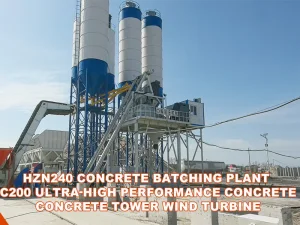
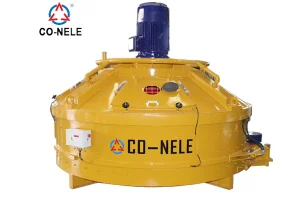
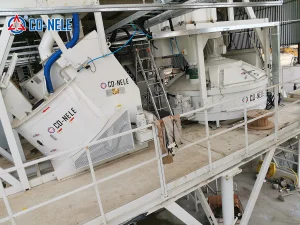
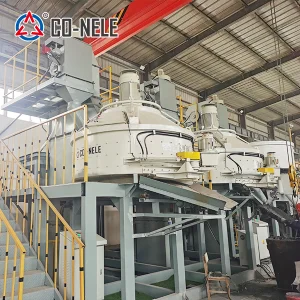
Why vertical-shaft planetary mixers dominate high-specification precast, UHPC, and technical refractory production.
In modern concrete manufacturing and industrial material processing, achieving absolute material homogeneity within the shortest possible cycle time is the primary determinant of end-product structural integrity. Traditional horizontal twin-shaft mixers and standard drum tilting mixers excel at mass ready-mix concrete production where coarse aggregate movement relies largely on gravity and linear agitation. However, when handling complex formulations such as Ultra-High-Performance Concrete (UHPC), Glass Fiber Reinforced Concrete (GFRC), dry-cast paving blocks, or synthetic refractory castables, conventional mixers leave microscopic unmixed zones, uneven fiber clusters, and density variations.
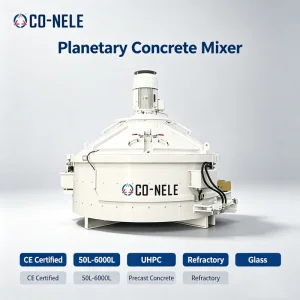
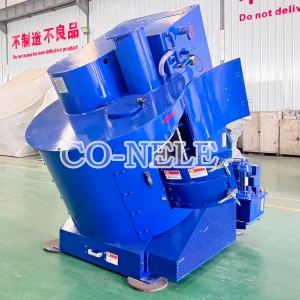
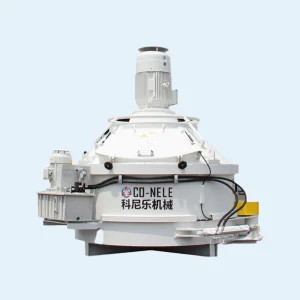
A Planetary Concrete Mixer overcomes these kinetic limitations through counter-current rotational mechanics. The mixing star arms rotate around their own vertical axis while simultaneously orbiting around the central axis of the mixing pan. This dual-kinematic motion ensures that every square millimeter of the mixing liner floor is swept swept per revolution, producing intensive shear force, rapid particle dispersion, and a mixing coefficient of variation ($CV$) consistently under 3% to 5%.
To evaluate equipment selection for high-value concrete applications, civil engineers and plant directors rely on quantifiable performance metrics. Below is a comparative breakdown of planetary counter-current mixing versus alternative mixing technologies:
| Performance Parameter | Planetary Counter-Current Mixer | Twin-Shaft Compulsory Mixer | Traditional Pan / Drum Mixer |
|---|---|---|---|
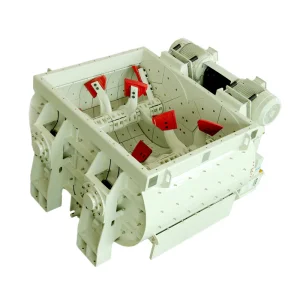
| Primary Mixing Mechanism | Dual-rotation planetary star arms + high-shear orbit | Dual counter-rotating horizontal shafts with paddles | Gravity tumbling or simple single-axis rotation |
| Dead Angle / Unmixed Zone | 0% (Complete floor & wall scraping) | 5% - 8% (Near shaft ends & corner seals) | 12% - 20% (Wall buildup & center dead zone) |
| Fiber Dispersion (UHPC / GFRC) | Optimal (Zero clumping, full 3D matrix) | Moderate (Risk of balling at high fiber volume) | Poor (High balling, manual intervention required) |
| Coefficient of Variation (CV) | < 3.0% (Micro-homogeneity) | < 6.0% (Macro-homogeneity) | > 10.0% (High density variance) |
| Discharge Efficiency | Fast hydraulic gate + rotating discharge blade | Bottom dual-gate drop | Slow gravity tilt or single manual gate |
| Wear Rate per Tonne | Extremely Low (Adjustable high-chrome blades) | Moderate (High wear on shaft seals & liners) | High (Unprotected shell abrasion) |
China has emerged as the global epicenter for industrial mixing machine engineering, combining advanced metallurgical supply chains with precision gearbox manufacturing.
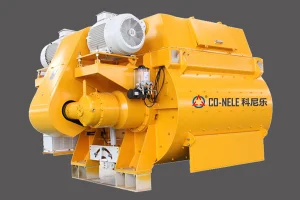
Leading Chinese mixing plant factories design and manufacture dedicated planetary gearboxes in-house. Unlike standard commercial gearboxes, industrial mixing reducers are customized to handle severe torsional vibration, sudden shock loads from thick UHPC mixes, and high thermal strain during continuous 24/7 operations.
Chinese factories leverage localized access to high-chrome alloy foundries ($Cr26$, $Cr28$, Ni-Hard iron) and Hardox steel plate fabricators. Mixing blades and pan liners achieve wear lifecycles exceeding 150,000 batches under normal aggregate conditions, dramatically reducing maintenance downtime for international buyers.
Top-tier China machine factories implement stringent quality inspection protocols, including 72-hour continuous no-load bench testing, gearbox oil temperature and vibration spectrum analysis, magnetic particle flaw detection on welded structures, and laser alignment of planetary mixing stars prior to export shipment.
How automation, material science, and sustainability are transforming the planetary concrete mixer industry.
Modern concrete plants are shifting from time-based mixing cycles to slump-and-rheology responsive control. Integrated microwave moisture probes mounted on the mixing pan floor continuously sample water-binder ratios, while drive motor current fluctuations are analyzed by AI algorithms to determine optimal discharge timing, eliminating human error.
To eliminate fiber agglomeration in Ultra-High-Performance Concrete (UHPC) and engineered cementitious composites (ECC), Chinese planetary mixers are increasingly equipped with secondary high-speed fly-cutters. Operating at speeds up to 1,450 RPM, these high-shear rotors rapidly break up micro-silica agglomerates and distribute steel or polymer fibers evenly throughout the matrix.
Energy consumption accounts for a significant share of operational expenditure in batching operations. Third-generation planetary mixers utilize optimized helical gear arrangements, synthetic high-lubricity gear oil, and variable frequency drive (VFD) motors. This combination cuts energy consumption by up to 18% per cubic meter of concrete produced.
Contractors require rapid deployment capability for short-term infrastructure contracts. Modern Chinese concrete plant designs incorporate foundationless, containerized modular structures. Pre-wired and factory-tested planetary mixing units can be erected and commissioned within 48 to 72 hours without extensive concrete foundation work.
From offshore renewable energy structures to precision refractory manufacturing, see where China planetary concrete mixers demonstrate superior operational performance.
Operational Requirement: Offshore and land-based wind energy structures increasingly rely on hybrid precast concrete towers exceeding 160 meters in height. The concrete formulation demands compressive strength ratings above 150 MPa, ultra-low water-binder ratios ($W/B < 0.18$), and high dosage of micro-steel fibers (up to $2\% - 3\%$ by volume).
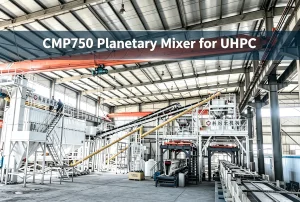
Engineered Solution: Specialized CMP Series UHPC planetary batching plants equipped with dual mixing stars, high-torque reducers, and high-shear fly cutters. The intense forced kinetic mixing breaks surface tension in fine silica fume powders, dispersing fibers uniformly without balling or segregation. Result: Maximum density and structural reliability under high cyclic load dynamics.
Operational Requirement: High-speed automated block machines require zero-slump, dry-cast concrete mixes with absolute batch-to-batch color and moisture uniformity. Any moisture fluctuation results in height variations, efflorescence, or structural cracking in paving blocks and retaining walls.
Engineered Solution: CMP1000 and CMP1500 planetary mixers integrated into precast block batching lines. Rapid 60-second mixing cycles ensure complete cement hydration and pigment coating on fine sand particles. Real-time moisture probe feedback allows auto-dosing adjustments, producing uniform green-strength concrete for high-speed block demolding.
Operational Requirement: Steel mills, glass furnaces, and cement kilns demand high-alumina, corundum, or silicon carbide refractory materials. These raw ingredients are exceptionally abrasive, dry, and sensitive to moisture variations during site application.
Engineered Solution: Heavy-duty refractory planetary mixers (e.g., CMP500 & CR19) lined with replaceable diamond-grade ceramic or $Cr28$ alloy wear plates. The dust-sealed mixing tub, combined with high-torque gearboxes, safely processes dense, high-viscosity refractory slurries without thermal overload or dust leakage into the plant floor.
Beyond individual mixing machines: complete turnkey concrete batching, material conveying, and automated dosing plant systems.
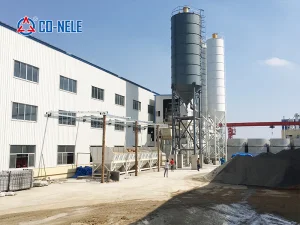
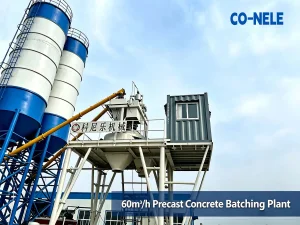
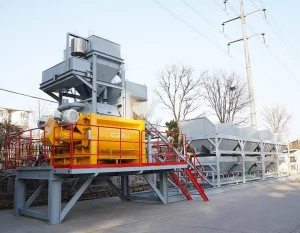
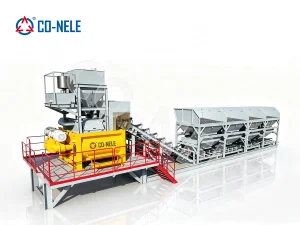
Full-scope design and manufacturing of stationary (HZS Series), compact, and foundationless batching plants. Integrating automated aggregate bins, belt feeders, powder silos, screw conveyors, and PLC centralized control rooms tailored to site geography.
Incorporating micro-dosing systems for liquid chemical admixtures, dry pigment powders, silica fume, and steel fibers. Multi-stage load cell weighing sensors achieve dosing precision within $\pm 0.5\%$, satisfying strict infrastructure standard specifications.
Standardized modular wear components ensure global interchangeability. High-wear mixing arms and scrapers feature simple bolt-on attachment mechanisms, allowing local site technicians to replace worn blades within hours without removing the rotor assembly.
A comprehensive framework for B2B procurement managers, EPC contractors, and factory directors evaluating Chinese machinery imports.
When selecting a China planetary concrete mixer manufacturer, overseas buyers must evaluate parameters far beyond the initial equipment purchase price. A rigorous Total Cost of Ownership (TCO) calculation incorporates energy efficiency, wear part longevity, localized electrical compliance, and long-term spare parts availability.
Verify whether the gearbox is designed specifically for planetary mixing duty or adapted from a standard industrial conveyor reducer. Demanded feature: Hardened alloy gears with forced oil lubrication.
Ensure the manufacturer configures motor windings and control panels to match your destination grid: 220V/380V/415V/440V/480V at 50Hz or 60Hz, with CE, UL, or CSA certified electrical components.
Select dual-mode hydraulic discharge systems equipped with manual emergency hand-pumps to guarantee safe gate opening during sudden factory power outages.
Match liner metallurgy to your raw materials: High-Chrome ($Cr26$) cast iron for standard aggregate, Hardox steel plates for medium abrasion, or specialized ceramic liners for extreme chemical/refractory wear.
Explore our complete catalog of intensive granulators, mobile batching stations, twin-shaft units, and compact concrete plants.
Technical guidance and answers provided by our senior process engineers and export technical directors.