CO-NELEMixing & Granulation
Explore our flagship planetary mixing systems, portable batching plants, and intensive granulators engineered for maximum operational efficiency.
In modern material science, advanced civil infrastructure, refractories, and high-performance composites, the boundary between research feasibility and industrial profitability is governed by one critical variable: mixing micro-homogeneity. Standard gravitational or single-axis horizontal mixers are increasingly incapable of satisfying the stringent requirements of contemporary material formulations. As industries transition to nano-engineered additives, ultra-fine silica fume, micro-steel fibers, and complex chemical admixtures, the physical mechanics of mixing must evolve.
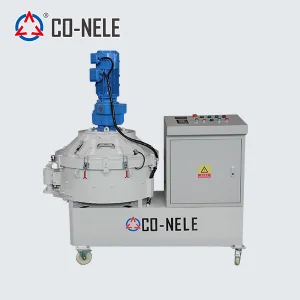
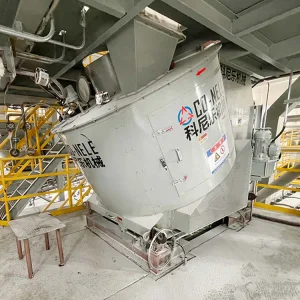
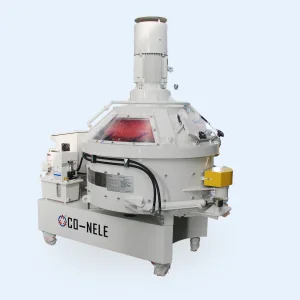
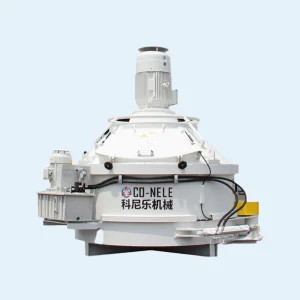
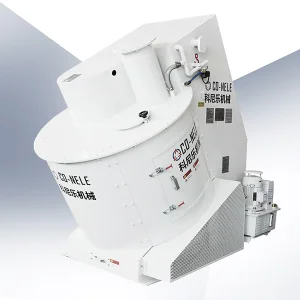
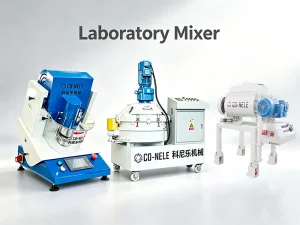
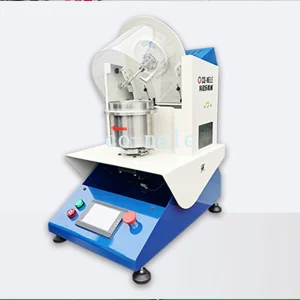
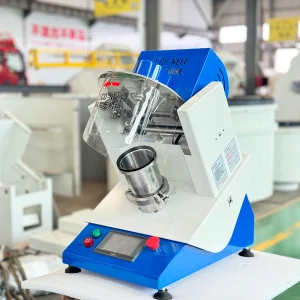
A laboratory planetary mixer serves as the foundation of modern process R&D. Operating under counter-current planetary motion vectors, these specialized mixing systems ensure that microscopic particle agglomerates are completely disrupted without crushing underlying aggregate matrices. The global demand for high-shear, zero-dead-zone laboratory mixing systems has experienced an unprecedented surge, driven primarily by four core industrial transformations:
UHPC requires water-binder ratios below 0.20, demanding extreme mechanical shear to activate micro-silica particles and evenly distribute steel micro-fibers without clumping or segregation.
Unshaped refractory castables and technical ceramic formulations require rapid, non-destructive dispersion of binders and dense matrices to prevent thermal spalling under extreme temperatures.
Energy storage and precision metallurgy demand absolute batch consistency, zero iron contamination, and linear volumetric scale-up from lab batches to multi-ton production lines.
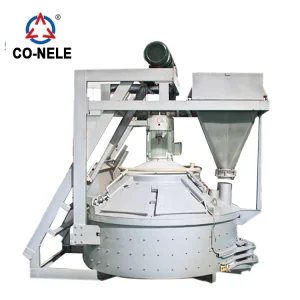
Understanding the kinetic superiority of the vertical-shaft planetary counter-current mixer requires analyzing the mechanical trajectory of the mixing star arms relative to the mixing pan wall.
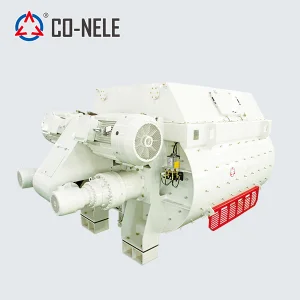
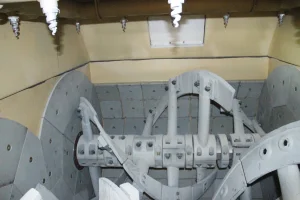
In a standard twin-shaft or ribbon mixer, material motion relies heavily on horizontal pushing forces and gravity-assisted falling zones. This creates localized velocity gradients, leading to "dead zones" at the corners and along shaft seals where micro-powders accumulate unmixed.
Conversely, a laboratory planetary mixer employs a complex dual-rotation system. The mixing star rotates on its own central axis while simultaneously orbiting the center of the static mixing vessel. This combination generates dynamic counter-current flow patterns across 100% of the pan floor during every single rotation cycle.
| Kinetic Parameter | Conventional Pan Mixer | Planetary Counter-Current Mixer |
|---|---|---|
| Mixing Homogeneity (CV) | < 10% - 15% | < 3% - 5% (Micro-Homogeneous) |
| Dead Zone Ratio | 8% - 12% of total volume | 0% (100% Active Swept Area) |
| Dispersion Rate (UHPC Silica) | Slow (Requires > 180s) | Ultra-Fast (60s - 90s) |
| Wear Component Life | Uneven localized wear | Symmetrical, balanced wear profiles |
| R&D Scale-Up Linear Correlation | Low (High variance) | Near 1.0 Mathematical Correlation |
Over the past two decades, China has evolved from a mass-assembly hub into the global center for advanced heavy machinery engineering and specialized mixing technology manufacturing. For international buyers—ranging from European ready-mix conglomerates to North American aerospace R&D centers—sourcing laboratory planetary mixers from specialized Chinese manufacturers offers decisive operational and economic advantages.
Prominent clusters in Qingdao consolidate planetary gearbox machining, high-chrome casting, hydraulic fabrication, and electrical control assembly within a single industrial ecosystem, dramatically reducing component lead times.
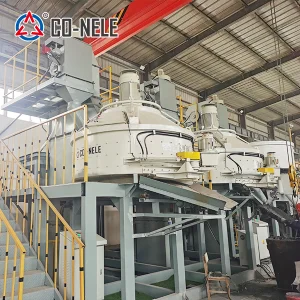
Leading factories like CO-NELE design and manufacture proprietary planetary reducers specifically engineered for high-shock mixing loads, eliminating reliance on off-the-shelf industrial gearboxes.
By optimizing production efficiency and structural assembly, Chinese manufacturers deliver premium European-tier mixing performance (CV < 3%) at a fraction of capital expenditure.
Whether integrating vacuum jacketed pans, explosion-proof ATEX motors, continuous torque monitoring, or custom wear liners, Chinese engineers pivot rapidly to meet exact buyer specifications.
Statistical proof of operational reliability across thousands of laboratory and industrial installations worldwide.
The versatility of a laboratory planetary mixer allows it to span vastly different sectors. Below are four key industrial applications where lab-scale planetary mixing directly drives product innovation.
In bridge joint engineering, architectural facade panels, and offshore wind turbine foundation grouting, mixing uniformity governs compressive strength exceeding 150 MPa. Laboratory planetary mixers allow process engineers to fine-tune polycarboxylate ether (PCE) superplasticizer dosages and simulate full-scale batching dynamics without wasting expensive silica fume and steel micro-fibers.
High-alumina, silicon carbide, and carbon-bonded refractories are sensitive to mixing moisture (often restricted to 4%-6%). A laboratory planetary mixer utilizes high-chrome, wear-resistant blades to force liquid dispersion through dry aggregates, preventing binder balling and reducing curing pore volume.
In electronic ceramic substrate production and wear-resistant ball manufacturing, dry powders must be wet-granulated with binders. Laboratory intensive mixing granulators shear slurry into spherical granules (sphericity > 90%) with uniform bulk density, essential for subsequent dry-pressing processes.
For emerging energy storage materials, absolute isolation from oxygen and atmospheric humidity is mandatory. Custom lab planetary mixers equipped with sealed, vacuum-rated chambers and thermal heating jackets facilitate reactive synthesis of sensitive powder blends.
When global procurement teams evaluate a China Laboratory Planetary Mixer manufacturer, price is only one metric. To ensure long-term integration into corporate R&D and pilot lines, technical buyers must audit manufacturers against four foundational criteria:
The gearbox is the heart of any planetary mixer. Avoid vendors using standard off-the-shelf inline gear reducers attached via belts. Inspect whether the factory manufactures specialized cast-iron single-body planetary reducers with surface-hardened gears capable of handling severe torsional shock during dry-charge initialization.
Different materials require specialized wear protection. Ensure the factory provides customizable lining options:
Exported equipment must comply with regional regulatory standards. Ensure the machine includes CE marking, Siemens or Schneider PLC controls, UL-certified wiring, and emergency stop interlocks linked to mixing pan access doors.
Verify whether the manufacturer operates a physical laboratory equipped with 5L to 75L test units. Reputable OEMs like CO-NELE accept customer raw materials for trial mixing, returning comprehensive analytical reports (particle distribution, density, power curve) before contract confirmation.
The laboratory mixing industry is undergoing a digital transformation. Modern pilot plants no longer rely on manual timing and visual moisture checks. Leading Chinese manufacturers are integrating smart hardware into laboratory planetary mixers:
By measuring motor electrical current variations and dynamic shaft torque in real time, the mixer acts as a large-scale rheometer, detecting the exact moisture saturation point of concrete or ceramic slurries without stopping the batch.
High-precision optical or microwave sensors integrated flush into the mixing pan floor measure real-time moisture content within dry aggregates, allowing PLC units to auto-correct water dosing on the fly.
Siemens-powered touch panels store hundreds of multi-stage mixing sequences (varying RPM, reverse rotation, liquid injection timing) and export CSV batch records directly to enterprise ERP systems for quality auditing.
Expert answers to the most common engineering and sourcing questions regarding laboratory planetary mixers.
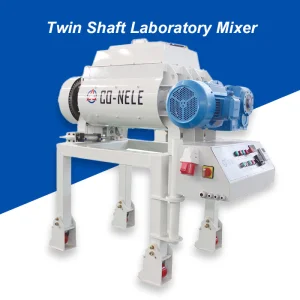
A laboratory planetary mixer features a vertical shaft with star arms that orbit the pan while spinning on their own axis. This counter-current movement eliminates dead zones and delivers intense shear, making it superior for dry powders, UHPC, GFRC, and refractory castables. A twin-shaft mixer utilizes horizontal counter-rotating shafts, which are optimized for high-volume ready-mix concrete with larger aggregate sizes but offer less micro-homogeneity on fine powders.
When using a CO-NELE CMP series planetary mixer, scale-up accuracy is exceptionally linear (correlation factor > 0.95). Because both the laboratory unit (e.g., CMP50) and the industrial production unit (e.g., CMP1500) share identical blade speed-ratios, pan geometry ratios, and counter-current kinematics, batch mixing times and material rheology match closely across scales.
Under standard aggregate concrete operation, high-chrome wear parts typically achieve 100,000 to 150,000 batch cycles. For highly abrasive mixes such as quartz-rich refractories or silicon carbide, wear life ranges between 40,000 and 60,000 batches. All wear liners are modular, bolt-on, and rapidly replaceable in the field.
Yes. All machines built for export are tailored to the buyer's localized power supply (220V, 380V, 415V, 440V, 480V at 50Hz or 60Hz). For chemical, battery, or explosive powder applications, systems can be built with ATEX/EX-proof motors, stainless steel contact surfaces, and nitrogen-purged sealed vessels.
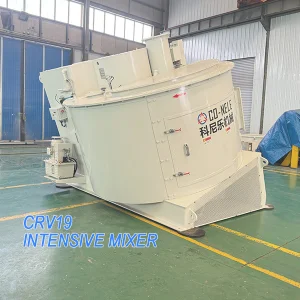
Explore our full lineup of industrial mixing machinery, high-intensity granulators, and precast batching plants.
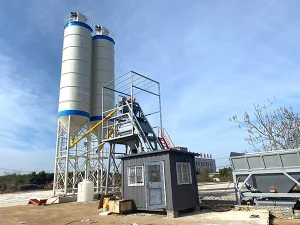
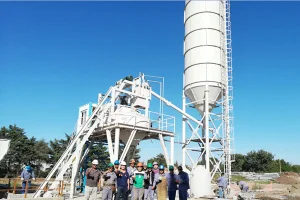
Whether you require a single 5-liter laboratory testing unit or a complete 180 m³/h automated precast batching line, our engineering team provides full design, testing, and field commissioning support.
Request Technical Quotation & Material Test Report