TECHNICAL WHITEPAPER & INDUSTRIAL GUIDE

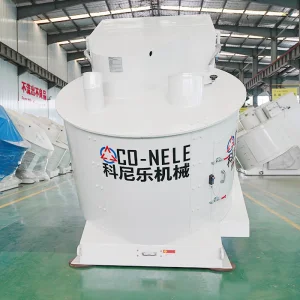
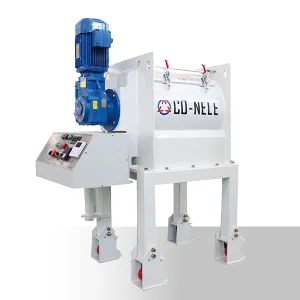
China Intensive Sand Mixer Manufacturer & Factory

Next-Generation Counter-Current Kinetic Mixing, High-Shear Granulation, and Intelligent Process Automation for Foundries, Refractories, Ceramics, and Advanced Materials

Featured Industrial Mixing & Granulation Systems
China Glass Industry Batch mixer Factory, Machine
Explore Model
China Magnetic Material Granulator Factory, Machine
Explore Model
China CDW100 Laboratory Dry Mortar Mixer Manufacturer, Factory
Explore Model
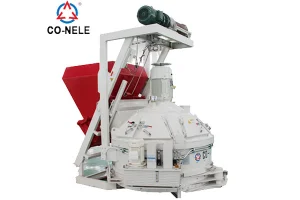
China MP500 Planetary concrete mixer Manufacturer, Factory
Explore Model
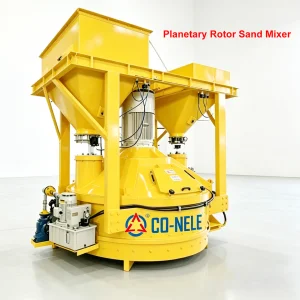
China Planetary Rotor Sand Mixer Manufacturer, Machine
Explore Model
China Precast Concrete Wall Panels | Planetary Concrete Mixer | PC Batching Plant Price Manufacturer, Factory
China Precast Concrete Wall Panels | Planetary Mixer
Explore Model
China Planetary mixer for concrete block bricks in Russia Manufacturer, Machine
China Planetary Mixer for Concrete Block Bricks in Russia
Explore Model
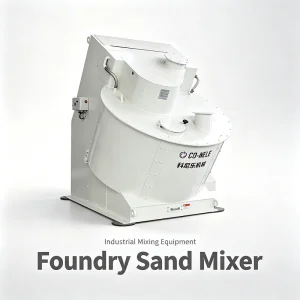
China Foundry Sand Mixer Factory, Machine
Explore Model
Foundational Physics

The Evolution of Intensive Sand Mixing Kinematics

Transitioning from traditional mechanical muller wheels to dynamic counter-current high-shear rotor technology—redefining material homogeneity, binder efficiency, and cycle speed.

Limitations of Conventional Sand Mullers

Traditional sand mixing relied heavily on vertical muller wheels designed to squeeze and rub sand grains against bentonite clay. While effective for simple green sand mixtures, conventional mullers suffer from distinct mechanical bottlenecks:

  • High Shear Dead-Zones: Inconsistent energy input leading to unactivated clay pockets.
  • Grain Degradation: Excessive compaction crushing quartz sand grains, altering grain fineness number (AFS).
  • Prolonged Mixing Cycles: Require up to 4–6 minutes per batch to reach basic homogeneity.
  • Thermal Retention: Friction heat generated during long cycles dries out water prematurely.

Counter-Current Intensive Mixing Mechanics

Modern Intensive Sand Mixers operate on a synchronized, non-overlapping kinematic principle. By rotating the mixing pan in one direction while one or more eccentric rotors turn in the opposite direction at variable high speeds, fluid dynamic forces dominate:

  • 100% Material Displacement: Wall and bottom scrapers continuously feed raw materials directly into the high-shear rotor path.
  • Micro-Layer Binder Coating: Binder films (bentonite, resin, silicate) are sheared down to sub-micron thickness over each sand grain.
  • Ultra-Fast Cycle Times: Homogeneous dispersion accomplished within 45 to 90 seconds.
  • Zero Grain Fracture: Shear forces are velocity-driven rather than pressure-driven, protecting grain structure.

Information Gain Insight: Modern foundry quality controls demand a Coefficient of Variation (CV) below 3% across green sand compactability, active clay dispersion, and wet tensile strength. CO-NELE intensive mixers achieve CV < 1.8% by optimizing the speed ratio between the rotating pan wall and high-speed rotor tools.

10,000+
Global Installations
80+
Export Countries
80+
Patents Held
45s
Avg. Mixing Cycle
Market Macro-Trends

Global Commercial & Industrial Landscape

How shifting automotive casting specs, environmental regulations, and advanced material demands are forcing a worldwide upgrade of industrial mixing machinery.

Automotive & Precision Foundry Shift

As electric vehicle (EV) lightweighting demands complex structural aluminum and ductile iron castings, foundry mold quality cannot tolerate casting defects such as pinholes, scabs, or sand burn-in. Intensive mixers ensure total bentonite activation and gas permeability control.

Green Transition & Energy Efficiency

Industrial processing facilities are heavily pressured to cut kWh-per-ton metrics. By reducing mixing cycles from minutes to seconds and achieving higher green strength at lower binder percentages, intensive mixing directly shrinks factory carbon footprints.

Advanced Ceramics & Energy Materials

Beyond traditional foundry sand, global chemical and energy sectors (solid-state battery electrodes, refractory ceramics, proppants) require dust-free, fully homogeneous wet/dry mixing and mechanical pelletizing within sealed single-vessel processing systems.

Application Engineering

Specialized Industrial Application Scenarios

Customized rotor geometries, peripheral speeds, and lining materials designed specifically for challenging material rheology.

1. Green Sand Preparation for High-Pressure Molding

Automated molding lines (Disamatic, Sintokogio, Heinrich Wagner Sinto) require green sand with tightly controlled compactability (38–42%) and high wet tensile strength (>0.20 N/cm²). China Intensive Sand Mixers integrate inline moisture measurement probes and dynamic water injection to guarantee uniform mold hardness across thousands of flasks per shift.

  • Optimal bentonite clay activation without over-mulling.
  • Homogeneous distribution of pulverized coal/carbonaceous additives.
  • Integrated cooling capability via air injection during batch discharge.

2. Resin-Bonded & Furan No-Bake Sand Mixing

For large steel castings, core-making, and no-bake molding, binder metering accuracy and fast discharge are paramount. Intensive mixers prevent premature binder setting inside the pan while guaranteeing 100% coating of sand grains with minimal resin addition (0.8–1.2% by weight), saving raw material costs.

  • Self-cleaning pan scrapers prevent cured resin buildup.
  • Precise dual-liquid resin and catalyst injection manifolds.
  • Extremely low thermal heating during high-shear mixing.

3. Refractory Materials & Ceramic Proppants

Dense refractory castables, corundum bricks, and ceramic frac sand demand intensive mixing combined with micro-granulation. China Intensive Mixers turn fine raw powders into perfectly spherical granules (0.5–2 mm) with 92%+ sphericity, enhancing bulk density before kiln firing.

  • Alumina ceramic or silicon carbide anti-wear pan liners.
  • Dust-tight gas-purged shaft seals for sub-micron powders.
  • Vacuum-assisted mixing and drying configurations available.

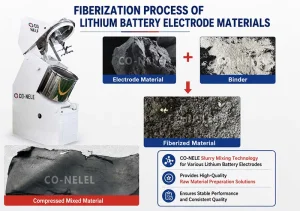
4. Dry Electrode & Battery Material Fibrosis

Next-generation lithium-ion battery manufacturing uses intensive mixing for dry PTFE fibrosis and cathode/anode active slurry preparation. High-shear rotors shear PTFE binders into micro-fibers that interlock cathode particles without using toxic NMP solvents.

  • Stainless steel 316L / Hastelloy contact surfaces.
  • Explosion-proof ATEX / IECEx compliant drive systems.
  • Precise temperature jacket cooling down to ±1°C accuracy.
Supply Chain Advantage

China Factory Supply Chain Resilience & Cost-Efficiency

How Qingdao's industrial ecosystem delivers precision engineering, robust alloy metallurgy, and unmatched lead times to global industrial buyers.

Qingdao Industrial Manufacturing Hub

Located in Shandong Province—China's heavy machinery capital—CO-NELE leverages an end-to-end local supply chain within a 50 km radius. From high-grade steel plate forging to precision CNC gear cutting, component sourcing is seamless and rapid.

In-House Gearbox & Metallurgical Engineering

Unlike assemblers who buy commercial gearboxes, CO-NELE designs and machines proprietary heavy-duty planetary reducers in-house. Gear sets undergo surface carburizing and precision grinding to handle extreme shock loads from dense sand recipes.

TCO & Lead-Time Superiority

Direct manufacturer pricing eliminates intermediary markups, delivering premium European-equivalent performance at 40-50% lower Total Cost of Ownership (TCO). Standard machine lead times are kept under 30 to 45 days.

Future Roadmap

Technological Roadmap & Industry 4.0 Integration

The convergence of predictive AI maintenance, optical sensory feedback, and advanced anti-wear material science in industrial mixing.

1. AI-Driven Dynamic Moisture & Viscosity Control

Integrating microwave moisture sensors with real-time motor torque feedback algorithms. The mixer automatically calculates sand moisture variations in incoming batches, adjusting water dosing valves within milliseconds to hit target compactability before batch discharge.

2. Advanced Wear Protection Materials

Development of carbide matrix cladding, tungsten carbide flame-sprayed rotor tips, and customizable ceramic tile liners (Al2O3 / ZrO2) that extend wear-part service life past 150,000 operational cycles on highly abrasive quartz sand.

3. Variable-Frequency Multi-Vector Kinematics

Dual VFD control systems allowing independent, dynamic speed adjustment of both the pan bowl and the mixing rotor during different phases of a single batch cycle (e.g., low-speed dry homogenization followed by high-speed wet shear dispersion).

4. Carbon-Neutral & Zero-Emissions Plant Design

Engineered with dust-tight negative-pressure sealing systems connected to central plant baghouse filters, ensuring zero particulate release into workshop environments and meeting strict European REACH and OSHA air quality standards.

Technical Specification & Performance Matrix

Model Series Batch Capacity (L) Output TPH (Green Sand) Rotor Drive Power (kW) Pan Drive Power (kW) Primary Industrial Applications
CEL01 Lab Series 5 – 50 L 0.2 – 1.0 TPH 3.0 – 7.5 kW 1.5 – 3.0 kW R&D, Formula Development, Battery Materials
CQ500 Series 250 – 500 L 10 – 18 TPH 22 – 37 kW 5.5 – 7.5 kW Specialty Foundries, Refractory Castables
CQ1500 Series 1,000 – 1,500 L 35 – 55 TPH 55 – 90 kW 15 – 22 kW High-Production Automotive Foundries
CQ3000 Series 2,500 – 3,000 L 80 – 120 TPH 132 – 200 kW 30 – 45 kW Heavy Industrial Green Sand & Metallurgy Lines
Global Quality Assurance

Localized Support & Regulatory Compliance

Ensuring smooth international integration, site safety compliance, and uninterrupted spare parts logistics.

International Safety Standards

Every mixer leaves the Qingdao facility built to strict global engineering standards: CE machinery safety directives, ISO9001 quality system certification, UL/CSA electrical control panel wiring, and ATEX explosion protection options.

Plug-and-Play Modular Design

Machines are fully assembled, pre-wired, and dry-tested in our workshop prior to shipment. Skid-mounted structural frames allow rapid installation and bolt-together mechanical integration with existing plant batching silos.

24/7 Global Field Engineering

Supported by resident installation engineers, remote PLC diagnostics via cloud VPN gateways, and overnight express shipping of standardized wear parts (rotor blades, scrapers, liners) directly from Qingdao stock hubs.

Expert Knowledge Base

Frequently Asked Questions (FAQ)

Technical guidance and operational insights from CO-NELE senior process engineers.
What makes an Intensive Sand Mixer superior to a conventional planetary or twin-shaft mixer for foundry sand?
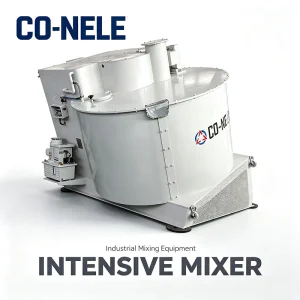
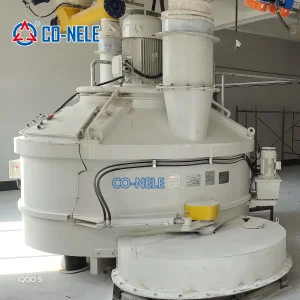
An Intensive Sand Mixer combines an inclined or horizontal rotating bowl with an independent high-speed eccentric rotor. While planetary mixers excel at bulk concrete, intensive sand mixers generate significantly higher shearing velocity vector gradients. This high kinetic shear activates bentonite binder layers on quartz sand grains instantly without crushing the sand substrate, achieving target wet tensile strength and compactability in 45-60 seconds compared to 3-5 minutes in standard planetary pans.
How does CO-NELE ensure anti-wear durability when handling highly abrasive quartz sand or corundum?
We employ a multi-tier wear protection strategy: Pan bottoms and walls feature bolt-on, interchangeable high-chrome alloy plates (HRC ≥ 62) or sintered ceramic tile linings (Al2O3 / SiC). Mixing blades and rotor tips are heavily armored with tungsten carbide hardfacing matrix cladding. All wear components are modular, allowing localized replacement of high-wear edges rather than discarding entire arm assemblies.
Can intensive mixing technology perform wet granulation and powder pelletizing in the same vessel?
Yes. By modulating the variable frequency drive (VFD) speed of the rotor tool, the machine transitions seamlessly from high-shear micro-homogenization to controlled agglomeration. Adding liquid binders during high rotor speed creates tiny seed nuclei; slowing the rotor speed down allows stable granule growth to targeted particle diameters (0.5 mm to 8 mm) with narrow size distribution curves.
What process data is required to request a custom industrial mixer proposal?
To provide an accurate technical proposal and machine sizing, our process engineers need three primary inputs: 1) Raw material specs (bulk density, particle size distribution, moisture level, abrasiveness), 2) Target recipe goal (compactability, strength grade, moisture %, or granule size requirement), and 3) Batch volume or required hourly output capacity (TPH or m³/h).
Complete Heavy-Duty Equipment Portfolio
China Dry Electrode Mixing & PTFE Fibrosis Machine Manufacturer, Machine
China Dry Electrode Mixing & PTFE Fibrosis Machine
Explore Model
China Vietnam 60m³/h Concrete Batching Plant for Core Vibration Pipe Production Factory, Machine
China Vietnam 60m³/h Concrete Batching Plant
Explore Model
China Concrete Block Batching Plant and BLB Blocos e Lajes Factory, Machine
China Concrete Block Batching Plant BLB
Explore Model
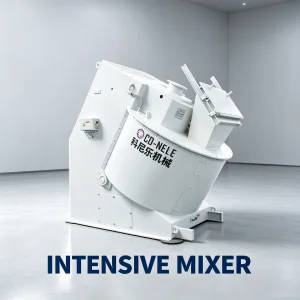
China Inclined Intensive mixer Manufacturer, Factory
Explore Model
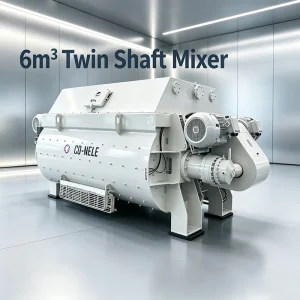
China 6m³ Twin Shaft Concrete Mixer Factory, Machine
Explore Model
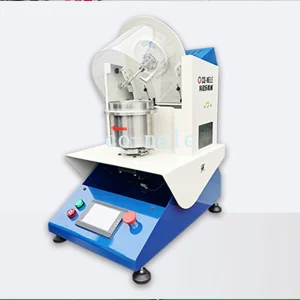
China CEL01 intensive lab mixer Manufacturer, Factory
Explore Model
China 750L Adsorbent Granulation Machine Manufacturer, Machine
China 750L Adsorbent Granulation Machine
Explore Model
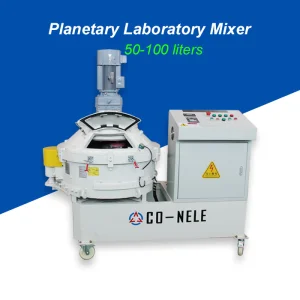
China Laboratory Planetary Mixer CMP50/CMP100 Manufacturer, Machine
China Lab Planetary Mixer CMP50/CMP100
Explore Model