CO-NELEMixing & Granulation
Engineered to deliver exceptional mixing homogeneity, strict batch repeatability, and low lifecycle operational costs across global infrastructure projects.
Analyzing the macro-technological transformation of concrete manufacturing, sustainable cementitious formulations, and high-precision automation demand worldwide.
The modern concrete batching and ready-mix production sector is currently undergoing its most profound structural evolution in half a century. Driven by strict global carbon-neutrality mandates, accelerating mega-infrastructure commitments across emerging markets, and the urgent imperative for operational cost reduction, concrete batching plants are no longer evaluated merely on volumetric throughput ($m^3/h$). Instead, industrial buyers evaluate plants based on batch accuracy coefficients, thermodynamic efficiency, micro-scale mixing homogeneity, and long-term mechanical reliability.
The global shift toward low-carbon binders—including Ground Granulated Blast-furnace Slag (GGBS), Pulverized Fuel Ash (PFA), and Calcined Clay (LC3)—demands higher shear force mixing systems capable of homogeneously dispersing ultra-fine, low-hydration particles without agglomeration.
Structural applications in offshore wind platforms, long-span bridges, and precast architectural façades require UHPC recipes with water-cement ratios below 0.20 and high steel/synthetic fiber loads. Legacy pan mixers fail; counter-current planetary mixers have become mandatory.
Modern commercial ready-mix operators require real-time batch correction based on microwave aggregate moisture sensing, automated slump tracking, dynamic chemical admixture dosing, and remote cloud analytics for predictive gear reducer maintenance.
Selecting the optimal mixing core for your concrete batching facility based on rheological properties, aggregate size, cycle speed, and target material density.
The mixer core serves as the heart of any batching facility. The mechanical interaction between the mixing tool arms, wear plates, and batch ingredients dictates whether the final slurry achieves colloidal micro-dispersion or suffers from localized cement segregation.
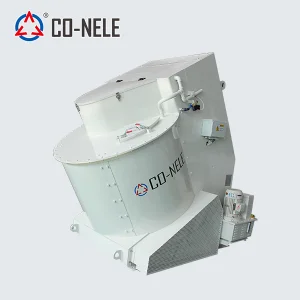
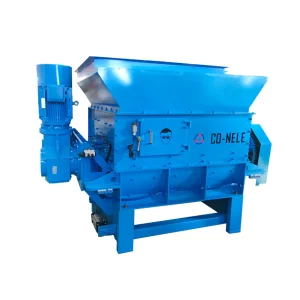
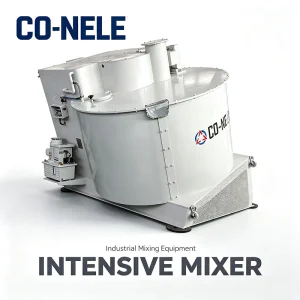
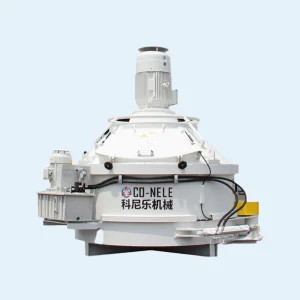
| Performance Benchmark | Planetary Counter-Current Mixer (CMP/MP Series) | Twin-Shaft Compulsory Mixer (CHS Series) | Inclined Intensive Mixer (CEL Series) |
|---|---|---|---|
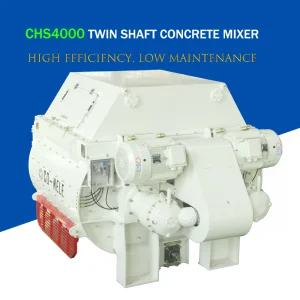
| Primary Mixing Kinematics | Vertical-shaft counter-current star arms with complex 3D orbital trajectories. | Dual horizontal shafts with counter-rotating helical paddle arrangements. | Inclined rotating pan with high-speed asymmetric rotor mechanism. |
| Homogeneity (Coeff. of Var. CV) | Ultra-High (< 3% within 45 seconds) | High (< 5% within 30 seconds) | Superior Micro-Granulation (< 1.5%) |
| Target Applications | UHPC, Precast elements, Dry-cast blocks, Pigmented paving tiles, Refractory. | High-volume Ready-Mix (RMC), Dam concrete, Mass civil foundation pours. | Ceramic powder, Battery mass, Powder metallurgy, Dry mortar pelletizing. |
| Discharge Segregation | Zero segregation; clean rapid bottom-door drop. | Minimal segregation; long hydraulic gate discharge. | Complete pan-tilting or bottom rotor discharge. |
| Wear Life & Maintenance | Bolt-on high-chrome tiles (65 HRC), easy top inspection access. | Dual shaft seals require automatic continuous lubrication systems. | Rotor blades replaceable in under 15 minutes; wear-resistant alloy coatings. |
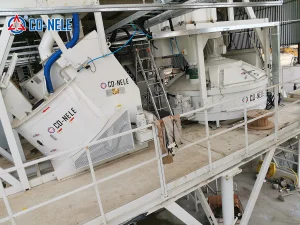
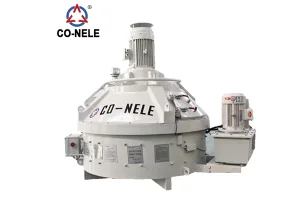
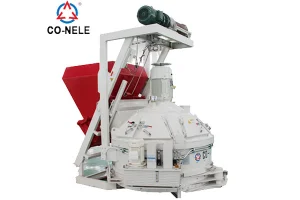
In a standard horizontal mixer, gravity pulls aggregate downward while paddles lift it, creating localized concentration zones. CO-NELE planetary counter-current mixers utilize mixing stars that rotate on their own axis while revolving around the central drive axis. This dual-kinematic motion ensures every square millimeter of the mixing pan is swept within 4 revolutions, totally eliminating dead zones and ensuring perfect dispersion of pigments, micro-silica, and steel fibers.
How international EPC contractors, commercial RMC producers, and precast plants evaluate Chinese original equipment manufacturers (OEMs) for long-term ROI.
Procuring capital-intensive machinery from China requires navigating a spectrum of suppliers ranging from low-cost trading integrators to advanced, direct-engineering OEMs. Enterprise buyers must apply a rigorous Total Cost of Ownership (TCO) matrix during vendor evaluation:
Tailored concrete batching architectures engineered to meet rigorous civil, marine, municipal, and industrial manufacturing standards worldwide.
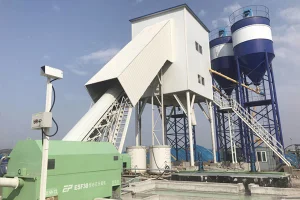
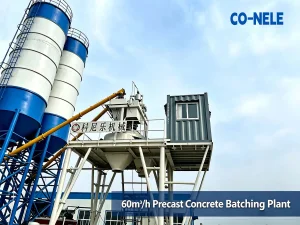
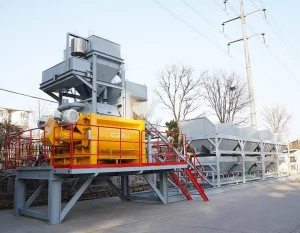
Designed for commercial concrete suppliers requiring output capacities from 90 $m^3/h$ to 180 $m^3/h$. Featuring enclosed aggregate bin structures, pulse-jet baghouse dust collection, twin-shaft compulsory mixers, and automated dual-truck batching logic.
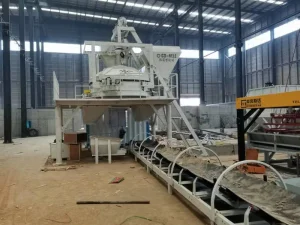
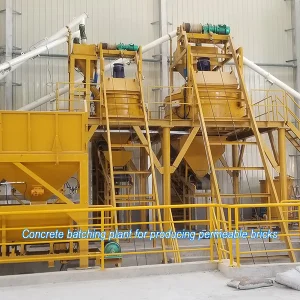
Specialized batching plants built around vertical planetary mixers engineered for dry-cast concrete blocks, kerbstones, permeable paving bricks, and precast wall panels. Provides precise color dosing and fast face-mix loading capabilities.
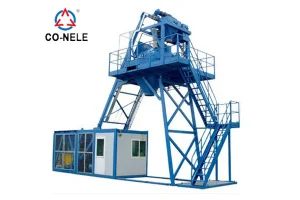
Fully containerized and towable mobile batching plants ($25 m^3/h$ to $50 m^3/h$) integrated onto heavy-duty wheel chassis. Allows highway, runway, and bridge contractors to deploy, batch, and relocate with zero concrete foundation requirements.
Ensuring seamless operational integration, international compliance certification, and rapid spare parts availability across global job sites.
Operating industrial machinery in international markets requires rigorous localized compliance and robust after-sales technical infrastructure. CO-NELE supports global buyers through a comprehensive lifecycle assurance framework:
Every plant shipped from our factory undergoes pre-commissioning electrical and mechanical safety audits. Standard configurations comply with the European Machinery Directive (2006/42/EC), Low Voltage Directive (2014/35/EU), and Electromagnetic Compatibility Directive (2014/30/EU). Electrical cabinets feature dual-channel safety relays, emergency stop circuits, and lock-out/tag-out (LOTO) maintenance isolators.
To eliminate commissioning delays, plants feature plug-and-play IP67 quick-connect wiring harnesses and pre-tested PLC software. Factory-trained commissioning engineers provide on-site setup, calibration of load cells (accuracy within ±1% for cement/water and ±2% for aggregate), and local operator training. Interchangeable spare parts are maintained in stock and dispatched via global express logistics within 24 hours.
Pioneering the next decade of intelligent mixing automation, automated aggregate moisture compensation, and closed-loop concrete recycling.
As the construction industry transitions toward digital twin monitoring and decarbonization, concrete batching equipment must integrate advanced automation. CO-NELE’s engineering lab in Qingdao is driving innovation across key technology vectors:
By measuring real-time motor torque variations and current draw harmonics during the mixing cycle, neural network algorithms instantly calculate slurry viscosity and dynamic yield stress, automatically adjusting micro-water additions prior to discharge.
Integrating closed-loop aggregate reclaimer units and slurry water agitation tanks into stationary batching plants. Unused returned concrete is completely separated into clean stone/sand aggregates and gray water for 100% recycling back into production.
Next-generation planetary gearboxes paired with IE4 super-premium efficiency IE4/IE5 motors and dynamic variable frequency drives (VFDs), reducing power consumption per batch cycle ($kWh/m^3$) by up to 18% compared to direct-on-line drives.
In-depth technical answers provided by CO-NELE senior mixing engineers to support informed capital equipment procurement decisions.
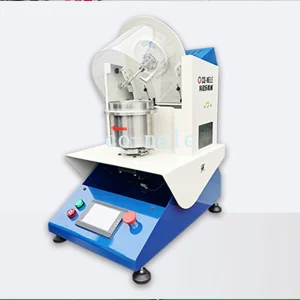
Discover complete precast plant solutions, twin-shaft concrete mixers, intensive lab units, and mobile batching machinery engineered in Qingdao, China.